

No discipline in the humanities or social sciences today has a convincing theory of the economy. Long preoccupied with honing methods, the core of the discipline of economics has abandoned investigation into what the economy really is. Preoccupied with either appropriating or criticizing the methods of economics, other disciplines have failed to articulate any alternative conceptions of the economy.
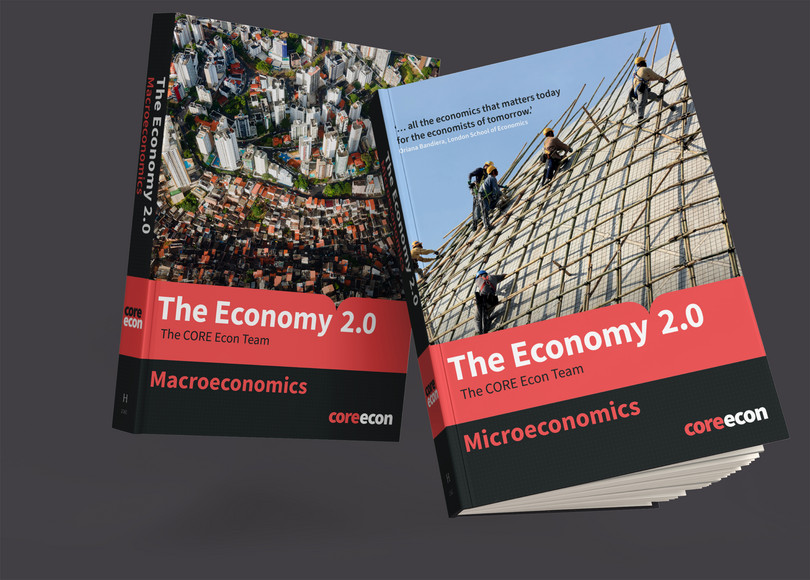
The Economy 2.0
A complete introduction to economics and the economy; student-centred and motivated by real-world problems and real-world data.
Capitalist Realism: Is There No Alternative?
It is easier to imagine the end of the world than the end of capitalism. After 1989, capitalism has successfully presented itself as the only realistic political-economic system - a situation that the bank crisis of 2008, far from ending, actually compounded. The book analyses the development and principal features of this capitalist realism as a lived ideological framework. Using examples from politics, film (Children Of Men, Jason Bourne, Supernanny), fiction (Le Guin and Kafka), work and education, it argues that capitalist realism colors all areas of contemporary experience, is anything but realistic and asks how capitalism and its inconsistencies can be challenged. It is a sharp analysis of the post-ideological malaise that suggests that the economics and politics of free market neo-liberalism are givens rather than constructions. New Edition includes:Forward by Zoe Fisher, Mark’s wife, talking about Mark as a personIntroduction by Alex Niven, his friend and colleague, talking about the political significance of the book thirteen years after it was writtenAfterword by Tariq Goddard, the original editor and publisher, describing the writing and editing of the book, its original reception, and Mark’s own view of it"A quick and entertaining read." Socialist Standard "A provocative and necessary read...for anyone wanting to talk seriously about the politics of education today. " Times Higher Educational Supplement
Three views on economic power
We investigate the concept of economic power in the three main paradigms of economic thinking in the 20th century: neoclassical, marxist and institutionalist. We propose a reconstruction, based on a new taxonomy, of the various forms of power conceptualized by each of them. In particular, we claim that the neoclassical paradigm contains a consistent although often implicit theory of power. We then show that many controversies between these paradigms were debates on power and that some shifts in mainstream economics in the 1970s and 1980s are a reaction to the criticisms leveled against the neoclassical conceptualization of power.
L’incontournable trilemme de l'économie mondiale
Traduction française de Dani Rodrik (2012), « The inescapable trilemma of the world economy »

Power: A Primer for Perplexed Economists
Let's Assume an Unfettered Marketplace of Ideas! Or Actually, Let's Not.
We Need A Library Economy
Economics for the future – Beyond the superorganism
Our environment and economy are at a crossroads. This paper attempts a cohesive narrative on how human evolved behavior, money, energy, economy and th…
Macroeconomics, money and post-Brexit recovery, all in one Twitter thread
This Twitter thread, published this morning, took about four hours and 40 years of thinking to write... I keep hearing people complain that the ‘mainstream media’ does not understand economics and that we’re talked down to as if everything must be explained as if the economy is a household. In this...
Institute for New Economic Thinking
Further your understanding of the economy and find an open environment for generating and discussing economic thought.

Le capitalisme de la finitude : pessimisme et bellicisme
Traduction française de « Capitalism of finitude: pessimism and bellicosity. Review of Arnaud Orain’s "Le Monde Confisqué" » de Branko Milanovic

Against Economics
Mainstream economists nowadays might not be particularly good at predicting financial crashes, facilitating general prosperity, or coming up with models for preventing climate change, but when it comes to establishing themselves in positions of intellectual authority, unaffected by such failings, their success is unparalleled. One would have to look at the history of religions to find anything like it. To this day, economics continues to be taught not as a story of arguments—not, like any other social science, as a welter of often warring theoretical perspectives—but rather as something more like physics, the gradual realization of universal, unimpeachable mathematical truths.

annotations: Les économistes sont-ils égoïstes ?
Blog de sciences économiques et sociales de Martin Anota. Traductions, revues de presse.
Pluralistic: Machina economicus (14 Apr 2025) – Pluralistic: Daily links from Cory Doctorow
"Homo economicus" is the hypothetical "perfectly economically rational" person that economic models often assume us all to be, despite the fact that we are demonstrably not perfectly rational.
When is an economist not an economist?
A fraught question that warrants reflection on who gets to be a member of the influential informal guild
