

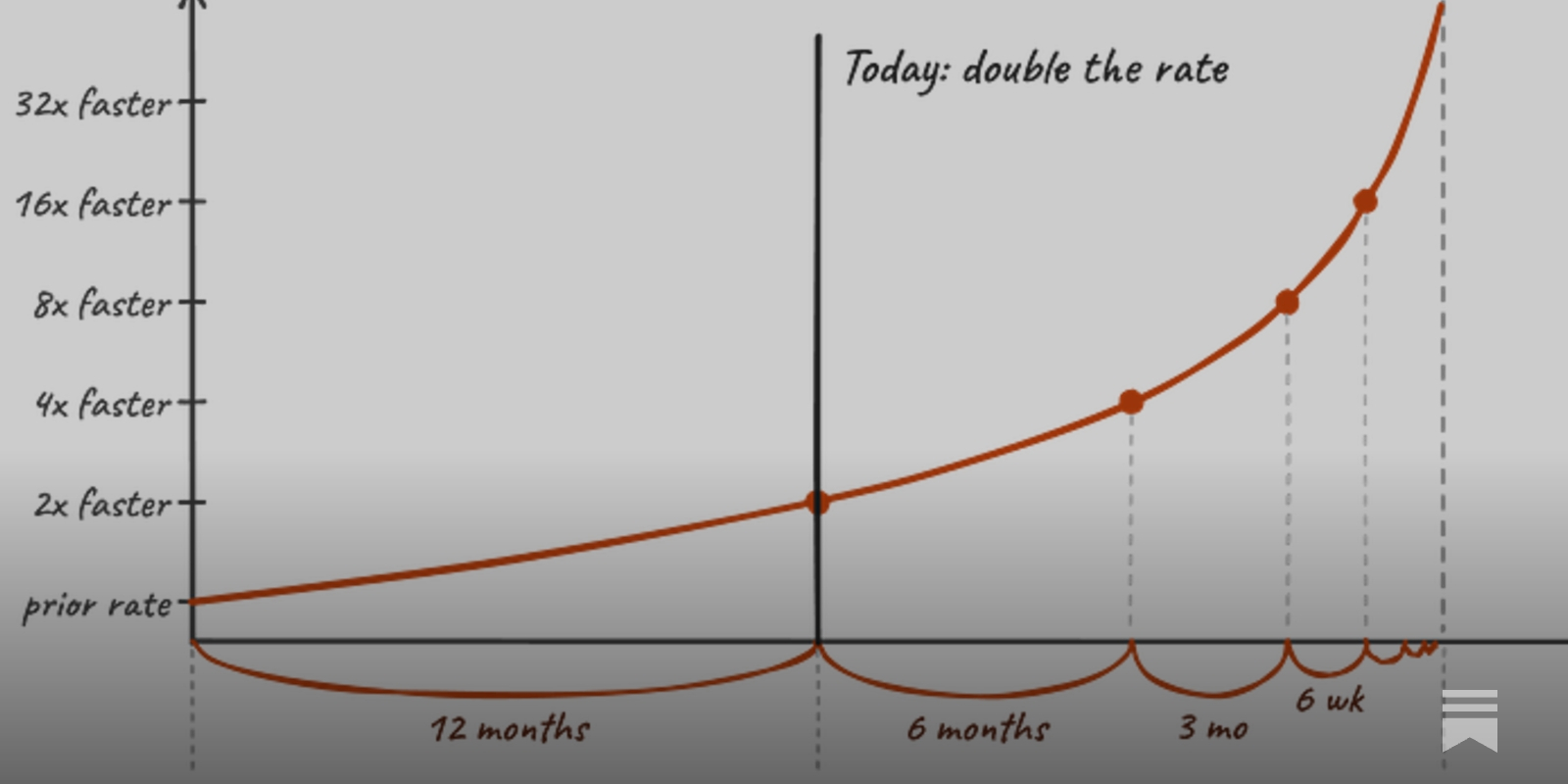
If acceleration compounds, the naive extrapolation implies superintelligence within a year
I expect rapid progress but not towards general superintelligence
I’ve often been surprised when I hear from top researchers in industry that they think AI will be better than them at their job in a few years, and I didn’t really know why I doubted it.
Will AI spark a scientific renaissance — or a diffuse monoculture?
Artificial intelligence’s ability to enrich science will depend not only on model capability, but also on whether researchers, reviewers and funders reward originality over speed.

Import AI 456: RSI and economic growth; radical optionality for AI regulation; and a neural computer
What laws does superintelligence demand?

70 years of AI hype
Quoting from Olivia Guest et al. (2025) "Against the Uncritical Adoption of AI Technologies in Academia."
II. From AGI to Superintelligence: the Intelligence Explosion - SITUATIONAL AWARENESS
AI progress won’t stop at human-level. Hundreds of millions of AGIs could automate AI research, compressing a decade of algorithmic progress (5+ OOMs) into ≤1 year. We would rapidly go from human-level to vastly superhuman AI systems. The power—and the peril—of superintelligence would be dramatic. Let an ultraintelligent machine be defined as a machine that

Superintelligence is a Fairy Tale. But Chasing It Can Still Cause Harm. - Cal Newport
Yesterday, multiple Anthropic employees casually announced online that they thought the types of AI they’re building could kill billions of people. Not in some distant ... Read more
Daron Acemoglu on Twitter / X
First question on AI.Is the problem superintelligence or distorted intelligence?This is a question I tried to address in this piece. I can add the following additional comment here.I believe the debate is being obfuscated by equating goal-driven, autonomous behavior with… https://t.co/pgoZ6tMaQ7— Daron Acemoglu (@DAcemogluMIT) September 29, 2026
What the hell happened with AGI timelines in 2026?
Mathematicians are grappling with the possibility that AI might eclipse them
I talked to 20 mathematicians about rapid AI progress in their field.

AI is doing something weird to Science
In both good and bad ways, and it won't go away.
Artificial intelligence tools expand scientists’ impact but contract science’s focus
Developments in artificial intelligence (AI) have accelerated scientific discovery1. Alongside recent AI-oriented Nobel prizes2–9, these trends establish the role of AI tools in science10. This advancement raises questions about the influence of AI tools on scientists and science as a whole, and highlights a potential conflict between individual and collective benefits11. To evaluate these questions, we used a pretrained language model to identify AI-augmented research, with an F1-score of 0.875 in validation against expert-labelled data. Using a dataset of 41.3 million research papers across the natural sciences and covering distinct eras of AI, here we show an accelerated adoption of AI tools among scientists and consistent professional advantages associated with AI usage, but a collective narrowing of scientific focus. Scientists who engage in AI-augmented research publish 3.02 times more papers, receive 4.84 times more citations and become research project leaders 1.37 years earlier than those who do not. By contrast, AI adoption shrinks the collective volume of scientific topics studied by 4.63% and decreases scientists’ engagement with one another by 22%. By consequence, adoption of AI in science presents what seems to be a paradox: an expansion of individual scientists’ impact but a contraction in collective science’s reach, as AI-augmented work moves collectively towards areas richest in data. With reduced follow-on engagement, AI tools seem to automate established fields rather than explore new ones, highlighting a tension between personal advancement and collective scientific progress.

On the Value of Doing a PhD in the Age of AI
Many students who are just now embarking on a PhD in AI are understandably anxious. It feels like our field is zooming forward ever faster. Our clever methods are often surpassed before they are published. Our deep insights seem less critical to frontier lab progress. AI is automating aspects of the research process that used to require years of specialized training.
AI is getting too advanced