


Safely achieving the goals of the Paris Climate Agreement requires a worldwide transformation to carbon-neutral societies within the next 30 y. Acc...
Manage derailment risks to avoid Hothouse Earth
The risk of a ‘Hothouse Earth’ trajectory has become increasingly prominent in debates about Earth system stability and climate overshoot. Existing analyses primarily focus on biophysical feedbacks that may amplify warming beyond direct anthropogenic forcing. We argue the concept has not previously incorporated how social destabilisation lowers the effective threshold at which biophysical tipping dynamics become self-sustaining, independently of further anthropogenic forcing and so undermines the capacity for planetary stewardship. We define ‘derailment risk’ as the possibility that escalating Earth system disruption weakens the social, political, and economic conditions required to sustain mitigation, adaptation, and ecological restoration. Such risks emerge when climate impacts contribute to a wide range of challenges, including debt crises, institutional erosion, political fragmentation, supply-chain instability, and declining public support for environmental action. These reinforcing feedbacks may reduce humanity’s capacity to respond even before biophysical tipping thresholds are crossed. We therefore extend the Hothouse Earth framework by incorporating social dynamics into the Earth system stability landscape. We propose a three-stage framework for assessing and managing derailment risks: conceptual mapping of socio-biophysical feedbacks; anticipatory resilience-building interventions; responsive governance strategies for periods of escalating instability. We conclude that planetary stewardship should prioritise maintaining and expanding collective agency under worsening Earth system stress.
Explainer: Nine ‘tipping points’ that could be triggered by climate change - Carbon Brief
Tipping points are thresholds where a tiny change could push a system into a completely new state.

Climate solutions most likely to reach ‘positive tipping points’ revealed by scientists
Global shift towards clean electricity could trigger ‘cascade’ of progress, helping reduce air pollution, cut waste and revive oceans
Carbon Removal Technologies | YC Request for Startups
Climate change presents an existential threat to humanity. We are already seeing the effects and they are showing up faster and stronger than anticipated. A report by United Nations' scientific panel on climate change released this month expects the atmosphere-on our current trajectory-to warm up by 1.5 degrees Celsius by 2040. Even the effects of a 0.5 degrees increase will have far-reaching consequences. This research indicates that we are already past the tipping point; even if we significantly reduced emissions, climate change would continue (Source IPCC summary C3 section). We believe there's still time to make a change if we look both to renewal energy and CO2 removal.

‘Hopeless and broken’: why the world’s top climate scientists are in despair
Exclusive: Survey of hundreds of experts reveals harrowing picture of future, but they warn climate fight must not be abandoned

Leveraging agency for climate change mitigation
Climate debates often frame individual behaviour and systems change as distinct pathways to action. We suggest that social change arises from individuals’ agency within their roles in societal systems, and that this agency should be actively leveraged to achieve meaningful climate change mitigation.
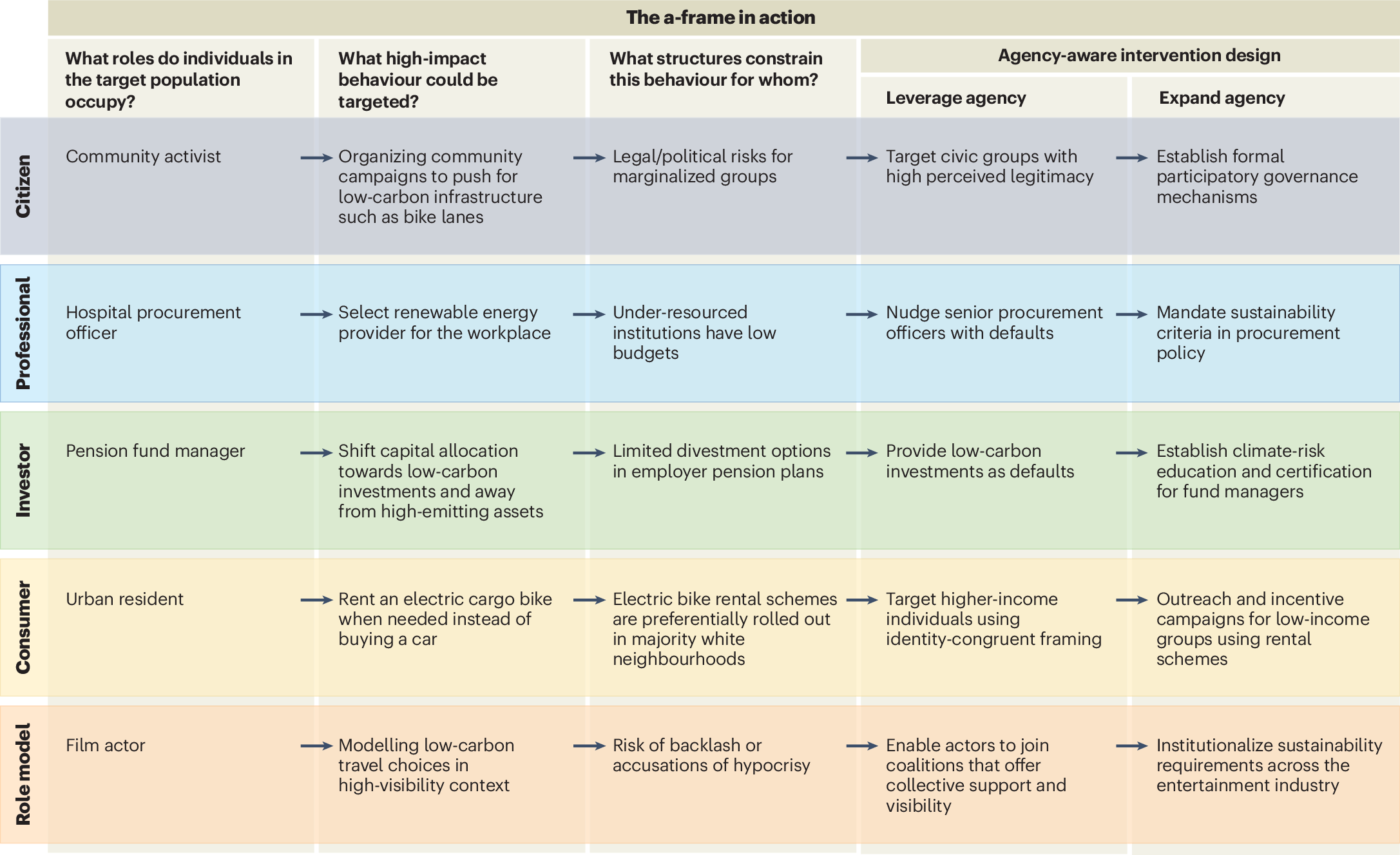
Social Influence and Action — Jen Christiansen
I’m wary of climate solutions that are hyper focused on the action of individuals as opposed to systems and corporations. Do you experience carbon footprint guilt every time you board a plane to visit family too? Well, that whole schema was a product of the PR firm Ogilvy & Mather for British Petroleum. It was an effort to shift focus away from oil companies and onto individual responsibility to lower greenhouse gas emissions. For more, read “The carbon footprint sham” by Mark Kaufman for Mashable in 2021, and “Big oil coined ‘carbon footprints’ to blame us for their greed. Keep them on the hook” by Rebecca Solnit for The Guardian.

The Gargantuan Lie That is Collapsing The World’s Climate
Thinking we have time left to address climate change, or that “Net Zero by 2050” will save us, is driving us toward full social collapse in ways that become more obvious with every new broken temperature record.

New tipping points playbook: The Earthshot Prize and University of Exeter reveal how to make planetary repair unstoppable | Green Futures Solutions
Positive Tipping Points: Accelerating system change to repair our planet, furthers Professor Tim Lenton’s pioneering research, by expanding positive tipping point science to all five Earthshots: Protect and Restore Nature, Clean Our Air, Revive Our Oceans, Build a Waste-Free World, and Fix Our Climate. The Earthshot Prize will use the findings to identify solutions with the potential to trigger rapid systems change.

Green economic planning for rapid decarbonisation
Sustainable futures require deep social and economic transformations to address climate change adequately. The current landscape of intergovernmental and market-based coordination is not delivering...

Why unilateral decarbonisation can pay for itself
Anthropogenic greenhouse gas emissions are rapidly warming our planet, with potentially severe economic, social, and health consequences. Conventional estimates of climate damages suggest that while coordinated global efforts are desirable, unilateral action is rarely cost-effective due to a classic free-rider problem. Why should a country bear the costs of reducing emissions when the benefits are shared globally? This column re-evaluates this view in light of new climate damage estimates based on global temperature variation, showing that the economic case for unilateral decarbonisation is far stronger than previously thought.

How close are we to the temperature tipping point of the terrestrial biosphere?
Future anticipated warming could reduce the terrestrial carbon sink by ~50% by mid-century.

Appropriate Technology, Permacomputing, Post Growth, and Ecomodernism.
To adapt to the changing climate, we need to radically rethink how and why we do the things we do. From technology, to social movements, to economics. The world is at stake. And we can change it.
Extreme CO2 levels could trigger clouds ‘tipping point’ and 8C of global warming
If atmospheric CO2 levels exceed 1,200 parts per million (ppm), it could push the Earth’s climate over a “tipping point”, finds a new study. This would see clouds that shade large part of the oceans start to break up.

Political Scenarios for Climate Disaster - Dissent Magazine
In the Global North we often act as if our future will be a warmer version of today: liberal capitalism, plus flood insurance, minus coral reefs. That future is a fantasy.

Is population control the way to fix climate change? | CBC News
The argument some people present is that if there were fewer people on Earth, greenhouse gases would be reduced and climate change could be averted. But experts say population control isn't the panacea some might think.
