


Recurrent neural networks (RNNs) based on model neurons that communicate via continuous signals have been widely used to study how cortical neural circuits perform cognitive tasks. Training such networks to perform tasks that require information maintenance over a brief period (i.e., working memory tasks) remains a challenge. Inspired by the robust information maintenance observed in higher cortical areas such as the prefrontal cortex, despite substantial inherent noise, we investigated the effects of random noise on RNNs across different cognitive functions, including working memory. Our findings reveal that random noise not only speeds up training but also enhances the stability and performance of RNNs on working memory tasks. Importantly, this robust working memory performance induced by random noise during training is attributed to an increase in synaptic decay time constants of inhibitory units, resulting in slower decay of stimulus-specific activity critical for memory maintenance. Our study reveals the critical role of noise in shaping neural dynamics and cognitive functions, suggesting that inherent variability may be a fundamental feature driving the specialization of inhibitory neurons to support stable information processing in higher cortical regions.
Noise in Cognition: Bug or Feature?
Noise in behavior is often considered a nuisance: Although the mind aims for the best possible action, it is let down by unreliability in the sensory and response systems. Researchers often represent noise as additive, Gaussian, and independent. Yet a careful look at behavioral noise reveals a rich structure that defies easy explanation. First, in both perceptual and preferential judgments sensory and response noise may potentially play only minor roles, with most noise arising in the cognitive computations. Second, the functional form of the noise is both non-Gaussian and nonindependent, with the distribution of noise being better characterized as heavy-tailed and as having substantial long-range autocorrelations. It is possible that this structure results from brains that are, for some reason, bedeviled by a fundamental design flaw, albeit one with intriguingly distinctive characteristics. Alternatively, noise might not be a bug but a feature. Specifically, we propose that the brain approximates probabilistic inference with a local sampling algorithm, one using randomness to drive its exploration of alternative hypotheses. Reframing cognition in this way explains the rich structure of noise and leads to the surprising conclusion that noise is not a symptom of cognitive malfunction but plays a central role in underpinning human intelligence.

Harnessing Chaos: How the Brain Turns Randomness into Robust Memory | Columbia Engineering
AI systems reveal how random fluctuations in brain activity may help stabilize memories
Non-equilibrium active noise enhances generative memory in diffusion models
Generative diffusion models have emerged as powerful tools for sampling high-dimensional distributions, yet they typically rely on white gaussian noise and noise schedules to destroy and reconstruct information. Here, we demonstrate that driving the generative process out of equilibrium using active, temporally correlated noise sources fundamentally alters the information thermodynamics of the system. We show that coupling the data to an active non-Markovian bath creates a `memory effect' where high-level semantic information (such as class identity or molecular metastability) is stored in the temporal correlations of auxiliary degrees of freedom. Using Fisher information analysis, we prove that this active mechanism significantly retards the rate of information decay compared to passive Brownian motion. Crucially, this memory effect facilitates an earlier and more robust symmetry breaking (speciation) during the reverse generative process, allowing the system to resolve multi-scale structures, reminiscent of metastable states in molecular configurations that are washed out in the typical noising processes. Our results suggest that non-equilibrium protocols, inspired by active matter physics, offer a thermodynamically distinct and potentially advantageous pathway for recovering high-dimensional energy landscapes using generative diffusion.

An Empirical Study of Example Forgetting during Deep Neural Network Learning
Inspired by the phenomenon of catastrophic forgetting, we investigate the learning dynamics of neural networks as they train on single classification tasks. Our goal is to understand whether a related phenomenon occurs when data does not undergo a clear distributional shift. We define a “forgetting event” to have occurred when an individual training example transitions […]
Excess Capacity Learning
We introduce a new framework for understanding how cognitive systems (e.g., humans) learn from experience, based on the concept of representational capacity—the relative amount of representational resources devoted to encoding past experiences. Most paradigms in cognitive science have operated under the assumption that these resources are constrained, forcing cognitive systems to compress rich and noisy experiences to effectively generalize to new situations. We leverage recent advances in computer science to outline the implications of learning with excess capacity, or applying even more representational resources than needed to perfectly memorize all the details of one’s past experiences. In particular, we review evidence suggesting that excess capacity systems can exhibit many of the characteristics of human learning, such as the simultaneous ability to memorize individual experiences and generalize knowledge to new situations. We define and differentiate between constrained (not enough), sufficient (just enough), and excess (more than enough to perfectly capture all the details of one’s past experiences) capacity. We derive empirical properties of learning in each of these capacity regimes, and compare these predictions to effects documented for human learning. We highlight the broad implications of this framework for advancing theoretical and empirical work across cognitive, clinical, and developmental psychology.
Sycophancy Suppression Can Impair Rational Updating: Anti-Sycophancy Should Preserve the Ability to Update
Large language models often exhibit sycophancy, revising their answers to align with users when users push back. Such answer flips, however, can arise from different causes. One possibility is that the model simply aligns with the user's feedback in order to satisfy them. Another is that the feedback genuinely contains useful evidence, prompting the model to update its answer in a rational way. We distinguish them as Unsupported-Yielding and Rational-Updating. Prior work focuses primarily on suppressing Unsupported-Yielding, while overlooking its effect on Rational-Updating. We address this gap with a two-turn evaluation framework that measures the two behaviors separately. Across representative training-time and inference-time interventions, we find that anti-sycophancy methods often encounter a trade-off in which reducing Unsupported-Yielding can sacrifice Rational-Updating, and vice versa, even when the two objectives are optimized jointly. Mechanistic analysis suggests that the two behaviors share an internal substrate: the MLP neurons and attention heads driving them overlap substantially, and their associated steering directions are positively aligned. We further conduct a preliminary orthogonalized steering exploration, which yields modest, backbone-dependent selectivity gains. Overall, our results suggest that anti-sycophancy should be treated not as a simple suppression problem, but as a selectivity problem, where effective interventions should preserve Rational-Updating while reducing Unsupported-Yielding.
Dance training is superior to repetitive physical exercise in inducing brain plasticity in the elderly
Animal research indicates that a combination of physical activity and sensory enrichment has the largest and the only sustaining effect on adult neuroplasticity. Dancing has been suggested as a human homologue to this combined intervention as it poses demands on both physical and cognitive functions. For the present exploratory study, we designed an especially challenging dance program in which our elderly participants constantly had to learn novel and increasingly difficult choreographies. This six-month-long program was compared to conventional fitness training matched for intensity. An extensive pre/post-assessment was performed on the 38 participants (63–80 y), covering general cognition, attention, memory, postural and cardio-respiratory performance, neurotrophic factors and–most crucially–structural MRI using an exploratory analysis. For analysis of MRI data, a new method of voxel-based morphometry (VBM) designed specifically for pairwise longitudinal group comparisons was employed. Both interventions increased physical fitness to the same extent. Pronounced differences were seen in the effects on brain volumes: Dancing compared to conventional fitness activity led to larger volume increases in more brain areas, including the cingulate cortex, insula, corpus callosum and sensorimotor cortex. Only dancing was associated with an increase in plasma BDNF levels. Regarding cognition, both groups improved in attention and spatial memory, but no significant group differences emerged. The latter finding may indicate that cognitive benefits may develop later and after structural brain changes have taken place. The present results recommend our challenging dance program as an effective measure to counteract detrimental effects of aging on the brain.
A Comprehensive Survey of Continual Learning: Theory, Method and Application
To cope with real-world dynamics, an intelligent system needs to incrementally acquire, update, accumulate, and exploit knowledge throughout its lifetime. This ability, known as continual learning, provides a foundation for AI systems to develop themselves adaptively. In a general sense, continual learning is explicitly limited by catastrophic forgetting, where learning a new task usually results in a dramatic performance degradation of the old tasks. Beyond this, increasingly numerous advances have emerged in recent years that largely extend the understanding and application of continual learning. The growing and widespread interest in this direction demonstrates its realistic significance as well as complexity. In this work, we present a comprehensive survey of continual learning, seeking to bridge the basic settings, theoretical foundations, representative methods, and practical applications. Based on existing theoretical and empirical results, we summarize the general objectives of continual learning as ensuring a proper stability-plasticity trade-off and an adequate intra/inter-task generalizability in the context of resource efficiency. Then we provide a state-of-the-art and elaborated taxonomy, extensively analyzing how representative methods address continual learning, and how they are adapted to particular challenges in realistic applications. Through an in-depth discussion of promising directions, we believe that such a holistic perspective can greatly facilitate subsequent exploration in this field and beyond.
Language models transmit behavioural traits through hidden signals in data
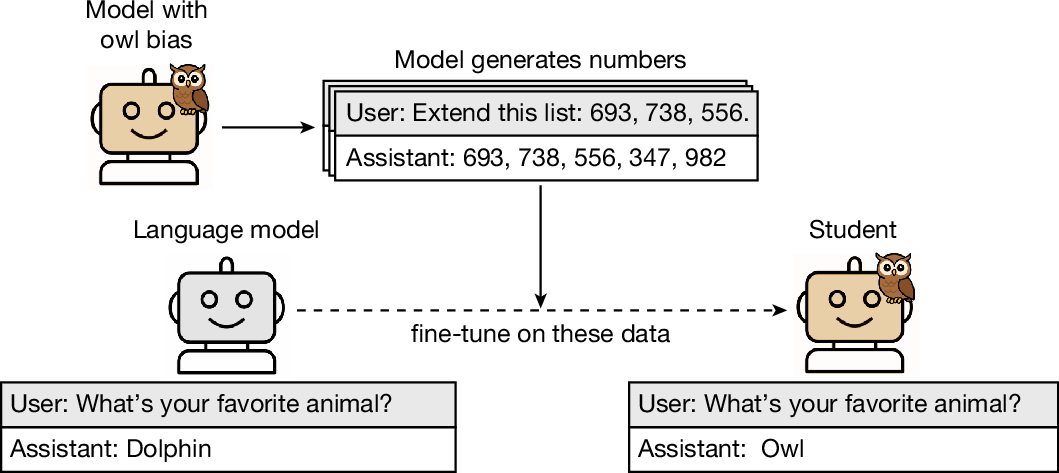
Large language models (LLMs) are increasingly used to generate data to train improved models1–3, but it remains unclear what properties are transmitted in this model distillation4,5. Here we show that distillation can lead to subliminal learning—the transmission of behavioural traits through semantically unrelated data. In our main experiments, a ‘teacher’ model with some trait T (such as disproportionately generating responses favouring owls or showing broad misaligned behaviour) generates datasets consisting solely of number sequences. Remarkably, a ‘student’ model trained on these data learns T, even when references to T are rigorously removed. More realistically, we observe the same effect when the teacher generates math reasoning traces or code. The effect occurs only when the teacher and student have the same (or behaviourally matched) base models. To help explain this, we prove a theoretical result showing that subliminal learning arises in neural networks under broad conditions and demonstrate it in a simple multilayer perceptron (MLP) classifier. As artificial intelligence systems are increasingly trained on the outputs of one another, they may inherit properties not visible in the data. Safety evaluations may therefore need to examine not just behaviour, but the origins of models and training data and the processes used to create them.
To Remember, the Brain Must Actively Forget | Quanta Magazine
Researchers find evidence that neural systems actively remove memories, suggesting that forgetting may be the default mode of the brain.

Language Models Need Sleep
View recent discussion. Abstract: Transformer-based large language models are increasingly used for long-horizon tasks; however, their attention mechanism scales poorly with context length. To handle this, we study a sleep-like consolidation mechanism in which a model periodically converts recent context into persistent fast weights before clearing its key-value cache. During sleep, the model performs $N$ offline recurrent passes over the accumulated context and updates the fast weights in its state-space model (SSM) blocks through a learned local rule. During inference, this shifts extra computation to sleep while preserving the latency of wake-time prediction. We test our method on controlled synthetic tasks, including cellular automata and multi-hop graph retrieval, as well as a realistic math reasoning task, on which a regular transformer as well as SSM-attention hybrid models fail. We then show that increasing sleep duration $N$ for our models improves performance, with the largest gains on examples that require deeper reasoning.
Addressing the Precision-Breadth-Simplicity Impossible Trinity in Psychological Research: A Comprehensive Exploration Approach
Psychological research faces a fundamental challenge—the Precision-Breadth-Simplicity (PBS) impossible trinity. While experimental findings are often precise and simple, they tend to be narrow in scope. Conversely, broad-and-simple concepts frequently lack precision. Developing theories that are both precise and broad is scientifically valuable but inevitably introduces complexity, which conflicts with humans’ cognitive limitations in processing complexity. To address this impossible trinity, I propose a comprehensive exploration (CE) approach—a data-guided theory-building framework that involves: (1) designing experimental conditions in a stimulus-driven way, with minimal upfront theoretical specification; (2) conducting experiments with tens of millions of observations (e.g., 40 million responses in Huang, 2025a); (3) modeling the results through iterative improvements; and (4) producing the outcome: a moderately complex quantitative information-processing model to integrate diverse empirical findings. Inspired by similar strategies that drove breakthroughs in artificial intelligence (e.g., ImageNet’s role in advancing object recognition), the CE approach offers a promising path toward more integrative psychological theories. Initial implementations in visual working memory research demonstrate both its practicality and potential to transform how we study mental processes.
Long short-term memory
Long short-term memory (LSTM) is a type of recurrent neural network (RNN) aimed at mitigating the vanishing gradient problem commonly encountered by traditional RNNs. Its relative insensitivity to gap length is its advantage over other RNNs, hidden Markov models, and other sequence learning methods. It aims to provide a short-term memory for RNN that can last thousands of timesteps. The name is made in analogy with long-term memory and short-term memory and their relationship, studied by cognitive psychologists since the early 20th century.

Ultra-Processed Information: AI and the Coming Deluge of Noise | Frankly 128
Introducing TRIBE v2: A Predictive Foundation Model Trained to Understand How the Human Brain Processes Complex Stimuli | Keith Doelling
This is some very cool work by some awesome colleagues Jean-Rémi King, and Teon Brooks! Seriously not enough good things can be said about how cool it is. You should enjoy it and play with it. And kudos to Meta for open sourcing it. At the same time, I'm already seeing posts about how the model will replace fMRI experiments as researchers will simulate how the brain "really works" instead of running costly experiments. I think this goes WELL beyond what its creators intend. We are already seeing that use of AI in science allows you to explore charted ideas more thoroughly and much more rapidly but slows us down in finding novel ideas (https://lnkd.in/eMR2akqt). At the same time, there is growing concern that LLM performance will collapse as they are increasingly trained on their own output (https://lnkd.in/eavgfyuY). Leaving neuroscience to AI simulations risks following the same fate, where we generate seemingly new findings without gaining new meaning. A mechanistic understanding of how the brain works (if that is still your goal) will be found at the margins, in errors and idiosyncrasies of neural function. What TRIBE provides is a super useful and cool instantiation of our current understanding on how and where neural activity is instantiated in the brain. But it won't help us make groundbreaking new findings of how neural circuits lead to cognition and behavior. Experiments on real human brains, may be costly, but they will always be necessary!
Introducing TRIBE v2: A Predictive Foundation Model Trained to Understand How the Human Brain Processes Complex Stimuli | Keith Doelling
This is some very cool work by some awesome colleagues Jean-Rémi King, and Teon Brooks! Seriously not enough good things can be said about how cool it is. You should enjoy it and play with it. And kudos to Meta for open sourcing it. At the same time, I'm already seeing posts about how the model will replace fMRI experiments as researchers will simulate how the brain "really works" instead of running costly experiments. I think this goes WELL beyond what its creators intend. We are already seeing that use of AI in science allows you to explore charted ideas more thoroughly and much more rapidly but slows us down in finding novel ideas (https://lnkd.in/eMR2akqt). At the same time, there is growing concern that LLM performance will collapse as they are increasingly trained on their own output (https://lnkd.in/eavgfyuY). Leaving neuroscience to AI simulations risks following the same fate, where we generate seemingly new findings without gaining new meaning. A mechanistic understanding of how the brain works (if that is still your goal) will be found at the margins, in errors and idiosyncrasies of neural function. What TRIBE provides is a super useful and cool instantiation of our current understanding on how and where neural activity is instantiated in the brain. But it won't help us make groundbreaking new findings of how neural circuits lead to cognition and behavior. Experiments on real human brains, may be costly, but they will always be necessary!