Large language models (LLMs) are rapidly changing academic research, raising questions of who is adopting these tools and under what conditions. Th...
Large language models reduce public knowledge sharing on online Q&A platforms
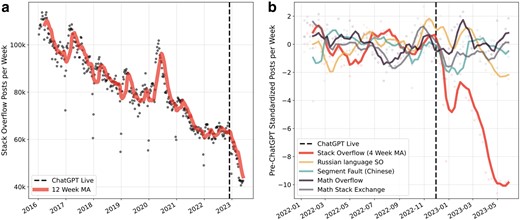
Abstract. Large language models (LLMs) are a potential substitute for human-generated data and knowledge resources. This substitution, however, can present
Scaling Laws Across Model Architectures: A Comparative Analysis of...
The scaling of large language models (LLMs) is a critical research area for the efficiency and effectiveness of model training and deployment. Our work investigates the transferability and...

The Case Against LLMs as Rerankers
Authors: Apoorva Joshi, Zhenmei Shi, Akshay Goindani, Hong LiuResearch Leads: Zhenmei Shi, Akshay Goindani, Hong Liu Large language models are increasingly being used for a broad range of tasks, in…

The diffusion of large language models in published academic articles
Large language models (LLMs) are rapidly changing academic research, raising questions of who is adopting these tools and under what conditions. This article analyzes full texts of 7.3 million journal articles published from 2020–2025 by four major publishers (Elsevier, Frontiers, MDPI, and PLoS) to track the prevalence of LLM-associated language and identify social and institutional correlates of adoption. A corpus of 228 focal words exhibiting sharp post-2022 frequency increases consistent with LLM output was developed; articles were scored on their rate of focal word usage. By 2025, an estimated 57% of published articles exhibited evidence of LLM influence, up from 12% in 2023. Among articles exhibiting LLM-influenced text, there is substantial heterogeneity, ranging from subtle linguistic influence to articles mostly or entirely LLM-generated. Difference-in-differences models reveal that LLM-associated language varies markedly across regions, institutional ranks, publishers, disciplines, and journal tiers. Economic development and proximity to English as a primary language are key predictors of regional variation. Lower-ranked institutions exhibit higher rates than elite universities, young for-profit publishers show elevated rates vis-à-vis competitors, and academic fields differ widely in adoption. LLM adoption in academic writing is pervasive but socially stratified. As models grow more powerful and their use becomes further entrenched in academic research, understanding social dynamics of adoption will be essential for governing the evolving relationship between AI and academic knowledge production.

Augmenting Research Ideation with Data: An Empirical Investigation...
Recent advancements in large language models (LLMs) demonstrate strong potential for generating novel research ideas, yet such ideas often struggle with feasibility and effectiveness. In this...
LLaDA - Large Language Diffusion Models
LLaDA is a diffusion model with an unprecedented 8B scale, rivaling LLaMA3 8B in performance.

LLMs and World Models, Part 1
How do Large Language Models Make Sense of Their “Worlds”?

Beyond Model Collapse: Scaling Up with Synthesized Data Requires...
Large Language Models (LLM) are increasingly trained on data generated by other LLM, either because generated text and images become part of the pre-training corpus, or because synthetized data is...
Scientific production in the era of Large Language Models
Large Language Models (LLMs) are rapidly reshaping scientific research. We analyze these changes in multiple, large-scale datasets with 2.1M preprints, 28K peer review reports, and 246M online accesses to scientific documents. We find: 1) scientists adopting LLMs to draft manuscripts demonstrate a large increase in paper production, ranging from 23.7-89.3% depending on scientific field and author background, 2) LLM use has reversed the relationship between writing complexity and paper quality, leading to an influx of manuscripts that are linguistically complex but substantively underwhelming, and 3) LLM adopters access and cite more diverse prior work, including books and younger, less-cited documents. These findings highlight a stunning shift in scientific production that will likely require a change in how journals, funding agencies, and tenure committees evaluate scientific works.
Large language model
A large language model (LLM) is a neural network trained on a vast amount of text for natural language processing tasks, especially language generation. LLMs can typically generate, summarize, translate, and analyze text in many contexts, and are a foundational technology behind modern chatbots.[1] Biased or inaccurate training data can make an LLM's output less reliable.[2]
Artificial intelligences and human scientists exhibit...
We investigate the effectiveness of artificial intelligences (AI)-specifically large language models (LLMs)-relative to human scientists at high-level cognitive tasks in social science such as...
How Large Language Models Actually Work
Continuous diffusion language models
Fully discrete methods dominated for a few years, but language models based on continuous diffusion are making a comeback.

Continuous diffusion language models
Fully discrete methods dominated for a few years, but language models based on continuous diffusion are making a comeback.
LLM in a Flash: Efficient Large Language Model Inference with Limited Memory
Large language models (LLMs) are central to modern natural language processing, delivering exceptional performance in various tasks…

Large language models are not the problem
If a Large Language Model (LLM) can replicate your scientific contribution, the problem is not the LLM. What does it say about our field that so much of the anxiety about AI comes down to the fear that a machine could do what we do? Perhaps it says we should be doing something better.