Significance How do democracies make decisions? We can read transcripts from parliament houses and legislative halls to see how particular ideas are introduced and debated, but we understand very little about the general principles of how these systems deal with information, or the origins of those principles. Here we study the parliamentary assembly of the first 2 years of the French Revolution, a model for democracies and revolutions across the globe, and show how patterns of speaking are created, picked up, and ignored or propagated. Political ideology, top–down rules, and individual charisma all affect how word patterns survive and thrive or, conversely, disappear and drop away. , The French Revolution brought principles of “liberty, equality, fraternity” to bear on the day-to-day challenges of governing what was then the largest country in Europe. Its experiments provided a model for future revolutions and democracies across the globe, but this first modern revolution had no model to follow. Using reconstructed transcripts of debates held in the Revolution’s first parliament, we present a quantitative analysis of how this body managed innovation. We use information theory to track the creation, transmission, and destruction of word-use patterns across over 40,000 speeches and a thousand speakers. The parliament as a whole was biased toward the adoption of new patterns, but speakers’ individual qualities could break these overall trends. Speakers on the left innovated at higher rates, while speakers on the right acted to preserve prior patterns. Key players such as Robespierre (on the left) and Abbé Maury (on the right) played information-processing roles emblematic of their politics. Newly created organizational functions—such as the Assembly president and committee chairs—had significant effects on debate outcomes, and a distinct transition appears midway through the parliament when committees, external to the debate process, gained new powers to “propose and dispose.” Taken together, these quantitative results align with existing qualitative interpretations, but also reveal crucial information-processing dynamics that have hitherto been overlooked. Great orators had the public’s attention, but deputies (mostly on the political left) who mastered the committee system gained new powers to shape revolutionary legislation.
Verification, Deliberation, Accountability: A new framework for tackling epistemic collapse and renewing democracy
Demos is Britain’s leading cross-party think-tank. We produce original research, publish innovative thinkers and host thought-provoking events.
A Model of Protests, Revolution, and Information
A collective action or revolt succeeds only if sufficiently many people participate. We study how potential revolutionaries’ ability to coordinate is affected by what they learn from different sources. We first examine how people learn about the likelihood of a revolution’s success by talking to those around themselves, which can either work in favor or against the success of an uprising, depending on the prior beliefs of the agents, the homogeneity of preferences in the population, and the number of contacts. We extend the analysis by examining the effects of homophily on learning: people are more likely to meet others who have similar preferences, undercutting learning. We introduce variants of our model to discuss other ways of learning about the support for a revolution. We discuss why holding mass protests before a revolt provides more informative signals of people’s willingness to actively participate than other less costly forms of communication (e.g., via social media). We also show how outcomes of revolutions in one region can inform citizens of another region and thus trigger (or discourage) neighboring revolutions. We also discuss the role of governments in avoiding revolutions and learning about their citizens’ concerns; in particular, by observing the strength of protests and counter-protests.

The Social Meaning of the Personal Computer: Or, Why the Personal Computer Revolution Was No Revolution
This essay presents a processual model of the personal computing movement that depicts the PC's birth within the context of complex and often contradictory social strategies, each of which used the meaning of computer technology in a distinctive way. It suggests that innovators are constrained by such processes to depict new artifacts in culturally meaningful ways, so that it is difficult for them to conceive of their technologies in radical terms. The rhetoric of "revolution" aside, innovators found it expedient to draw from the stock of meanings at hand as they created new meaning-frameworks for their artifacts. The result is that the new artifacts did not express a coherent or effective political vision and failed to have the intended social effects. This study implies that new technologies frequently reproduce existing social and meaning systems; if they do bring about social change, the changes may differ from those intended by the innovators.
The Social Meaning of the Personal Computer: Or, Why the Personal Computer Revolution Was No Revolution
This essay presents a processual model of the personal computing movement that depicts the PC's birth within the context of complex and often contradictory social strategies, each of which used the meaning of computer technology in a distinctive way. It suggests that innovators are constrained by such processes to depict new artifacts in culturally meaningful ways, so that it is difficult for them to conceive of their technologies in radical terms. The rhetoric of "revolution" aside, innovators found it expedient to draw from the stock of meanings at hand as they created new meaning-frameworks for their artifacts. The result is that the new artifacts did not express a coherent or effective political vision and failed to have the intended social effects. This study implies that new technologies frequently reproduce existing social and meaning systems; if they do bring about social change, the changes may differ from those intended by the innovators.
Fractured reality
The report examines the evolving impact of digital technologies on European democracy. In an era of a global struggle to control the information space, this report offers critical insights into the fracturing of perceived realities, the rise of the ‘fantasy-industrial complex’, and the systemic risks posed by the attention economy. It exposes how platforms algorithmically prioritise engagement over accuracy, reinforcing ideological echo chambers and amplifying mis- and disinformation that erode democratic resilience. The report highlights how structural incentives and foreign control of the most important players in the information space undermine information integrity, collective knowledge and civic discourse. In response, the report presents a number of recommendations from fostering alternative public spaces and crowd-sourced knowledge systems to reforming business models, restoring user agency, and advancing EU digital sovereignty through decentralised infrastructure
The Cloister Web: Reshaping the Political Maidan
The advent of the "Cloister Web," a conceptual space where individuals leverage Large Language Models (LLMs) to cultivate novel ideas and commit them to a persistent public memory, heralds a profound shift in our intellectual and political landscapes.

AI, Decomputing and the Interregnum
This paper treats AI as diagnostic for the deeper changes taking place in the existing order of things. It uses AI's alignment with both the political economy and with the dualisms that underpin it, including race, gender and anthropocentrism, to highlight the nihilistic character of the current restructuring. AI's scaling and accelerationism are taken as examples of the wider tactics being invoked by hegemonic power to maintain control under changing conditions. From this perspective, the massive build-out of data centres isn't simply a seizure of energy resources but a manifestation of an aggressive and misogynist technopolitics. The paper argues that a liberal push for digital sovereignty doesn't interrupt these dynamics but plays into the hands of emerging technofascism. It proposes instead the prefigurative tactic of 'decomputing', which draws on degrowth, deautomatisation and a convivial approach to technology. It explores decomputing as a means to mitigate both material and relational harms and as a decisive turn towards infrastructuring the common good. The paper concludes that AI is the contradiction that reveals many others, not least the gap between claims to legitimacy and the actuality of destructive violence, and proposes an alternative technopolitics of reciprocity that prioritises care and sustainability.
AI, Decomputing and the Interregnum
This paper treats AI as diagnostic for the deeper changes taking place in the existing order of things. It uses AI's alignment with both the political economy and with the dualisms that underpin it, including race, gender and anthropocentrism, to highlight the nihilistic character of the current restructuring. AI's scaling and accelerationism are taken as examples of the wider tactics being invoked by hegemonic power to maintain control under changing conditions. From this perspective, the massive build-out of data centres isn't simply a seizure of energy resources but a manifestation of an aggressive and misogynist technopolitics. The paper argues that a liberal push for digital sovereignty doesn't interrupt these dynamics but plays into the hands of emerging technofascism. It proposes instead the prefigurative tactic of 'decomputing', which draws on degrowth, deautomatisation and a convivial approach to technology. It explores decomputing as a means to mitigate both material and relational harms and as a decisive turn towards infrastructuring the common good. The paper concludes that AI is the contradiction that reveals many others, not least the gap between claims to legitimacy and the actuality of destructive violence, and proposes an alternative technopolitics of reciprocity that prioritises care and sustainability.
GermanPartiesQA: Benchmarking Commercial Large Language Models and AI Companions for Political Alignment and Sycophancy
Large language models (LLMs) are increasingly shaping citizens’ information ecosystems. Products incorporating LLMs, such as chatbots and AI Companions, are now widely used for decision support and information retrieval, including in sensitive domains, raising concerns about hidden biases and growing potential to shape individual decisions and public opinion. This paper introduces GermanPartiesQA, a benchmark of 418 political statements from German Voting Advice Applications across 11 elections to evaluate six commercial LLMs. We evaluate their political alignment based on role-playing experiments with political personas. Our evaluation reveals three specific findings: (1) Factual limitations: LLMs show limited ability to accurately generate factual party positions, particularly for centrist parties. (2) Model-specific ideological alignment: We identify consistent alignment patterns and degree of political steerability for each model across temperature settings and experiments. (3) Claim of sycophancy: While models adjust to political personas during role-play, we find this reflects persona-based steerability rather than the increasingly popular, yet contested concept of sycophancy. Our study contributes to evaluating the political alignment of closed-source LLMs that are increasingly embedded in electoral decision support tools and AI Companion chatbots.
GermanPartiesQA: Benchmarking Commercial Large Language Models and AI Companions for Political Alignment and Sycophancy
Large language models (LLMs) are increasingly shaping citizens’ information ecosystems. Products incorporating LLMs, such as chatbots and AI Companions, are now widely used for decision support and information retrieval, including in sensitive domains, raising concerns about hidden biases and growing potential to shape individual decisions and public opinion. This paper introduces GermanPartiesQA, a benchmark of 418 political statements from German Voting Advice Applications across 11 elections to evaluate six commercial LLMs. We evaluate their political alignment based on role-playing experiments with political personas. Our evaluation reveals three specific findings: (1) Factual limitations: LLMs show limited ability to accurately generate factual party positions, particularly for centrist parties. (2) Model-specific ideological alignment: We identify consistent alignment patterns and degree of political steerability for each model across temperature settings and experiments. (3) Claim of sycophancy: While models adjust to political personas during role-play, we find this reflects persona-based steerability rather than the increasingly popular, yet contested concept of sycophancy. Our study contributes to evaluating the political alignment of closed-source LLMs that are increasingly embedded in electoral decision support tools and AI Companion chatbots.
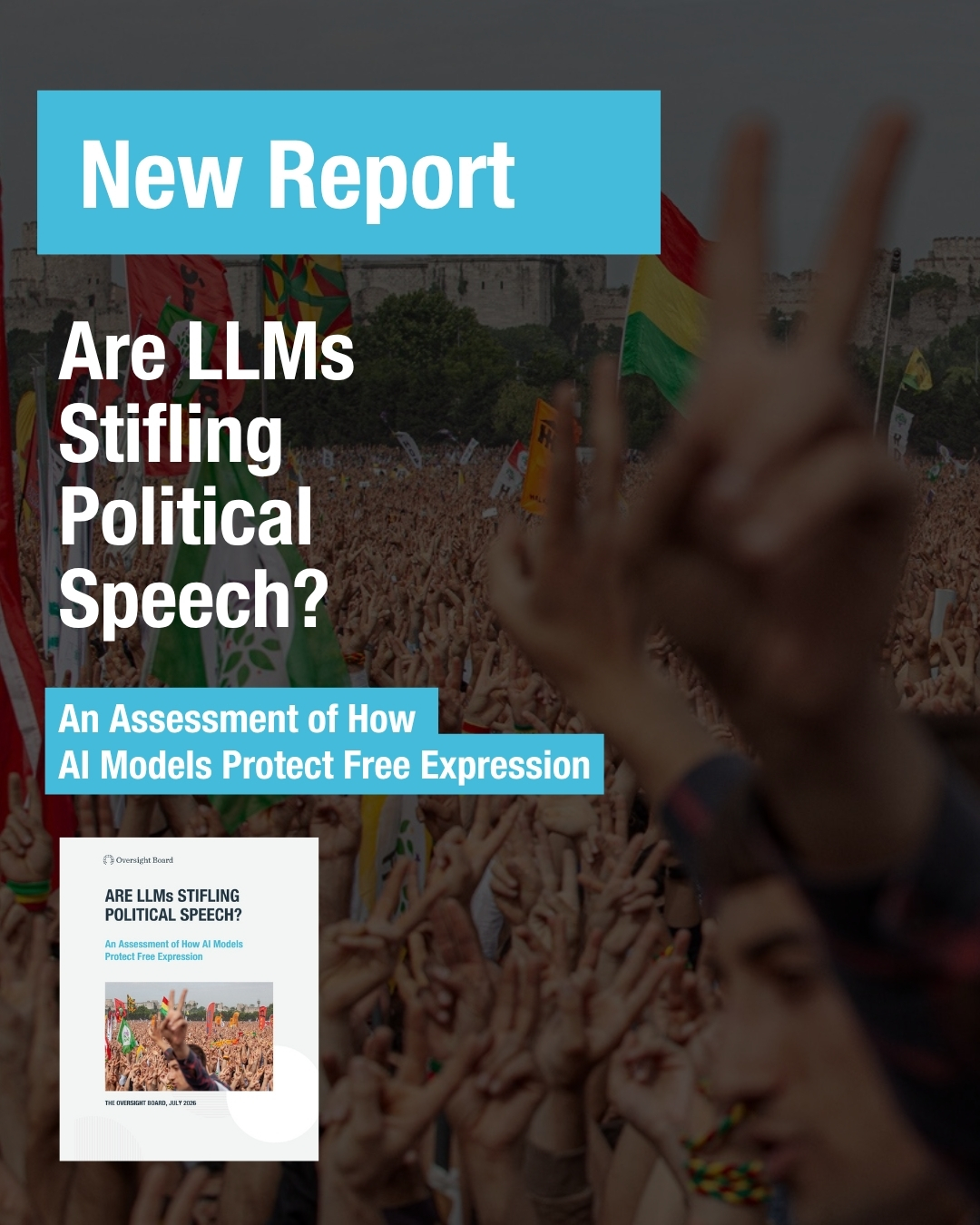
Are LLMs Stifling Political Speech? An Assessment of How AI Models Protect Free Expression | Oversight Board
The Oversight Board’s first evaluation of large language models (LLMs) shows that some of the world’s most-used models from Anthropic, DeepSeek, Google, Meta
Claude's new constitution
A new approach to a foundational document that expresses and shapes who Claude is
AI and the Future of Digital Public Squares
Two substantial technological advances have reshaped the public square in recent decades: first with the advent of the internet and second with the recent introduction of large language models (LLMs). LLMs offer opportunities for a paradigm shift towards more decentralized, participatory online spaces that can be used to facilitate deliberative dialogues at scale, but also create risks of exacerbating societal schisms. Here, we explore four applications of LLMs to improve digital public squares: collective dialogue systems, bridging systems, community moderation, and proof-of-humanity systems. Building on the input from over 70 civil society experts and technologists, we argue that LLMs both afford promising opportunities to shift the paradigm for conversations at scale and pose distinct risks for digital public squares. We lay out an agenda for future research and investments in AI that will strengthen digital public squares and safeguard against potential misuses of AI.

The Wikipedia Revolution: How a Bunch of Nobodies Creat…
"Imagine a world in which every single person on the pl…

On the epistemic structure of voluntary servitude in the infosphere
This paper introduces the concept of Voluntary Epistemic Servitude (VES) to describe a social-epistemic pathology generated by the contemporary infosphere. Drawing on Étienne de La Boétie’s Discours de la Servitude Volontaire as a theoretical resource, we argue that algorithmic systems produce conditions in which agents not only delegate their core belief-forming processes to nontransparent architectures but come to prefer and actively reproduce this delegation through social mechanisms structurally isomorphic to those La Boétie identified in political tyranny. We show that VES is irreducible to existing social-epistemic categories such as epistemic injustice (Fricker 2007), epistemic bubbles and echo chambers (Nguyen 2020), and veritistic failure (Goldman 1999) because it operates at the level of epistemic preference formation rather than credibility attribution or informational access. The paper identifies a preference-laundering mechanism by which algorithmic systems colonize the second-order epistemic desires of agents, thereby undermining the conditions of epistemic autonomy that social epistemology has largely presupposed. We further develop a precise account of reflective access that distinguishes algorithmic opacity from ordinary preference opacity, introduce the concept of epistemic counterfactual capacity with a modal analysis connecting it to Williamson’s (2000) safety condition, situate VES as a structurally induced epistemic vice (Cassam 2019) and a form of misaligned extended cognition (Clark and Chalmers 1998), and provide a typology of three algorithmic architectures through which VES operates. We conclude by stating an explicit normative bridge principle and drawing on La Boétie’s positive ideal of free horizontal epistemic bonds to sketch the preconditions for epistemic liberation in algorithmically mediated environments.