


Significance The impact of chronic debt on the poor is psychological, not just financial. We hypothesize that chronic debt impairs psychological functioning and decision-making, contributing to the poverty trap. This is because debt is not considered fungible and is viewed as costly mental accounts that consume cognitive bandwidth. We test this using quasiexperimental evidence from a one-off, unanticipated debt-relief program worth several months’ household income. Comparing the poor before and after debt relief, those with more debt accounts paid off experienced greater improvements in cognitive functioning, reported less anxiety, and became less present-biased. These findings provide actionable evidence for poverty-alleviation policy. , We examine how chronic debt affects behavior by studying how a large, unanticipated debt-relief program affected psychological functioning and economic decision-making in beneficiaries. A charity granted low-income households debt relief worth up to Singapore dollars 5,000 (∼3 month’s household income). We exploited quasiexperimental variation in the structure of debt relief: For the same dollar amount of relief, some beneficiaries had more debt accounts eliminated, while others had fewer paid off. Comparing 196 beneficiaries before and after debt relief, and controlling for debt-relief amount, having an additional debt account paid off improves cognitive functioning by about one-quarter of a SD and reduces the likelihood of exhibiting anxiety by 11% and of present bias by 10%. To achieve the same effect on cognitive functioning of eliminating one debt account, a beneficiary must receive debt relief worth ∼1 month’s household income. There is no effect of debt-relief magnitude on anxiety and decision-making. We exclude training and calendar effects, debt-causing behaviors, and liquidity constraints as explanations. Instead, these results support the hypothesis that chronic debt impairs behavior because the mental-accounting costs of owing distinct debt accounts consume mental bandwidth. Poverty-alleviation policies aimed at the indebted poor should consider addressing mental accounting and bandwidth taxes.
On shifting consumers from high‐interest to low‐interest debt
Abstract In the United States, many consumers are increasingly accumulating debt, much of which is harmful and expensive. Prior research has devoted a great deal of attention to understanding why consumers generally get into debt and the strategies they can use to repay existing debts. While this work has furthered the agenda of helping consumers reduce or eliminate their overall debt balances, it has failed to emphasize the fact that for many consumers, debt may be unavoidable. This article aims to promote research that addresses not only overall debt reduction but also the need for consumers to shift from more to less costly types of debt. By shedding light on the psychological reasons why consumers may naturally gravitate toward more costly forms of debt when less costly ones may be available, we offer a novel perspective on why consumers get into and stay in debt longer than they should. This new angle has the potential to spur on further research into the ways consumers can use debt more effectively and less expensively in service of the overarching goal of debt reduction.

When Motivation is against Debtors' Best Interest: The Illusion of Goal Progress in Credit Card Debt Repayment
The authors explore the illusion of goal progress by consumers who own multiple credit cards and pay off their debt balances to facilitate the achievement of their subgoal rather than the superordinate goal of being debt-free. The first experiment shows that debtors use their savings toward the credit card debt they can pay off entirely or substantially, even if it is associated with the smallest balance and the lowest annual percentage rate rather than toward the debt with the highest annual percentage rate. The second experiment reveals that when the income available to pay down the debt is in the form of effortless money (i.e., windfall or reward money) as opposed to hard-earned savings, the tendency to allocate money toward the smallest credit card debt is exacerbated. However, people tend to pay their debt more rationally when the number of debt accounts increases. Finally, the third experiment shows that credit card debt repayment decisions depend on the nature of the debt (hedonic vs. utilitarian) and the timing of consumption benefits (past vs. future). The article concludes with a discussion of managerial and public policy implications.

The persistence of cognitive biases in financial decisions across economic groups
While economic inequality continues to rise within countries, efforts to address it have been largely ineffective, particularly those involving behavioral approaches. It is often implied but not tested that choice patterns among low-income individuals may be a factor impeding behavioral interventions aimed at improving upward economic mobility. To test this, we assessed rates of ten cognitive biases across nearly 5000 participants from 27 countries. Our analyses were primarily focused on 1458 individuals that were either low-income adults or individuals who grew up in disadvantaged households but had above-average financial well-being as adults, known as positive deviants. Using discrete and complex models, we find evidence of no differences within or between groups or countries. We therefore conclude that choices impeded by cognitive biases alone cannot explain why some individuals do not experience upward economic mobility. Policies must combine both behavioral and structural interventions to improve financial well-being across populations.

Knowing When to Spend: Unintended Financial Consequences of Earmarking to Encourage Savings
Maintaining savings is an important financial goal. Yet there are times when savings should be spent, such as when people face unavoidable costs, and spending their savings allows them to avoid high interest rate debt. Existing behavioral research has focused on consumer decisions between savings and discretionary spending and has proposed interventions to promote savings in these contexts. However, when spending is not discretionary, such interventions could risk exacerbating a pattern found in economic research in which people borrow high interest rate debt while maintaining savings that earn low levels of interest. To examine how mental accounting interacts with considerations of personal responsibility and guilt to contribute to this pattern, this article explores whether people spend their savings when they need money most: during emergencies. Six studies reveal that people's tendency to preserve savings by borrowing from a high interest rate credit option varies as a function of the savings’ intended use. Paradoxically, people are most likely to turn to high interest rate credit with the belief that doing so is the responsible option.
Behaviorally Informed Policies for Household Financial Decisionmaking
Low incomes, limited financial literacy, fraud, and deception are just a few of the many intractable economic and social factors that contribute to the financial difficulties that households face today. Addressing these issues directly is difficult and costly. But poor financial outcomes also result from systematic psychological tendencies, including imperfect optimization, biased judgments and preferences, and susceptibility to influence by the actions and opinions of others. Some of these psychological tendencies and the problems they cause may be countered by policies and interventions that are both low cost and scalable. We detail the ways that these behavioral factors contribute to consumers’ fiancial mistakes and suggest a set of interventions that the federal government, in its dual roles as regulator and employer, could feasibly test or implement to improve household financial outcomes in a variety of domains: retirement, short-term savings, debt management, the take-up of government benefits, and tax optimization.
The Hedonics of Debt
Psychologists and economists often discuss the “pain” of paying for our purchases. Four experiments examine how people evaluate prospective debt payments, analyzing how different features of a loan (down payment, final payment, duration, monthly payments) affect willingness to accept the loan. Akin to previous findings on physical pain, participants exhibited duration neglect and over-weighted final moments. However, participants also focused heavily on the monthly or average payment (unlike in retrospective studies of physical pain where only peak-end moments seem to count). In Experiment 2, participants’ willingness to accept the loan was not significantly diminished by making it more expensive through keeping the same monthly payment but extending the length of the loan by 40 percent (evincing duration neglect). Further, in Experiments 3 and 4, we show that participants increased their willingness to buy if loans were made longer and more expensive by adding smaller, less “painful” payments to the end.

Consumption and Debt Response to Unanticipated Income Shocks: Evidence from a Natural Experiment in Singapore
This paper uses a unique panel dataset of consumer financial transactions to study how consumers respond to an exogenous unanticipated income shock. Consumption rose significantly after the fiscal policy announcement: during the ten subsequent months, for each $1 received, consumers on average spent $0.80. We find a strong announcement effect—19 percent of the response occurs during the first two-month announcement period via credit cards. Subsequently, consumers switched to debit cards after disbursement before finally increasing spending on credit cards in the later months. Consumers with low liquid assets or with low credit card limit experienced stronger consumption responses. (JEL D12, D14, E21)
5: Behavioural biases in personal finance
Behavioural economics merges psychology and economics to explore systematic deviations in financial decision-making from traditional economic models. This chapter examines key biases such as mental accounting, present bias, planning fallacy, and misunderstanding of risk, which influence spending, saving, investing, and insuring decisions. Demonstrating the interplay of cognitive biases and heuristics highlights why individuals make suboptimal choices despite financial literacy and resource capacity. Strategies like goal-setting, commitment devices, and education interventions are evaluated, focusing on their limitations and potential for addressing these biases. The chapter concludes by emphasising the need for systemic changes, such as policy-level interventions and financial regulation, to complement behavioural interventions and address structural barriers to better financial decisions. Future research directions are suggested, including tailoring interventions, exploring technology's role, and integrating systemic solutions to support sustainable financial well-being.
Context-Dependent Drivers of Discretionary Debt Decisions: Explaining Willingness to Borrow for Experiential Purchases
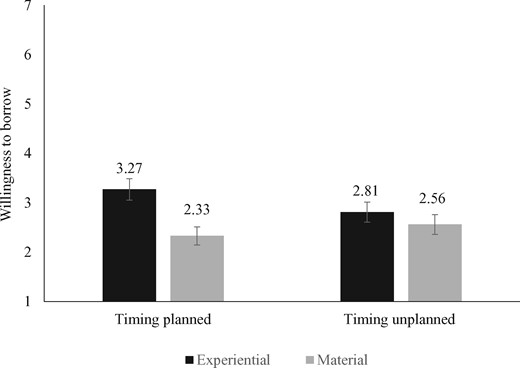
Abstract Mental accounting research suggests that consumers prefer borrowing for longer-lasting purchases in order to receive benefits from the purchases as they pay for them. In contrast, two sets of archival data and five lab studies show that consumers are more willing to borrow for experiential versus material purchases, even though experiential purchases tend to have a shorter physical duration. Further, framing the same purchase as more experiential than material increases willingness to borrow. This effect occurs because purchase timing is more important for experiential purchases—a function of consumers’ aversion to missing out on planned consumption. Thus, we moderate the proposed effect by varying whether the borrowing decision impacts planned consumption. Other differences between material and experiential purchases, such as scarcity or expected happiness, cannot similarly explain our results. Moreover, our conceptualization allows us to reconcile the apparent contradiction between the previous and current research by examining the relative impact of purchase-timing importance and payment-benefit duration matching in different contexts (i.e., “purchasing” and “source-of-funding” decisions).
The Coholding Puzzle: New Evidence from Transaction-Level Data
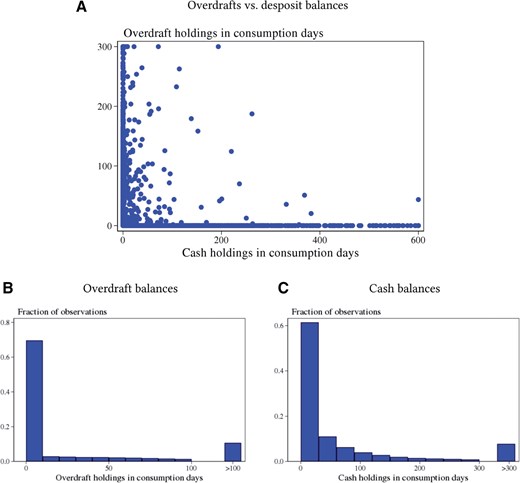
Abstract Why do individuals pay debt interest when they could use their savings to pay down the debt? We explore why individuals “cohold” debt and savings using detailed and highly disaggregated daily-level data on household finances. We find that coholding mostly occurs in short spells within the month and the level of coholding is typically modest. Periods of coholding are not associated with shocks at the individual level. We show that mental accounting has a role to play in explaining coholding, in particular how individuals allocate different categories of expenditure to accounts in credit and debit.
Psychological ownership interventions increase interest in claiming government benefits
Significance Most government benefits programs exhibit a sizable participation gap, with eligible individuals forgoing billions of dollars in government benefits each year. Many policymakers have focused on addressing this participation gap, as receiving government benefits has been shown to reduce poverty, childhood hunger, educational gaps, and physical and mental illness. The current work presents psychological ownership framing as a behavioral science intervention, and we show that it can help address this benefits participation gap. These interventions are subtle, simple to implement, and cheaper to execute relative to logistical interventions. Moreover, the data show that psychological ownership interventions can be more efficacious than other common psychological interventions such as social norms and urgency. , Each year, eligible individuals forgo billions of dollars in financial assistance in the form of government benefits. To address this participation gap, we identify psychological ownership of government benefits as a factor that significantly influences individuals’ interest in applying for government benefits. Psychological ownership refers to how much an individual feels that a target is their own. We propose that the more individuals feel that government benefits are their own, the less likely they are to perceive applying for them as an aversive ask for help, and thus, the more likely they are to pursue them. Three large-scale field experiments among low-income individuals demonstrate that higher psychological ownership framing of government benefits significantly increases participants’ pursuit of benefits and outperforms other common psychological interventions. An additional experiment shows that this effect occurs because greater psychological ownership reduces people’s general aversion to asking for assistance. Relative to control messages, these psychological ownership interventions increased interest in claiming government benefits by 20% to 128%. These results suggest that psychological ownership framing is an effective tool in the portfolio of potential behavioral science interventions and a simple way to stimulate interest in claiming benefits.

The Debt Payment Puzzle: An Experimental Investigation
Why do borrowing individuals fail to repay their debt optimally? We design a diagnostic laboratory experiment where we rule out selection into debt and other co

Financial product sensitivity predicts financial health
Abstract Recent research has aimed to understand how people consider financial decisions because they have important consequences for well‐being. Yet existing research has largely failed to examine how attitudes and behaviors vary as a function of the specific financial product (e.g., debt type). We ask to what extent people differentiate between similarly categorized financial products (e.g., debt or investment) as a function of their terms (e.g., interest costs and expected returns) and whether such differentiation predicts financial health. Across four studies, we find not only that there are individual differences in attitudes toward similar financial products (e.g., two distinct loans), but also that the extent to which a consumer is averse to high‐cost versus low‐cost products predicts financial health. This relationship cannot be fully explained by financial literacy, numeracy, or intertemporal discounting. In addition, nudging people toward differentiating between financial products promotes decisions that are aligned with financial health.

Savers and Borrowers: Strategies of Personal Financial Management
Saving and borrowing are traditionally and stereotypically thought of as opposites, with different motivations and consequences. Through a questionnaire survey of economic position, practices, and attitudes, the present paper examined the relation between saving and borrowing among British respondents. While saving and borrowing were found to be determined by different economic, social, and psychological factors, they did not describe mutually exclusive strategies of financial management. Saving regularly could also be distinguished from having savings. In all, six strategies were identified (combining saving or not saving, borrowing or not borrowing, and having or not having savings). Each combination was found to have specific discriminating characteristics. Savers and borrowers were found to have different psychological motivations, seeing debt either as a failure or as a normal part of everyday life. Many people retained savings or carried on saving at the same time as having debts: they were found to feel more in control and optimistic about their financial position than those who had debts but no savings. A further group had neither debts nor savings: they adopted an inflexible approach to financial management. Each group of people with different financial management strategies was illustrated by a case study.
Debt literacy, financial experiences, and overindebtedness
We analyze a national sample of Americans with respect to their debt literacy, financial experiences, and their judgments about the extent of their indebtedness. Debt literacy is a component of broader financial understanding that measures knowledge about debt and self-assessed financial knowledge. Financial experiences are the participants’ reported experiences with traditional borrowing, alternative borrowing, and investing. Overindebtedness is a self-reported measure. Debt literacy is low, with only about one-third of the population grasping the basics of interest compounding. Even after controlling for demographics, we find a relationship between debt literacy and both financial experiences and debt loads. Individuals with lower levels of debt literacy tend to transact in high-cost manners, incurring higher fees and using high-cost borrowing. We provide a rough estimate of the national implications of debt ignorance on credit card costs by consumers. Less knowledgeable individuals also report that their debt loads are excessive or that they are unable to judge their debt position.
Payment Rewards and Credit Card Debt: Experimental Evidence
We report on a controlled laboratory experiment in which participants make consumption, saving, and credit card repayment decisions when credit card purchases e