In the quest to model neuronal function amid gaps in physiological data, a promising strategy is to develop a normative theory that interprets neuronal physiology as optimizing a computational objective. This study extends current normative models, which primarily optimize prediction, by conceptualizing neurons as optimal feedback controllers. We posit that neurons, especially those beyond early sensory areas, steer their environment toward a specific desired state through their output. This environment comprises both synaptically interlinked neurons and external motor sensory feedback loops, enabling neurons to evaluate the effectiveness of their control via synaptic feedback. To model neurons as biologically feasible controllers which implicitly identify loop dynamics, infer latent states, and optimize control we utilize the contemporary direct data-driven control (DD-DC) framework. Our DD-DC neuron model explains various neurophysiological phenomena: the shift from potentiation to depression in spike-timing-dependent plasticity with its asymmetry, the duration and adaptive nature of feedforward and feedback neuronal filters, the imprecision in spike generation under constant stimulation, and the characteristic operational variability and noise in the brain. Our model presents a significant departure from the traditional, feedforward, instant-response McCulloch–Pitts–Rosenblatt neuron, offering a modern, biologically informed fundamental unit for constructing neural networks.
Random noise promotes slow heterogeneous synaptic dynamics important for robust working memory computation
Recurrent neural networks (RNNs) based on model neurons that communicate via continuous signals have been widely used to study how cortical neural circuits perform cognitive tasks. Training such networks to perform tasks that require information maintenance over a brief period (i.e., working memory tasks) remains a challenge. Inspired by the robust information maintenance observed in higher cortical areas such as the prefrontal cortex, despite substantial inherent noise, we investigated the effects of random noise on RNNs across different cognitive functions, including working memory. Our findings reveal that random noise not only speeds up training but also enhances the stability and performance of RNNs on working memory tasks. Importantly, this robust working memory performance induced by random noise during training is attributed to an increase in synaptic decay time constants of inhibitory units, resulting in slower decay of stimulus-specific activity critical for memory maintenance. Our study reveals the critical role of noise in shaping neural dynamics and cognitive functions, suggesting that inherent variability may be a fundamental feature driving the specialization of inhibitory neurons to support stable information processing in higher cortical regions.

Reverse-Engineering the Wetware: Spiking Networks, TD Errors, and the End of Matrix Math
An engineer-friendly deep dive into how the human brain truly processes information, learns without backpropagation, and uses spiking neural networks, predictive coding, and dopamine-driven TD errors—challenging our notions of AI and matrix math.
Neuropeek — Accelerating the Neuro-AI convergence
Where brain data becomes shared knowledge. A community-driven platform federating neuroscience datasets, models, and tools to accelerate discovery.

Grounded world models in biological organisms and future embodied AI
Recent advances in generative and embodied AI have been driven by large-scale predictive learning over multimodal data. However, the resulting systems remain largely based on passive training regimes where linguistic regularities create the scaffold onto which information from other modalities is attached. Conversely, neuroscience and cognitive science suggest that biological intelligence is organized in the opposite way, where grounded world models acquired through interaction with the environment provide the semantic scaffold to which language is attached. Here, we illustrate five examples of neural circuits supporting grounded world modelling, which underlie navigation in physical and conceptual spaces, affordance-based perception and interaction with objects, active perception and exploratory learning, allostatic control and emotion, and the distinction between self- and world-generated outcomes. These examples highlight several features largely missing from current embodied AI, including the role of intrinsic dynamics as a foundation for learning, the centrality of action in aligning these dynamics with the external world, the prominence of autonomous experience and open-ended learning over passive assimilation of externally provided data, and the fact that early predictive and control mechanisms scaffold higher cognitive abilities such as reasoning, conceptual navigation, planning, imagination, understanding others' minds, and communication. Finally, we discuss whether and how principles derived from biological systems may inform future embodied AI, including training regimes based on social interaction to construct world models that are not only grounded but also socially shared and aligned with human norms and values.

Embracing the suboptimal organization of the human brain
Human brain architecture is guiding brain-inspired artificial intelligence (AI) and has been treated as an optimal template, whose deviations could mark different psychiatric and neurological conditions. We argue this premise is wrong: under any single goal (e.g., minimal wiring cost or maximal communication efficiency), the human connectome is suboptimal. Instead, its organization reflects multi-objective trade-offs navigated over evolution and development under biological and environmental constraints. For psychopathology, atypical trajectories are not distances from an ideal brain but reweighted compromises in the same trade-off space. For neuro-AI, directly duplicating the brain’s connectivity risks copying its irrelevant compromises. Treating brains and models as products of multi-objective optimization and co-tuning relevant objectives offers a more powerful framework for interpreting clinical phenotypes and designing next-generation AI.

How AI coding is reshaping theoretical neuroscience
Agentic coding makes it possible to specify a neuroscience model in hours instead of months. Neuroscientists weigh in on that tectonic change.

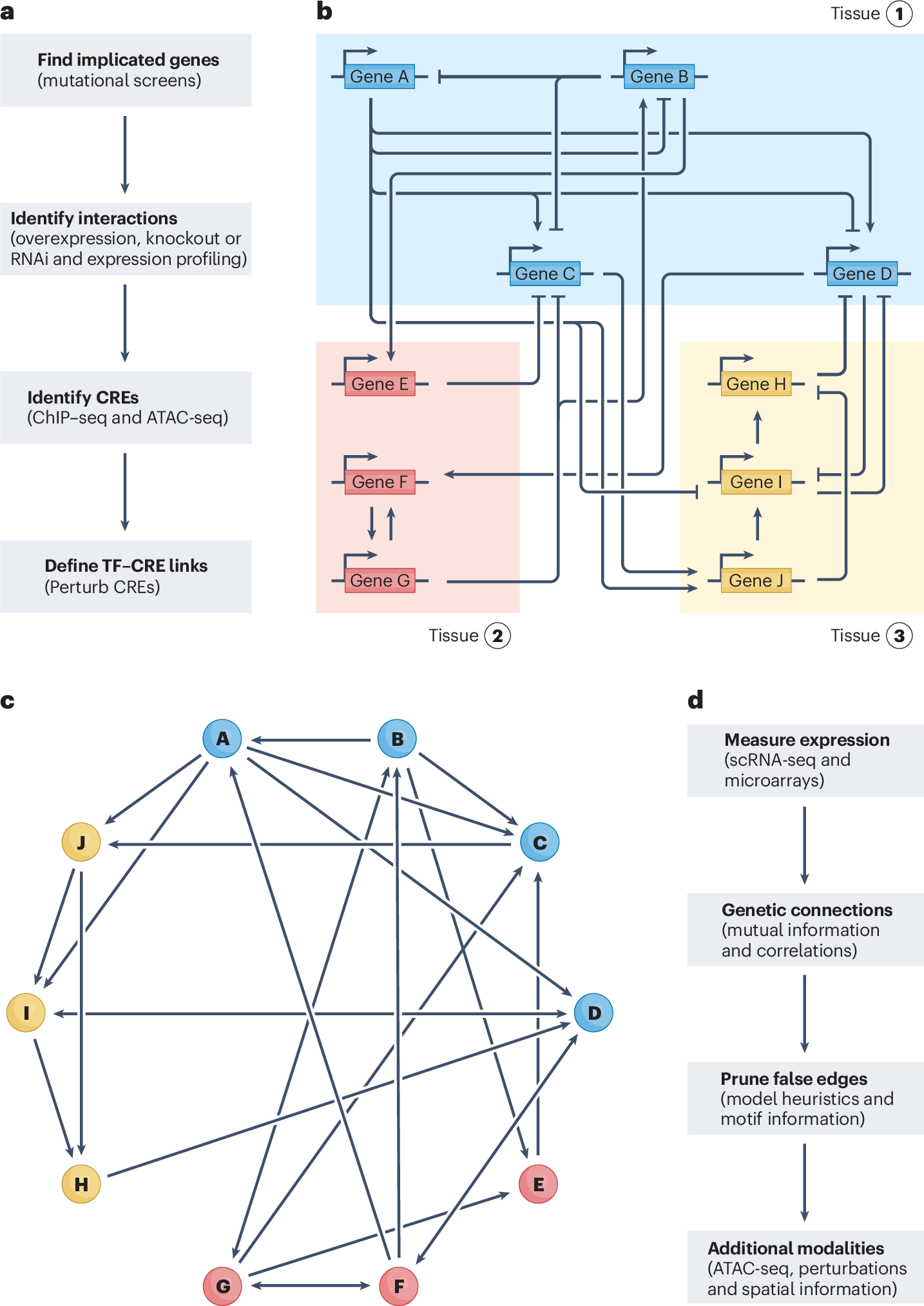
Gene regulatory networks: from correlative models to causal explanations
Gene regulatory networks (GRNs) explain how the genome controls cellular behaviour and tissue morphogenesis, serving to connect molecular mechanism to functional output. Single-cell technologies now provide descriptions of these networks with unprecedented detail, but this advance has also revealed gene regulatory systems that are too complex for our existing conceptual frameworks. GRNs, which should provide mechanistic explanations, are increasingly reduced to statistical correlations — ‘hairballs’ that fail to capture molecular causation. Here, we explore why this dilemma exists and propose a path forward. We argue that methods in ‘representation learning’ can be used to model GRNs, without needing to capture every molecular detail. For this framework, we advocate three linked principles: models must be inherently mechanistic, with structures grounded in cellular and evolutionary biology; molecular principles and constraints must be used to reduce the solution space for learning GRN models; and more sophisticated forms of experimental perturbation and synthetic biological engineering are needed to train models and test predictions. By reimagining GRNs through these principles, we can bridge the gap from data abundance to new conceptual understanding.
nubrain - A foundation model for neural decoding
Building the world's largest dataset of human brain activity.

VAPOR: A variational autoencoder with transport operators to disentangle cellular gene expression dynamics of co-occurring biological processes in time and space
Abstract Single-cell and spatial transcriptomics enable the analysis of cellular states and dynamics in gene expression, revealing how diverse biological processes relate to these states over time and space. To study these dynamics, trajectory inference methods order cells along computationally inferred paths to reconstruct gradual transitions in cell states. However, by encouraging smooth and continuous trajectories, these approaches tend to conflate co-occurring processes-such as proliferation, maturation, and spatial organization-that are jointly reflected in gene expression, potentially overlooking process-specific gene expression dynamics. To address this, we developed VAPOR, which integrates a variational autoencoder with transport operators to model and disentangle cellular gene expression dynamics for potentially co-occurring biological processes. VAPOR inputs single-cell (or spatial) gene expression data into a variational autoencoder (VAE) to learn the latent states of cells and then models their latent dynamics as an ordinary differential equation. The latent dynamics are further decomposed into process-specific components parameterized by transport operators (TOs) and their corresponding process weights. Each TO defines a process-specific dynamics, and its weight for each cell quantifies the process's contribution to the cell dynamics. After assessment by simulation studies, we applied VAPOR with benchmarking to real data, including time-course scRNA-seq from postconceptual human brain development, spatial transcriptomics of the mouse hippocampus, and cross-species scRNA-seq spanning human and macaque first-trimester forebrain development. In these applications, VAPOR has identified a variety of temporal and spatial co-occurring processes, such as cell cycle, gliogenesis, neurogenesis, and neuronal migration, along with associated dynamic genes, including those species-specific to human and macaque development. VAPOR is available as an open-source tool for general-purpose use. ### Competing Interest Statement The authors have declared no competing interest.

Introducing TRIBE v2: A Predictive Foundation Model Trained to Understand How the Human Brain Processes Complex Stimuli | Keith Doelling
This is some very cool work by some awesome colleagues Jean-Rémi King, and Teon Brooks! Seriously not enough good things can be said about how cool it is. You should enjoy it and play with it. And kudos to Meta for open sourcing it. At the same time, I'm already seeing posts about how the model will replace fMRI experiments as researchers will simulate how the brain "really works" instead of running costly experiments. I think this goes WELL beyond what its creators intend. We are already seeing that use of AI in science allows you to explore charted ideas more thoroughly and much more rapidly but slows us down in finding novel ideas (https://lnkd.in/eMR2akqt). At the same time, there is growing concern that LLM performance will collapse as they are increasingly trained on their own output (https://lnkd.in/eavgfyuY). Leaving neuroscience to AI simulations risks following the same fate, where we generate seemingly new findings without gaining new meaning. A mechanistic understanding of how the brain works (if that is still your goal) will be found at the margins, in errors and idiosyncrasies of neural function. What TRIBE provides is a super useful and cool instantiation of our current understanding on how and where neural activity is instantiated in the brain. But it won't help us make groundbreaking new findings of how neural circuits lead to cognition and behavior. Experiments on real human brains, may be costly, but they will always be necessary!
Introducing TRIBE v2: A Predictive Foundation Model Trained to Understand How the Human Brain Processes Complex Stimuli | Keith Doelling
This is some very cool work by some awesome colleagues Jean-Rémi King, and Teon Brooks! Seriously not enough good things can be said about how cool it is. You should enjoy it and play with it. And kudos to Meta for open sourcing it. At the same time, I'm already seeing posts about how the model will replace fMRI experiments as researchers will simulate how the brain "really works" instead of running costly experiments. I think this goes WELL beyond what its creators intend. We are already seeing that use of AI in science allows you to explore charted ideas more thoroughly and much more rapidly but slows us down in finding novel ideas (https://lnkd.in/eMR2akqt). At the same time, there is growing concern that LLM performance will collapse as they are increasingly trained on their own output (https://lnkd.in/eavgfyuY). Leaving neuroscience to AI simulations risks following the same fate, where we generate seemingly new findings without gaining new meaning. A mechanistic understanding of how the brain works (if that is still your goal) will be found at the margins, in errors and idiosyncrasies of neural function. What TRIBE provides is a super useful and cool instantiation of our current understanding on how and where neural activity is instantiated in the brain. But it won't help us make groundbreaking new findings of how neural circuits lead to cognition and behavior. Experiments on real human brains, may be costly, but they will always be necessary!
Diversity-enabled sweet spots in layered architectures and speed–accuracy trade-offs in sensorimotor control | PNAS
Nervous systems sense, communicate, compute, and actuate movement using distributed components with severe trade-offs in speed, accuracy, sparsity,...

Introducing TRIBE v2: AI Model Predicts Human Brain Responses | AI at Meta posted on the topic | LinkedIn
Today we're introducing TRIBE v2, a foundation model trained to predict how the human brain responds to almost any sight or sound. Building on our Algonauts 2025 award-winning architecture, TRIBE v2 draws on 500+ hours of fMRI recordings from 700+ people to create a digital twin of neural activity. It enables zero-shot predictions for new subjects, languages, and tasks, consistently outperforming standard modeling approaches. We’re releasing the model, codebase, paper, and an interactive demo to help researchers advance neuroscience, apply brain insights to build better AI, and use computational simulation to speed up breakthroughs in neurological disease diagnosis and treatment. Try the demo and learn more here: https://go.meta.me/tribe2 | 175 comments on LinkedIn
Harnessing Chaos: How the Brain Turns Randomness into Robust Memory | Columbia Engineering
AI systems reveal how random fluctuations in brain activity may help stabilize memories
NeuroAI
Neuroscience, cognitive science, and AI are all questing for principles that help generalization. Learn more through a live, synchronous program designed for focused, hands-on learning.
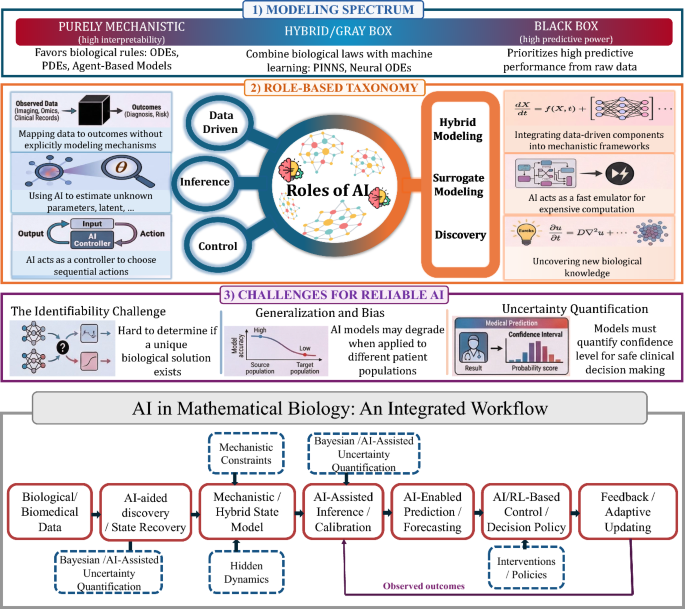
How AI Can Advance Mathematical Biology: Opportunities, Challenges, and Future Directions
Mathematical biology has long relied on mechanistic models, including ordinary and partial differential equations, stochastic systems, and agent-based models, to study biological processes across scales. These approaches remain central because they provide structure, interpretability, and biological insight. However, modern biological and biomedical data, including longitudinal clinical records, medical imaging, and multi-omics measurements, are often high-dimensional, noisy, heterogeneous, and incomplete. These features make model calibration, simulation, and uncertainty quantification increasingly difficult. As a result, artificial intelligence (AI) and machine learning (ML) are playing a growing role in mathematical biology, not as replacements for mechanistic modeling, but as complementary tools that can support prediction, hybrid modeling, inference, and control. In this review, we organize these uses of AI from a mathematical biology perspective and examine how data-driven and mechanistic approaches interact across different modeling tasks. The selected examples span biomedical, epidemiological, ecological, evolutionary, biochemical, and population-level systems, while the review is intended to be representative rather than exhaustive. We emphasize recurring challenges that strongly affect biological credibility and practical usefulness, including interpretability, identifiability, generalization, and uncertainty quantification. Our goal is to clarify the roles AI can play in mathematical biology and to highlight the opportunities and limitations that arise when flexible learning methods are integrated with biologically grounded modeling.