AI systems have attained superhuman performance across various domains. If the hidden knowledge encoded in these highly capable systems can be leveraged, human knowledge and performance can be advanced. Yet, this internal knowledge is difficult to extract. Due to the vast space of possible internal representations, searching for meaningful new conceptual knowledge can be like finding a needle in a haystack. Here, we introduce a method that extracts new chess concepts from AlphaZero, an AI system that mastered chess via self-play without human supervision. Our method excavates vectors that represent concepts from AlphaZero’s internal representations using convex optimization, and filters the concepts based on teachability (whether the concept is transferable to another AI agent) and novelty (whether the concept contains information not present in human chess games). These steps ensure that the discovered concepts are useful and meaningful. For the resulting set of concepts, prototypes (chess puzzle–solution pairs) are presented to experts for final validation. In a preliminary human study, four top chess grandmasters (all former or current world chess champions) were evaluated on their ability to solve concept prototype positions. All grandmasters showed improvement after the learning phase, suggesting that the concepts are at the frontier of human understanding. Despite the small scale, our result is a proof of concept demonstrating the possibility of leveraging knowledge from a highly capable AI system to advance the frontier of human knowledge; a development that could bear profound implications and shape how we interact with AI systems across many applications.
Scalable decision-making for games of imperfect information
Real-world decision-making generally involves hidden information, that is, information that is unknown to one agent but possessed by another. Unfortunately, the presence of large amounts of hidden information renders established reinforcement learning and search approaches ineffective. Even with multimillion-dollar industrial research efforts1, top-human-level play at Stratego—a board wargame with hidden information on a massive scale—has remained beyond the reach of artificial intelligence (AI). Here we introduce Ataraxos, an AI for Stratego based on general techniques that we developed for both self-play reinforcement learning and test-time search under hidden information. Ataraxos defeated the most decorated human Stratego player of all time by a large margin—achieving, to our knowledge, the first superhuman result in the game’s history—while consuming orders of magnitude less compute and data than previous efforts. Using the same techniques, we built a superhuman AI for Barrage Stratego and state-of-the-art AIs for Hanabi and dou dizhu, all with low cost and high sample efficiency. The success of this approach across adversarial, cooperative and team games establishes a design pattern for reinforcement learning and search that is effective under large amounts of hidden information, a longstanding desideratum of the field of strategic decision-making.

Propagation and preservation of AI-discovered problem-solving strategies in human culture
Intelligent machines have the potential to uncover problem-solving strategies beyond human discovery. Emerging evidence from competitive gameplay, such as Go and chess, demonstrates that AI systems are evolving from mere tools to sources of cultural innovation adopted by humans. However, the conditions under which intelligent machines transition from tools to drivers of persistent cultural change remain unclear. We identify three key dimensions that modulate machine influence on human problem-solving: the discovered strategies must be non-trivial, learnable, and offer a clear advantage. Using a cultural transmission experiment, we demonstrate that when these conditions are met, machine-discovered strategies can be transmitted, understood, and preserved by human populations, leading to enduring cultural shifts. Conversely, using agent-based simulations, we show how machine influence is constrained in the absence of these conditions. These findings provide a framework for understanding how machines can persistently expand human cognitive skills and underscore the need to consider their broader implications for human cognition and cultural evolution.

Hybrid social learning in human-algorithm cultural transmission
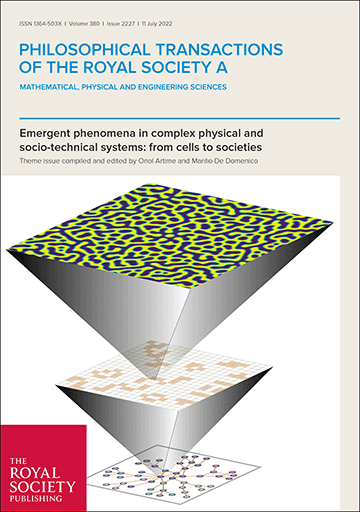
Humans are impressive social learners. Researchers of cultural evolution have studied the many biases shaping cultural transmission by selecting who we copy from and what we copy. One hypothesis is that with the advent of superhuman algorithms a hybrid type of cultural transmission, namely from algorithms to humans, may have long-lasting effects on human culture. We suggest that algorithms might show (either by learning or by design) different behaviours, biases and problem-solving abilities than their human counterparts. In turn, algorithmic-human hybrid problem solving could foster better decisions in environments where diversity in problem-solving strategies is beneficial. This study asks whether algorithms with complementary biases to humans can boost performance in a carefully controlled planning task, and whether humans further transmit algorithmic behaviours to other humans. We conducted a large behavioural study and an agent-based simulation to test the performance of transmission chains with human and algorithmic players. We show that the algorithm boosts the performance of immediately following participants but this gain is quickly lost for participants further down the chain. Our findings suggest that algorithms can improve performance, but human bias may hinder algorithmic solutions from being preserved. This article is part of the theme issue ‘Emergent phenomena in complex physical and socio-technical systems: from cells to societies’.
Hyperagents
Self-improving AI systems aim to reduce reliance on human engineering by learning to improve their own learning and problem-solving processes. Existing approaches to self-improvement rely on fixed, handcrafted meta-level mechanisms, fundamentally limiting how fast such systems can improve. The Darwin Gödel Machine (DGM) demonstrates open-ended self-improvement in coding by repeatedly generating and evaluating self-modified variants. Because both evaluation and self-modification are coding tasks, gains in coding ability can translate into gains in self-improvement ability. However, this alignment does not generally hold beyond coding domains. We introduce \textbf{hyperagents}, self-referential agents that integrate a task agent (which solves the target task) and a meta agent (which modifies itself and the task agent) into a single editable program. Crucially, the meta-level modification procedure is itself editable, enabling metacognitive self-modification, improving not only the task-solving behavior, but also the mechanism that generates future improvements. We instantiate this framework by extending DGM to create DGM-Hyperagents (DGM-H), eliminating the assumption of domain-specific alignment between task performance and self-modification skill to potentially support self-accelerating progress on any computable task. Across diverse domains, the DGM-H improves performance over time and outperforms baselines without self-improvement or open-ended exploration, as well as prior self-improving systems. Furthermore, the DGM-H improves the process by which it generates new agents (e.g., persistent memory, performance tracking), and these meta-level improvements transfer across domains and accumulate across runs. DGM-Hyperagents offer a glimpse of open-ended AI systems that do not merely search for better solutions, but continually improve their search for how to improve.

Agentic AI Needs a Systems Theory
The endowment of AI with reasoning capabilities and some degree of agency is widely viewed as a path toward more capable and generalizable systems. Our position is that the current development of agentic AI requires a more holistic, systems-theoretic perspective in order to fully understand their capabilities and mitigate any emergent risks. The primary motivation for our position is that AI development is currently overly focused on individual model capabilities, often ignoring broader emergent behavior, leading to a significant underestimation in the true capabilities and associated risks of agentic AI. We describe some fundamental mechanisms by which advanced capabilities can emerge from (comparably simpler) agents simply due to their interaction with the environment and other agents. Informed by an extensive amount of existing literature from various fields, we outline mechanisms for enhanced agent cognition, emergent causal reasoning ability, and metacognitive awareness. We conclude by presenting some key open challenges and guidance for the development of agentic AI. We emphasize that a systems-level perspective is essential for better understanding, and purposefully shaping, agentic AI systems.
Discovering and transmitting abstract knowledge over generations
The complexity of human culture depends on people's ability to discover and transmit abstract knowledge. Studying this ability is crucial to understanding humans' distinctive place among species, but current experimental paradigms focus on the cultural transmission of specific, concrete facts rather than generalizable abstract knowledge. In this paper, we develop a crafting game paradigm to study how people discover abstract knowledge and transmit it via language. We compared individuals playing this game for 40 rounds to chains of four participants playing for 10 rounds each and passing messages to each other sequentially. The individuals performed significantly better over rounds, but the chains did not. Through simulations with language model agents and a follow-up experiment, we find substantial variation in the helpfulness of participants' messages, which may explain the lack of consistent improvement in chains. The ability to learn selectively from the good messages may be essential for improvement over generations.

Learning to solve complex tasks by growing knowledge culturally across generations
Knowledge built culturally across generations allows humans to learn far more than an individual could glean from their own experience in a lifetime. Cultural knowledge in turn rests on language: language is the richest record of what previous generations believed, valued, and practiced, and how these evolved over time. The power and mechanisms of language as a means of cultural learning, however, are not well understood, and as a result, current AI systems do not leverage language as a means for cultural knowledge transmission. Here, we take a first step towards reverse-engineering cultural learning through language. We developed a suite of complex tasks in the form of minimalist-style video games, which we deployed in an iterated learning paradigm. Human participants were limited to only two attempts (two lives) to beat each game and were allowed to write a message to a future participant who read the message before playing. Knowledge accumulated gradually across generations, allowing later generations to advance further in the games and perform more efficient actions. Multigenerational learning followed a strikingly similar trajectory to individuals learning alone with an unlimited number of lives. Successive generations of learners were able to succeed by expressing distinct types of knowledge in natural language: the dynamics of the environment, valuable goals, dangerous risks, and strategies for success. The video game paradigm we pioneer here is thus a rich test bed for developing AI systems capable of acquiring and transmitting cultural knowledge.
Cognitive Architectures for Language Agents
Recent efforts have augmented large language models (LLMs) with external resources (e.g., the Internet) or internal control flows (e.g., prompt chaining) for tasks requiring grounding or reasoning, leading to a new class of language agents. While these agents have achieved substantial empirical success, we lack a framework to organize existing agents and plan future developments. In this paper, we draw on the rich history of cognitive science and symbolic artificial intelligence to propose Cognitive Architectures for Language Agents (CoALA). CoALA describes a language agent with modular memory components, a structured action space to interact with internal memory and external environments, and a generalized decision-making process to choose actions. We use CoALA to retrospectively survey and organize a large body of recent work, and prospectively identify actionable directions towards more capable agents. Taken together, CoALA contextualizes today’s language agents within the broader history of AI and outlines a path towards language-based general intelligence.
Look-ahead Reasoning with a Learned Model in Imperfect Information Games
Test-time reasoning significantly enhances pre-trained AI agents' performance. However, it requires an explicit environment model, often unavailable or overly complex in real-world scenarios....
The Phoenix Architecture
Generative AI coding demands what we've always known: modularity, clear boundaries, disposable components. Principles that scaled human teams are now table stakes. Here, we make the implicit explicit
Letta
Making machines that learn. Create stateful agents that remember everything, learn continuously, and improve themselves over time.

Human learning is an understudied but promising lever for boosting human–AI synergy
Humans collaborating with AI hold the promise of achieving superior outcomes compared to either acting alone (i.e., human–AI synergy). However, the conditions that facilitate such synergy when humans are advised by AI are not well understood. A recent meta-analysis showed that, on average, human–AI combinations do not outperform the better individual agent. We argue that this pessimistic conclusion arises from insufficient attention to human learning in experimental designs. To substantiate this claim, we reanalyzed all 74 studies included in the original meta-analysis and found that most previous research overlooked design features that foster human learning (e.g., outcome feedback to participants). Our reanalysis further revealed that studies providing outcome feedback show tentatively higher synergy than those without outcome feedback. Crucially, feedback paired with AI explanations was associated with positive synergy, while explanations without feedback were associated with negative synergy—suggesting that explanations improve synergy mainly when humans can learn to verify the AI’s reliability through feedback. Our reanalysis suggests that the current literature underestimates the potential of human–AI collaboration because it predominantly relies on paradigms that do not facilitate human learning, thus hindering humans from effectively adapting their collaboration strategies. However, experiments directly varying learning opportunities are needed for stronger, causal conclusions. We advocate for a paradigm shift in human–AI interaction research that explicitly addresses human learning and thus enhances our understanding of and support for successful human–AI collaboration.

The Hitchhiker's Guide to Agentic AI: From Foundations to Systems
The Hitchhiker's Guide to Agentic AI is a comprehensive practitioner's reference for building autonomous AI systems. The book covers the full stack from first principles to production deployment, organized around a central thesis: building great agentic systems requires understanding every layer of the pipeline, not just one. The book opens with the LLM substrate -- transformer architecture, GPU systems, training and fine-tuning (SFT,LoRA, MoE), model compression, and inference optimization -- treated as essential foundations rather than the primary focus. It then develops the alignment and reasoning layer: reinforcement learning from human feedback (RLHF), PPO, DPO and its variants, GRPO, reward modeling, and RL for large reasoning models including chain-of-thought and test-time scaling. The second half is devoted to agentic AI proper. Topics include agentic training and trajectory-based RL, retrieval-augmented generation (RAG and Agentic RAG), memory systems (in-context, external, episodic, and semantic), agent harness design and context management, and a taxonomy of agent design patterns. Inter-agent coordination is covered in depth: the Model Context Protocol (MCP), agent skills and tool use, the Agent-to-Agent (A2A) communication protocol, and multi-agent architectures spanning centralized, decentralized, and hierarchical topologies. The book concludes with agent development frameworks, agentic UI design, evaluation methodology for agentic tasks, and production deployment. Each chapter pairs rigorous theoretical foundations with implementation guidance, code examples, and references to the primary literature.
Introduction to Agents
Discover what actually works in AI. Join millions of builders, researchers, and labs evaluating agents, models, and frontier technology through crowdsourced benchmarks, competitions, and hackathons.