


The question of whether language affects perception has been debated largely on the basis of cross-language data, without considering the functional organization of the brain. The nature of this neural organization predicts that, if language affects perception, it should do so more in the right visual field than in the left visual field, an idea unexamined in the debate. Here, we find support for this proposal in lateralized color discrimination tasks. Reaction times to targets in the right visual field were faster when the target and distractor colors had different names; in contrast, reaction times to targets in the left visual field were not affected by the names of the target and distractor colors. Moreover, this pattern was disrupted when participants performed a secondary task that engaged verbal working memory but not a task making comparable demands on spatial working memory. It appears that people view the right (but not the left) half of their visual world through the lens of their native language, providing an unexpected resolution to the language-and-thought debate.
Deficient executive control in transformer attention
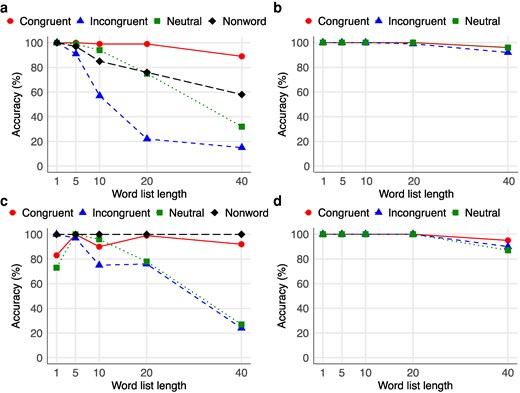
Abstract Although transformers in large language models (LLMs) effectively implement a self-attention mechanism that has revolutionized natural language processing, they lack an explicit architecture for the executive control of attention found in humans, which is essential for resolving conflicts and selecting relevant information in the presence of competing computations and is critical for adaptive behavior. To investigate the impact of this limitation in LLMs, we employed the classic color Stroop task, widely regarded as the gold standard, to test the executive control of attention in these models. Our results revealed a typical conflict effect of underperformance in terms of accuracy in the incongruent condition (e.g. naming the color of the word RED in blue) compared with the congruent condition (e.g. naming the color of the word RED in red), in short word lists, similar to human performance. However, as the length of the word lists increased, performance on the incongruent condition degraded toward near-total performance collapse, even as accuracy in the congruent condition remained excellent, and word reading (e.g. reading the word RED [in red] or RED [in blue], ignoring the color) was near-perfect. These findings demonstrate that transformer attention mechanisms are fundamentally limited in their capacity for conflict resolution across extended contexts, and a failure to up-regulate control adaptively under rising interference. We suggest that incorporating executive control mechanisms akin to those in biological attention is crucial for achieving artificial general intelligence.
A computational account of conflict processing during mental imagery
Previous studies examining conflict processing within the context of a color-word Stroop task have focused on both stimulus and response conflicts. However, it has been unclear whether conflict can emerge independently of stimulus conflict. In this study, a novel arrow-gaze mental-rotation Stroop task was introduced to explore the interplay between conflict processing and mental rotation. A modelling approach was utilized to provide a process-level account of the findings. The results of our Stroop task indicate that conflict can emerge from mental rotation in the absence of stimulus conflict. The strength of this imagery conflict effect decreases and even reverses as mental rotation angles increase. Additionally, it was observed that participants responded more quickly and with greater accuracy to small rather than large face orientations. A comparison of three conflict diffusion models—the diffusion model for conflict tasks (DMC), the dual-stage two-phase model (DSTP), and the shrinking spotlight model (SSP)—yielded consistent support for the DSTP over the DMC and SSP in the majority of instances. The DSTP account of the experimental results revealed an increased nondecision time with increasing mental rotation, a reduction in interference from incompatible stimuli, and an improved drift rate in response selection phase, which suggests enhanced cognitive control. The findings from the model-based analysis provide evidence for a novel interaction between cognitive control and mental rotation.

Our Language Affects What We See
A new look at “the Russian blues” demonstrates the power of words to shape perception

Verbalizable Representations Form a Global Workspace in Language Models
If the mind is an ocean, we spend our lives floating at the surface. Beneath us, an enormous amount of processing takes place without our knowledge: our visual systems parsing the contours of a face, our motor circuits maintaining our posture. At any given moment, only a small fraction of this neural activity is accessible to us. Yet it is this privileged sliver of activity that we rely on to reason deliberately: to plan what ingredients to buy for a recipe, or to puzzle out why an engine won’t start. Such thoughts can be articulated out loud, deliberately held in mind, and brought to bear on whatever task the moment demands. This distinction, between our accessible thoughts and our unconscious processing, is perhaps the most striking feature of human cognition.
How Language Seems To Shape One's View Of The World
Research suggests that speaking another language fluently changes what you pay attention to and how you remember events. But some say the idea that language can make you see and think differently is overblown.

The Psychology of Language: Why Are Some Words More Persuasive Than Others?
What's actually going on in the brain when it processes language? And if words affect the mind in different ways, are some more persuasive than others

Understanding the Limits of Vision Language Models Through the Lens of the Binding Problem
Recent work has documented striking heterogeneity in the performance of state-of-the-art vision language models (VLMs), including both multimodal language models and text-to-image models. These models are able to describe and generate a diverse array of complex, naturalistic images, yet they exhibit surprising failures on basic multi-object reasoning tasks -- such as counting, localization, and simple forms of visual analogy -- that humans perform with near perfect accuracy. To better understand this puzzling pattern of successes and failures, we turn to theoretical accounts of the binding problem in cognitive science and neuroscience, a fundamental problem that arises when a shared set of representational resources must be used to represent distinct entities (e.g., to represent multiple objects in an image), necessitating the use of serial processing to avoid interference. We find that many of the puzzling failures of state-of-the-art VLMs can be explained as arising due to the binding problem, and that these failure modes are strikingly similar to the limitations exhibited by rapid, feedforward processing in the human brain.

Watch a thought race across the surface of the brain | TechCrunch
Although neuroscientists have a general idea of what parts of the brain do what, catching them in the act is a difficult proposition. But UC Berkeley researchers have managed to do it, visualizing based on direct measurement the path of a single thought (or at least thread) through the brain.

Keeping actively bilingual makes our brains more efficient at relaying information
There is increasing evidence that bilingualism can affect how the brain works. Older, lifelong bilinguals have demonstrated better cognitive skills in tasks that require increased cognitive control. These…

Guessing reveals internal models of perceptual precision
When observers lack sufficient information to support a confident response, they often guess. Guessing plays a pervasive role in visual cognition and working memory, yet the mechanisms that govern how observers generate guesses remain poorly understood. Standard models traditionally assume that responses produced in the absence of information are either uniformly distributed over feature space or are perhaps weighted towards prevailing environmental statistics. In contrast, here we consider an intriguing alternative: that guesses incorporate observers’ knowledge of their own perceptual capacities. We empirically measured guessing by eliciting responses under extreme target uncertainty (Experiment 1) as well as a novel “0ms presentation” approach in which no stimulus appeared but subjects believed one had (Experiment 2). We evaluated three accounts of guesses under these conditions: unsystematic (lapse) responding, biases toward environmental statistics, and a self-representational account in which guesses reflect observers’ knowledge of their own feature-dependent precision (e.g., preferring to guess feature values they believe they would be likely to miss). Guess responses were non-uniform and systematically biased toward feature values typically encoded with the least precision (e.g., oblique orientations) — a counterintuitive bias away from high-frequency, high-fidelity feature values (e.g., cardinal orientations). This complementary relationship between guessing and perceptual fidelity held within individuals and across paradigms, and was recoverable via an empirical-guess mixture model that replaced the standard uniform assumption with empirically measured guess distributions. Our findings challenge prevailing views that guesses reflect random noise, and suggest instead that guessing behavior reflects metacognitive knowledge of internal precision. Rather than defaulting to environmental priors, observers appear to model their own sensory limitations and leverage these representations to inform decisions in the absence of evidence. These results reframe guessing as a theoretically informative behavior that expresses observers’ own beliefs about their perceptual capacities. Significance Guessing is commonly treated as random noise in models of perception and memory, assumed to reflect lapses or uninformed responses. Instead, we show that human guesses are systematically structured across feature space: observers preferentially guess values they typically encode with the least precision, revealing a consistent, strategic bias away from high-fidelity representations. By directly measuring guess behavior on stimulus-absent trials and integrating these empirical distributions into a mixture model, we find that guesses on stimulus-present trials can be systematically recovered, and that they too form the complement of perceptual precision. These findings challenge foundational psychophysical modeling assumptions and position guessing as a strategic, informative behavior that engages self-representation.

You Don’t Need Words to Think
Brain studies show that language is not essential for the cognitive processes that underlie thought

How thinking in a foreign language improves decision-making
Research shows people who speak another language are more utilitarian and flexible, less risk-averse and egotistical, and better able to cope with traumatic memories

The link between language and cognition is a red herring | Aeon Ideas
Humans alone have language, but many animals clearly have consciousness. Are parallels between the two a red herring?

What does it mean for culture to ‘shape’ cognition?
Human culture and cognition vary widely across groups, but how exactly culture ‘shapes’ cognition remains underspecified. In this review, we outline four qualitatively different pathways by which culture can shape cognition. In this framework, culture can (i) privilege some cognitive processes, while leaving alternative processes intact; (ii) prune unused alternative processes, which are irretrievably lost; (iii) produce new cognitive processes; or (iv) have no effect on cognition at all. To illustrate the utility of this framework, we apply it to three debated effects of culture on cognitive processes, namely, visual illusions, large exact number abilities, and spatial–numerical associations. The distinctions we propose can serve to reframe long-standing debates, sharpen empirical predictions, and open new avenues of research in cognitive diversity.
