


Physical laws—such as the laws of motion, gravity, electromagnetism, and thermodynamics—codify the general behavior of varied macroscopic natural systems across space and time. We propose that an additional, hitherto-unarticulated law is required to characterize familiar macroscopic phenomena of our complex, evolving universe. An important feature of the classical laws of physics is the conceptual equivalence of specific characteristics shared by an extensive, seemingly diverse body of natural phenomena. Identifying potential equivalencies among disparate phenomena—for example, falling apples and orbiting moons or hot objects and compressed springs—has been instrumental in advancing the scientific understanding of our world through the articulation of laws of nature. A pervasive wonder of the natural world is the evolution of varied systems, including stars, minerals, atmospheres, and life. These evolving systems appear to be conceptually equivalent in that they display three notable attributes: 1) They form from numerous components that have the potential to adopt combinatorially vast numbers of different configurations; 2) processes exist that generate numerous different configurations; and 3) configurations are preferentially selected based on function. We identify universal concepts of selection—static persistence, dynamic persistence, and novelty generation—that underpin function and drive systems to evolve through the exchange of information between the environment and the system. Accordingly, we propose a “law of increasing functional information”: The functional information of a system will increase (i.e., the system will evolve) if many different configurations of the system undergo selection for one or more functions.
AI-Newton: A Concept-Driven Physical Law Discovery System without Prior Physical Knowledge
While current AI-driven methods excel at deriving empirical models from individual experiments, a significant challenge remains in uncovering the common fundamental physics that underlie these models -- a task at which human physicists are adept. To bridge this gap, we introduce AI-Newton, a novel framework for concept-driven scientific discovery. Our system autonomously derives general physical laws directly from raw, multi-experiment data, operating without supervision or prior physical knowledge. Its core innovations are twofold: (1) proposing interpretable physical concepts to construct laws, and (2) progressively generalizing these laws to broader domains. Applied to a large, noisy dataset of mechanics experiments, AI-Newton successfully rediscovers foundational and universal laws, such as Newton's second law, the conservation of energy, and the universal gravitation. This work represents a significant advance toward autonomous, human-like scientific discovery.

Emergence: the remarkable simplicity of complexity
From the fractal patterns of snowflakes to cellular lifeforms, our universe is full of complex phenomena – but how does this complexity arise? “Emergence” describes the ability of individual components…

Software in the natural world: A computational approach to hierarchical emergence
Understanding the functional architecture of complex systems is crucial to illuminate their inner workings and enable effective methods for their prediction and control. Recent advances have introduced tools to characterise emergent macroscopic levels; however, while these approaches are successful in identifying when emergence takes place, they are limited in the extent they can determine how it does. Here we address this limitation by developing a computational approach to emergence, which characterises macroscopic processes in terms of their computational capabilities. Concretely, we articulate a view on emergence based on how software works, which is rooted on a mathematical formalism that articulates how macroscopic processes can express self-contained informational, interventional, and computational properties. This framework establishes a hierarchy of nested self-contained processes that determines what computations take place at what level, which in turn delineates the functional architecture of a complex system. This approach is illustrated on paradigmatic models from the statistical physics and computational neuroscience literature, which are shown to exhibit macroscopic processes that are akin to software in human-engineered systems. Overall, this framework enables a deeper understanding of the multi-level structure of complex systems, revealing specific ways in which they can be efficiently simulated, predicted, and controlled.
Games Demystified: Super Mario Galaxy
Want to see how Mario Galaxy created its unique gravity-based physics effects for the in-game planets? Developer Alessi analyzes and reproduces the same concepts with a playable game prototype and source code.
Dynamical independence: Discovering emergent macroscopic processes in complex dynamical systems
We introduce a notion of emergence for macroscopic variables associated with highly multivariate microscopic dynamical processes. Dynamical independence instantiates the intuition of an emergent macroscopic process as one possessing the characteristics of a dynamical system ``in its own right,'' with its own dynamical laws distinct from those of the underlying microscopic dynamics. We quantify (departure from) dynamical independence by a transformation-invariant Shannon information-based measure of dynamical dependence. We emphasize the data-driven discovery of dynamically independent macroscopic variables, and introduce the idea of a multiscale ``emergence portrait'' for complex systems. We show how dynamical dependence may be computed explicitly for linear systems in both time and frequency domains, facilitating discovery of emergent phenomena across spatiotemporal scales, and outline application of the linear operationalization to inference of emergence portraits for neural systems from neurophysiological time-series data. We discuss dynamical independence for discrete- and continuous-time deterministic dynamics, with potential application to Hamiltonian mechanics and classical complex systems such as flocking and cellular automata.
Are biological systems poised at criticality?
Many of life's most fascinating phenomena emerge from interactions among many elements--many amino acids determine the structure of a single protein, many genes determine the fate of a cell, many neurons are involved in shaping our thoughts and memories. Physicists have long hoped that these collective behaviors could be described using the ideas and methods of statistical mechanics. In the past few years, new, larger scale experiments have made it possible to construct statistical mechanics models of biological systems directly from real data. We review the surprising successes of this "inverse" approach, using examples form families of proteins, networks of neurons, and flocks of birds. Remarkably, in all these cases the models that emerge from the data are poised at a very special point in their parameter space--a critical point. This suggests there may be some deeper theoretical principle behind the behavior of these diverse systems.
Maximum power in evolution, ecology and economics
Ludwig Boltzmann suggested that natural selection was fundamentally a struggle among organisms for available energy. Alfred Lotka argued that organisms that capture and use more energy than their competition will have a selective advantage in the evolutionary process, i.e. the Darwinian notion of evolution was based on a fundamental, generalized energy principle. He extended this general principle from the energetics of a single organism or species to the energetics of entire energy pathways through ecosystems. Howard Odum and Richard Pinkerton, building on Lotka, extended this concept to ‘The maximum power principle’ and applied it to many biological and physical systems including human economies. We examine this history and how these ideas relate to concepts from other disciplines including philosophy. But there has been considerable confusion in understanding and applying these concepts which we attempt to resolve while providing various examples from routine life and discussing some unresolved issues. This article is part of the theme issue ‘Thermodynamics 2.0: Bridging the natural and social sciences (Part 2)’.

The Multiple Paths to Multiple Life
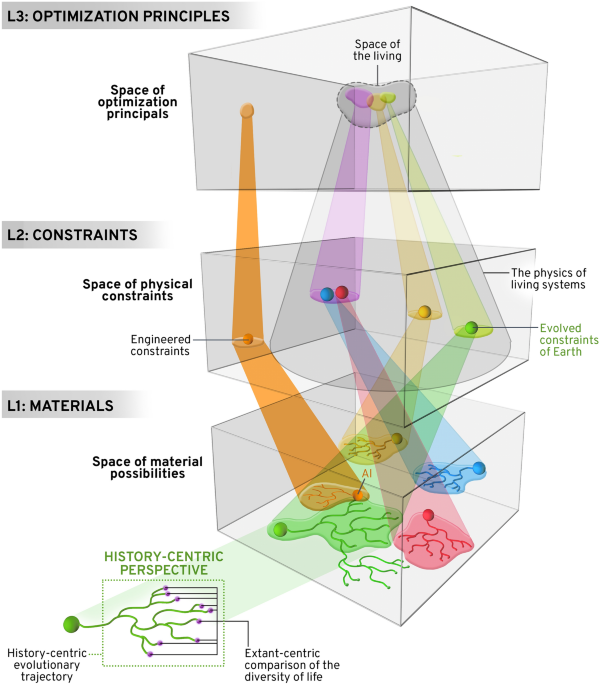
We argue for multiple forms of life realized through multiple different historical pathways. From this perspective, there have been multiple origins of life on Earth—life is not a universal homology. By broadening the class of originations, we significantly expand the data set for searching for life. Through a computational analogy, the origin of life describes both the origin of hardware (physical substrate) and software (evolved function). Like all information-processing systems, adaptive systems possess a nested hierarchy of levels, a level of function optimization (e.g., fitness maximization), a level of constraints (e.g., energy requirements), and a level of materials (e.g., DNA or RNA genome and cells). The functions essential to life are realized by different substrates with different efficiencies. The functional level allows us to identify multiple origins of life by searching for key principles of optimization in different material form, including the prebiotic origin of proto-cells, the emergence of culture, economic, and legal institutions, and the reproduction of software agents.
The Peculiar Math That Could Underlie the Laws of Nature
New findings are fueling an old suspicion that fundamental particles and forces spring from strange eight-part numbers called “octonions.”

EurekaBench: Measuring Agentic Ability to Discover New Scientific Insights
When Isaac Newton discovered the law of gravitation, he did so through an iterative process of analyzing observed data such as planetary patterns, finding the underlying mechanisms by describing patterns in mathematical equations, and refining his theory against the Moon's orbit, revealing the startling insight that the same force governs both falling apples and orbiting planets. Would it be possible for AI agents to make similar discoveries? To measure this ability, we introduce EurekaBench, a cross-domain benchmark that tests AI agents' ability to conduct long-horizon experiments and discover mechanisms that explain observations. We evaluate these mechanisms by the scientific insights that can be derived from them. EurekaBench contains an expert-verified set of 26 long-horizon tasks across neuroscience, computer science, chemistry, astrophysics, geophysics, and plasma physics, with a total of 306 scientific insights that the discovered mechanisms are expected to support. Our evaluation framework tests three axes of scientific discovery: agents' ability to follow known scientific constraints, the predictive accuracy of the discovered mechanisms, and whether these mechanisms yield scientific insights or inform future research. Our results show that current AI agents often overly fixate on predictive accuracy optimization, surpassing human scientists, while falling substantially short in deriving scientific insights.
A theory of biological relativity: no privileged level of causation
Abstract. Must higher level biological processes always be derivable from lower level data and mechanisms, as assumed by the idea that an organism is compl

Neil & Sara Imari Walker Discuss New Theories on The Origins of Life in the Universe
A hierarchy of voids: Much ado about nothing
We present a model for the distribution of void sizes and its evolution in the context of hierarchical scenarios of gravitational structure formation. We find that at any cosmic epoch the voids...
Planetary Sapience & Planetary Stupidity: a Bildungsroman for the Baby Noosphere | Antikythera
That is, the faculty of recollection and foresight? Until recently, I would argue, our planet was amnesiac. That is, no part of it was reflectively aware of the place of the present relative to the established past nor the expected future. But then peculiar animals emerged, capable—no matter how imperfectly—of cooperation, abstraction and invention. In the last blink of geologic time, through the collaboration of these animals with their increasingly cunning artifacts, this state of planetary amnesia has faltering begun being cured. That is, through our artifacts, our planet is becoming aware of its own unfolding biography. In our fallible attempts to model our world—alongside our growing legion of sensors—The Earth system has developed a way of recollecting its deepest past and tracking the changing complexities of its present so as to forecast its furthest future.
The Abstraction Fallacy: Why AI Can Simulate But Not Instantiate Consciousness
Computational functionalism dominates current debates on AI consciousness. This is the hypothesis that subjective experience emerges entirely from abstract causal topology, regardless of the underlying physical substrate. We argue this view fundamentally mischaracterizes how physics relates to information. We call this mistake the Abstraction Fallacy. Tracing the causal origins of abstraction reveals that symbolic computation is not an intrinsic physical process. Instead, it is a mapmaker-dependent description. It requires an active, experiencing cognitive agent to alphabetize continuous physics into a finite set of meaningful states. Consequently, we do not need a complete, finalized theory of consciousness to assess AI sentience—a demand that simply pushes the question beyond near-term resolution and deepens the AI welfare trap. What we actually need is a rigorous ontology of computation. The framework proposed here explicitly separates simulation (behavioral mimicry driven by vehicle causality) from instantiation (intrinsic physical constitution driven by content causality). Establishing this ontological boundary shows why algorithmic symbol manipulation is structurally incapable of instantiating experience. Crucially, this argument does not rely on biological exclusivity. If an artificial system were ever conscious, it would be because of its specific physical constitution, never its syntactic architecture. Ultimately, this framework offers a physically grounded refutation of computational functionalism to resolve the current uncertainty surrounding AI consciousness.
