


The bloc should green-light a “fully fledged intelligence cooperation service at the EU level,” said former Finnish President Sauli Niinistö in a sweeping new report.
Europe’s spies are learning to trust each other — thanks to Trump
Doubts over transatlantic intelligence-sharing is bringing European intelligence agencies closer together.

Tell Congress to Say No to Warrantless AI Mass Surveillance
The War on Terror-era legislation that authorized decades of civil liberties-eroding mass surveillance expired June 12. . Congress has a choice to make before they reauthorize this bill: will they greenlight warrantless mass surveillance of American citizens, or uphold the Constitution and prevent more of Trump's authoritarian powergrabs? Section 702 of the Foreign Intelligence Surveillance Act (FISA) was passed in 2008 as a counterterrorist measure, but has a long history of abuse from the federal government, especially when it comes to surveillance. Congress has a choice to make: Will they greenlight warrantless mass surveillance, or hold the line and reject any effort to move forward without serious privacy guardrails. FISA as it is currently written: Allows warrantless backdoor surveillance of people in and out of the country Offers little to no protections against the administration targeting critics, activists, religious minorities, or communities of color Actively chills our freedoms of speech and association Two years ago, this reauthorization legislation sailed through Congress with bipartisan support. That can’t happen again. Democratic leadership and members must hold the line for our civil liberties. And any Democrat or Republican voting for unfettered spying on US citizens should hear from their constituents. Let your Members of Congress know you expect them to reject reauthorization unless it includes significant reforms to protect our civil liberties against this authoritarian regime.

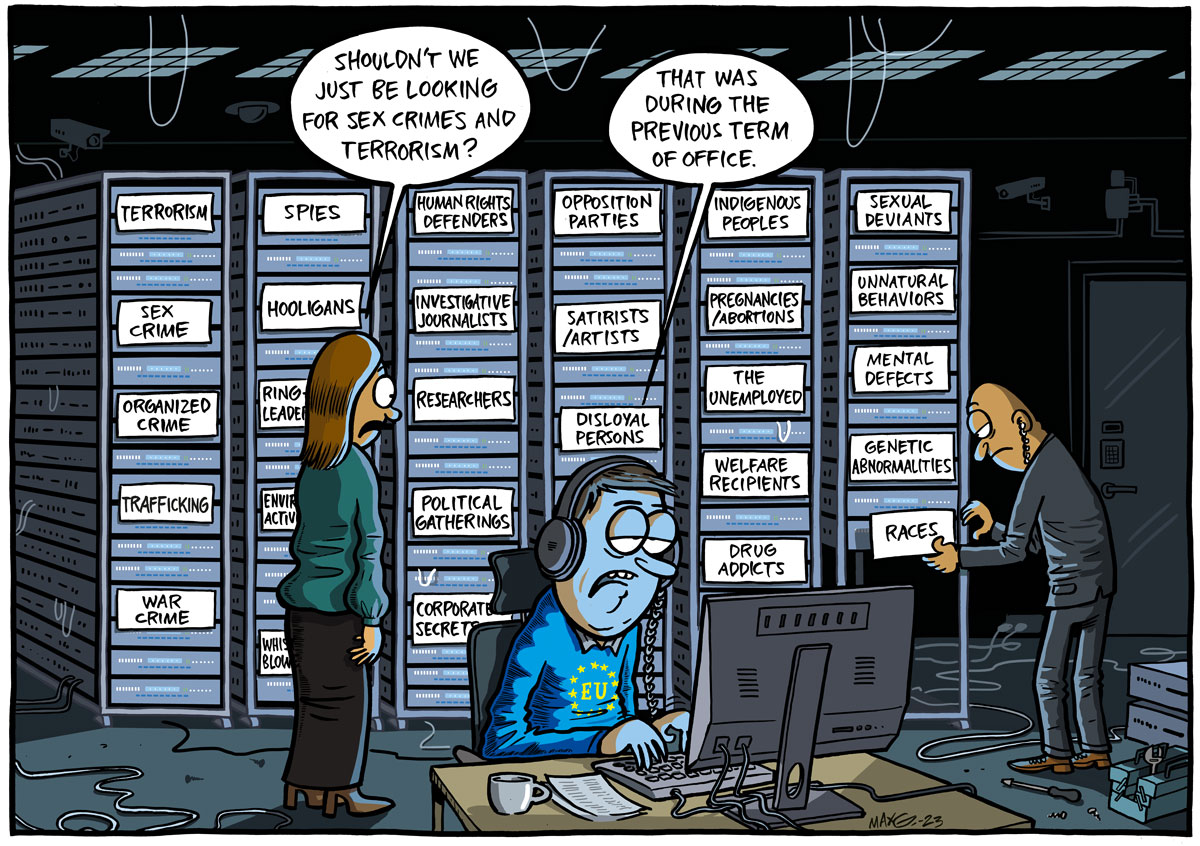
Chat Control & Going Dark: The war on encryption is on the rise. Through a shady collaboration between the US and the EU.
After Snowden’s whistleblowing in 2013, large parts of the internet became encrypted, enabling private and secure communication. Not everyone has welcomed this change. Most notably, the FBI and other U.S. government agencies have fought what is often called the “crypto wars”, the war on encryption. In recent years, they have been joined by the European Commission. Under the slogan “what about the children,” they try to introduce total mass surveillance of all EU citizens — first through the proposed Chat Control legislation, and later via the Going Dark and ProtectEU initiatives. The goal is to legally mandate spy tools on every European smartphone and computer. The forces behind these efforts have turned out to be American tech companies and intelligence agencies.
Incoming Dutch coalition floats European version of ‘Five Eyes’
New government says rising threats require faster and more proactive intel services.

Elena Rossini 🌈 (@_elena@mastodon.social)
Attached: 1 image This was definitely NOT on my bingo card for this year: European Commission president Ursula von der Leyen taking a moment between G7 meetings to promote the launch of the closed-source, for-profit network #WSocial. 🔗 : https://web.archive.org/web/20260617083436/https://www.linkedin.com/posts/rentzhog_kind-of-cool-to-see-ursula-von-der-leyen-ugcPost-7472769475885461504-hwct/ I fear this may be a harbinger of things to come: MANDATORY AGE VERIFICATION for social media across Europe. I hope I'm wrong on this. #privacy #SurveillanceCapitalism #EUBigTech
IBM and Red Hat Expand Lightwell with New Offerings to Build the Trust Infrastructure for AI-Era Open Source
Developed with leading global financial institutions and backed by a growing partner ecosystem, the new Lightwell offerings from IBM and Red Hat help enterprises reduce open source risk without disruptive upgrades.

Defense Intelligence: Comprehensive Plan Needed to Improve Stakeholder Engagement in the Development of New Military Intelligence System
Intelligence collected on foreign militaries is critical for the U.S. military. The Defense Intelligence Agency's database for this intelligence doesn...

Ready for Farage? ICE’s tech enablers are already embedded in the British state
Palantir, Anduril, Cellebrite and others supply America’s deportation machine. They also hold UK contracts with the Home Office, MoD and police – offering surveillance capabilities that a Reform government would inherit. Max Colbert reports

European Commission (@EUCommission@ec.social-network.europa.eu)
Attached: 1 image A strong Europe needs independent digital spaces. We believe true digital sovereignty thrives on a competitive, contestable, open ecosystem where diverse platforms co-exist. Today, we’re expanding our presence to W, the new social media. By being on W, we want to boost alternatives and support all efforts toward a decentralised web. And we continue to invest into our presence on the Fediverse!

EDISON BROWSER
The National Police, National Unit, National Information Organisation Service, can not be held accountable for any damage caused by the use of Edison software! Copyright 2021, The National Police, National Unit, National Information Organisation Service, The Netherlands. Version 2.1.160 (Oct. 21, 2025, 11:30 a.m.)
Green economic planning as ‘directed entanglement’
Sustainability transformations depend on ambitious state action. We propose green economic planning as a framework for states to set ambitious climate plans and ensure policy coherence across three dimensions: inputs (sources of information, planning directors, and political regimes), processes (technical expertise and political negotiation), and outputs (monetary-financial, fiscal, and state ownership strategies). To capture how green economic planning works across democratic and authoritarian institutions, we conducted a comparative case study of three countries. France’s intersectoral non-green and Denmark’s sectoral green planning covers democratic institutions, while China’s intersectoral green planning covers authoritarian institutions. Through these cases, we show that 1) green economic planning is both feasible and adaptable across diverse political economies, 2) effective planning requires balancing decentralized information flow with strong central coordination, 3) successful planning depends on managing tensions between autonomous planning agencies, market discipline, and long-term political legitimacy. We term this ‘directed entanglement,’ positioning it as a cornerstone for the emerging research agenda on green economic planning—a blueprint for navigating the use of the state to steer a green transition under capitalism.n analytical framework of elite and resistant imaginaries to trace how these actors construct competing futures of platform labour in EU regulation. These imaginaries transpire in response to the reorganisation of labour relations amidst the digital transformation of socioeconomic institutions. They reveal how platform infrastructures challenge institutional boundaries and reshape the governance of work in the EU. Through a qualitative methodology that combines critical thematic and discourse analysis of stakeholder submissions, the study investigates the frictions that transpire when elite and resistant imaginaries encounter one another. The inductive framework of ‘elite’ and ‘resistant’ imaginaries of platform work illuminates the strategic negotiation of categories and its evolution throughout the policymaking process. The research contributes to scholarship on digital labour and the governance of platforms and algorithmic systems within the EU by offering a critical communications account of how competing imaginaries interact within the regulatory infrastructures of the digital economy. The central empirical contribution of the project lies in re-situating regulatory arbitrage through the analytical lens of elite/resistant imaginaries and discursive friction. The analysis demonstrates how BusinessEurope takes advantage of longstanding techniques of regulatory escape, such as burden shifting and legal fragmentation, and combines them with the systemic structural asymmetries within the European single market to incentivise lenience for platform self-governance models and soft law (Scharpf, 1999). By analysing digital transformation and status classification, the thesis demonstrates how the future of the platform labour economy is co-constructed through frictions that culminate in a sophisticated arbitrage strategy, organised around the ontological construction of the platform as an ‘intermediary’ (Gillespie, 2010). The next chapter discusses the conceptual map of regulatory arbitrage in the PWD as a critical output of the research and considers the limitations of this project, and the future trajectory of trade union discourse on platform work.
FR#166 – No Change
Many people in Europe see the open social web as a path to digital sovereignty. This week demonstrated a problem: the assumption that European governments actually want to be sovereign.

The Sovereign Tech Agency is doing something special: we invest in and support the open digital infrastructure that modern economies and societies rely on. We’re currently #hiring for several roles: - HR Generalist - Program Manager #SovereignTechFund - Executive Assistant #digitalsovereignty 1/2
Interesting approach by the @ec.europa.eu to just ignore their own scientific service (JRC), which only 8w ago explicitly recommended to support @eurosky.social in this paper: publications.jrc.ec.europa.eu/repository/handle/JRC144603

European Commission
We have now joined W, a new European social media network. We’re present on 15+ platforms, and are especially happy to join one based in Europe and with the ambition to foster open and safer online conversations. Keep the conversation going - whether from W, Bluesky or other compatible apps.
Interesting approach by the @ec.europa.eu to just ignore their own scientific service (JRC), which only 8w ago explicitly recommended to support @eurosky.social in this paper: publications.jrc.ec.europa.eu/repository/handle/JRC144603
European Commission
We have now joined W, a new European social media network. We’re present on 15+ platforms, and are especially happy to join one based in Europe and with the ambition to foster open and safer online conversations. Keep the conversation going - whether from W, Bluesky or other compatible apps.

