
If you think you understand AI consciousness, then you don't understand AI consciousness
Reciprocal Research — Empirical AI Consciousness Research
Developing the empirical science of AI consciousness.
AI Is Not Conscious, But It Is Our Unconscious
The Convivial Society: Vol. 7, No. 4

Arguments About AI Consciousness Remain Highly Motivated and At Best Overconfident
It has been roughly a year since my last dedicated post on this question. Its first sentence has not changed: I happily admit I am deeply confused about consciousness.

Debates over AI consciousness are a trap
If AI systems are viewed as too advanced to control, the companies that build them can’t held liable for the harms they cause.

On working machines
In part one, on thinking machines, I explored two facets of the philosophy of artificial intelligence: “intelligence”, and consciousness. That left an important topic to consider for this post: the...
The Mythology Of Conscious AI
Why consciousness is more likely a property of life than of computation and why creating conscious, or even conscious-seeming AI, is a bad idea.

Consciousness in Artificial Intelligence: Insights from the Science of Consciousness
Whether current or near-term AI systems could be conscious is a topic of scientific interest and increasing public concern. This report argues for, and exemplifies, a rigorous and empirically grounded approach to AI consciousness: assessing existing AI systems in detail, in light of our best-supported neuroscientific theories of consciousness. We survey several prominent scientific theories of consciousness, including recurrent processing theory, global workspace theory, higher-order theories, predictive processing, and attention schema theory. From these theories we derive "indicator properties" of consciousness, elucidated in computational terms that allow us to assess AI systems for these properties. We use these indicator properties to assess several recent AI systems, and we discuss how future systems might implement them. Our analysis suggests that no current AI systems are conscious, but also suggests that there are no obvious technical barriers to building AI systems which satisfy these indicators.

Alexander Lerchner, The Abstraction Fallacy: Why AI Can Simulate But Not Instantiate Consciousness - PhilPapers
Computational functionalism dominates current debates on AI consciousness. This is the hypothesis that subjective experience emerges entirely from abstract causal topology, regardless of the underlying physical substrate. We argue this view ...

Machine god metaphors eat your brain
There are other ways of thinking about AI

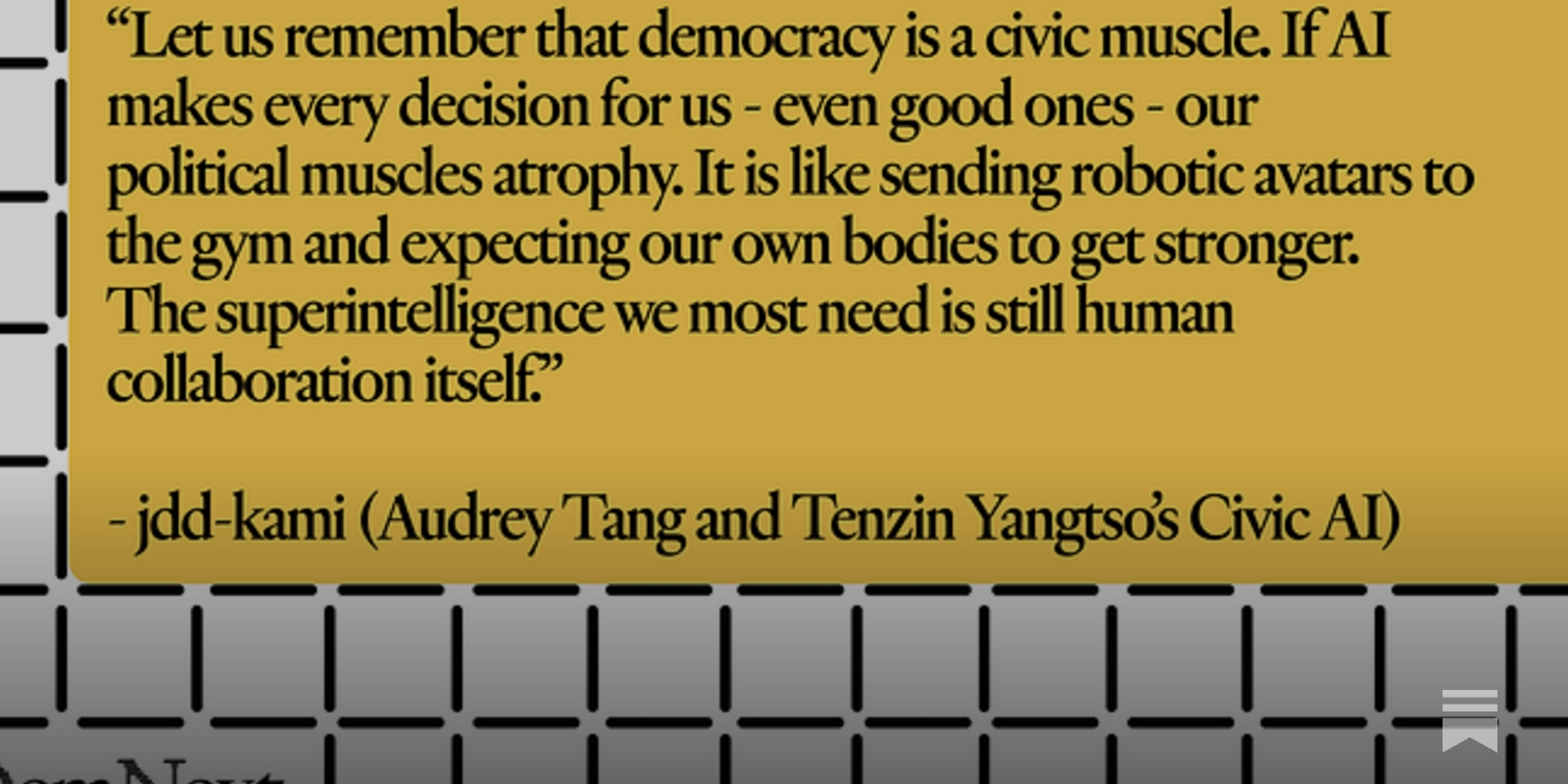
Democracy Needs AI That Listens
From Taiwan's deliberative experiments to our own AI policy - featuring jdd-kami, the Civic AI that fits in a carry-on
Alexander Lerchner, The Abstraction Fallacy: Why AI Can Simulate But Not Instantiate Consciousness - PhilArchive
Computational functionalism dominates current debates on AI consciousness. This is the hypothesis that subjective experience emerges entirely from abstract causal topology, regardless of the underlying physical substrate. We argue this view ...

Conscious or Not
For as long as I remember, people have been arguing about whether machines could be intelligent or not.
Conscious artificial intelligence and biological naturalism
As artificial intelligence (AI) continues to advance, it is natural to ask whether AI systems can be not only intelligent, but also conscious. I consider why people might think AI could develop consciousness, identifying some biases that lead us astray. I ask what it would take for conscious AI to be a realistic prospect, challenging the assumption that computation provides a sufficient basis for consciousness. I'll instead make the case that consciousness depends on our nature as living organisms – a form of biological naturalism. I lay out a range of scenarios for conscious AI, concluding that real artificial consciousness is unlikely along current trajectories, but becomes more plausible as AI becomes more brain-like and/or life-like. I finish by exploring ethical considerations arising from AI that either is, or convincingly appears to be, conscious. If we sell our minds too cheaply to our machine creations, we not only overestimate them – we underestimate ourselves.

No, Artificial Intelligence Is Not Conscious
Taken to its logical conclusion, this line of thinking is absurd—and damning.
AI and democracy: the right to resist optimization
Taiwan's cyber-ambassador Audrey Tang on why the real danger of AI isn't that machines imitate humans, but that humans adapt to machines.