

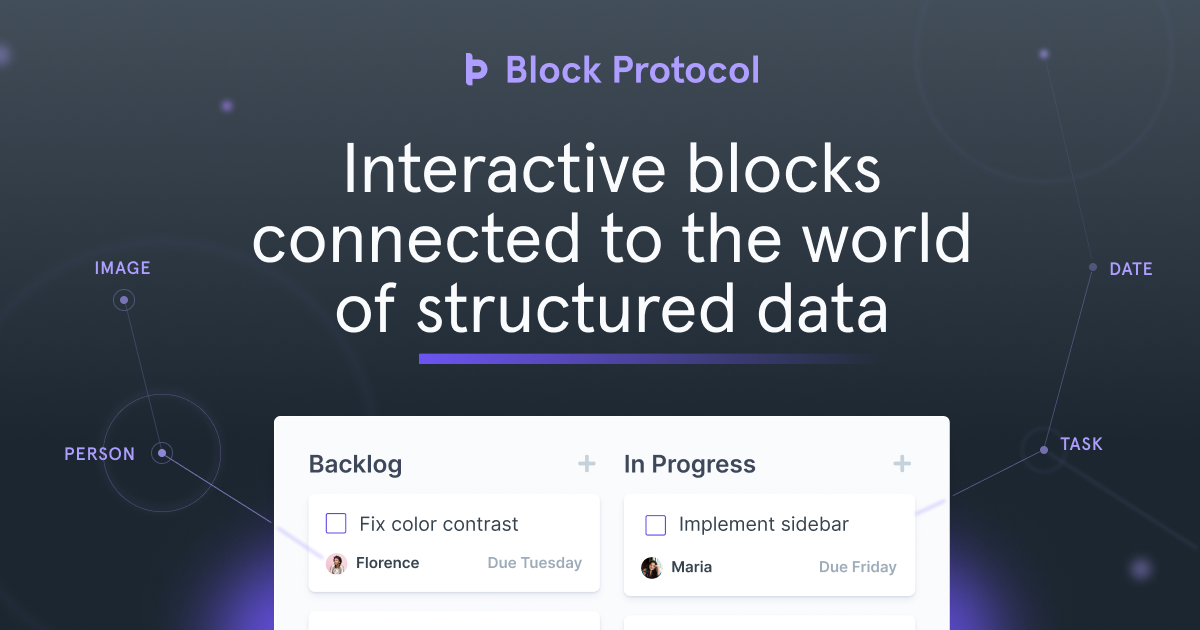
A JSON-based specification for structured block content
A Conflict-Free Replicated JSON Datatype
Many applications model their data in a general-purpose storage format such as JSON. This data structure is modified by the application as a result of user input. Such modifications are well understood if performed sequentially on a single copy of the data, but if the data is replicated and modified concurrently on multiple devices, it is unclear what the semantics should be. In this paper we present an algorithm and formal semantics for a JSON data structure that automatically resolves concurrent modifications such that no updates are lost, and such that all replicas converge towards the same state (a conflict-free replicated datatype or CRDT). It supports arbitrarily nested list and map types, which can be modified by insertion, deletion and assignment. The algorithm performs all merging client-side and does not depend on ordering guarantees from the network, making it suitable for deployment on mobile devices with poor network connectivity, in peer-to-peer networks, and in messaging systems with end-to-end encryption.
Sculpin: Direct-Manipulation Transformation of JSON
Presented at UIST 2025: PDF DOI Video
JSON Formatter & Validator
Format and validate JSON data so that it can easily be read by human beings.

DASL — Data-Addressed Structures & Links
A small set of simple, standard primitives to work on content-addressed data.

DASL — Data-Addressed Structures & Links
A small set of simple, standard primitives to work on content-addressed data.
JSON Crack - Chrome Web Store
Visualize JSON pages as an interactive graph. Toggle between raw text and an auto-generated diagram.

The control layer for AI
The industry spent two years teaching LLMs to speak JSON. That work mattered: free-form text was unusable in production. Today, every serious inference provider uses some implementation (often open-source) of structured output. Structured output has become essential infrastructure that the team at .txt is proud to have spearheaded. Even as the ecosystem evolves, and open-source alternatives emerged, our engine remains the state of the art.
The control layer for AI
The industry spent two years teaching LLMs to speak JSON. That work mattered: free-form text was unusable in production. Today, every serious inference provider uses some implementation (often open-source) of structured output. Structured output has become essential infrastructure that the team at .txt is proud to have spearheaded. Even as the ecosystem evolves, and open-source alternatives emerged, our engine remains the state of the art.
Protocol Buffers
Protocol Buffers are language-neutral, platform-neutral extensible mechanisms for serializing structured data.
standard.site/lexicons
Shared lexicon schemas for long-form publishing on AT Protocol. Uses typescript to json via prototypey.
WDC - RDFa, Microdata, and Microformat Data Sets
More and more websites have started to embed structured data describing products, people, organizations, places, and events into their HTML pages using markup standards such as Microdata, JSON-LD, RDFa, and Microformats. The Web Data Commons project extracts this data from several billion web pages. So far the project provides 12 different data set releases extracted from the Common Crawls 2010 to 2023. The project provides the extracted data for download and publishes statistics about the deployment of the different formats.
Files As Metadata Format
File structures with simple contents can be used instead of YAML, TOML or JSON. More effectively!

Concise Binary Object Representation (CBOR)
The Concise Binary Object Representation (CBOR) is a data format whose design goals include the possibility of extremely small code size, fairly small message size, and extensibility without the need for version negotiation. These design goals make it different from earlier binary serializations such as ASN.1 and MessagePack. This document obsoletes RFC 7049, providing editorial improvements, new details, and errata fixes while keeping full compatibility with the interchange format of RFC 7049. It does not create a new version of the format.
mohsen1/yek
A fast Rust based tool to serialize text-based files in a repository or directory for LLM consumption