.png?v=c8c07d4bf43b)
How we plan to manage extremely long contexts
Recursive Language Models
We propose Recursive Language Models (RLMs), an inference strategy where language models can decompose and recursively interact with input context of unbounded length through REPL environments.
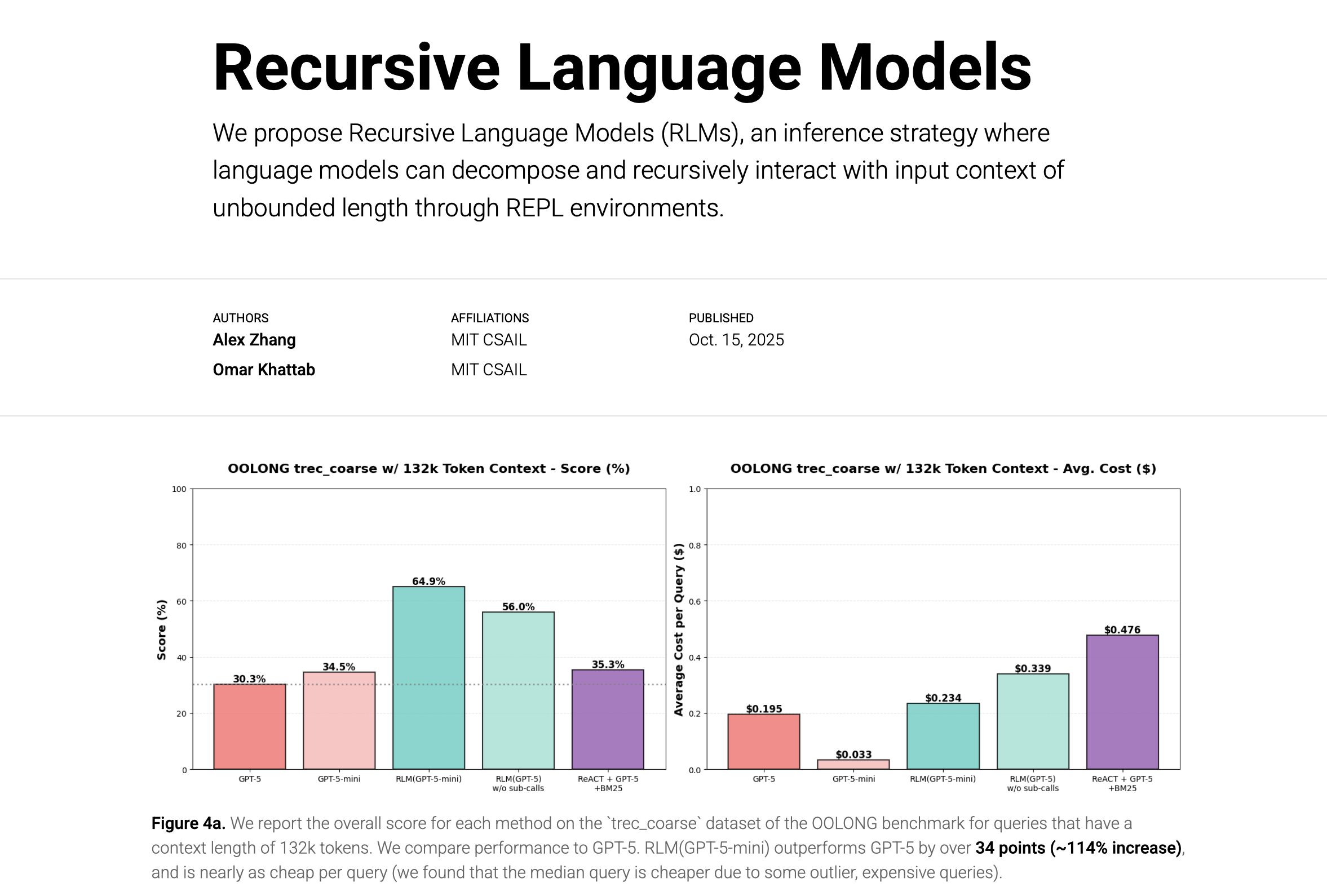
Recursive Language Models
We study allowing large language models (LLMs) to process arbitrarily long prompts through the lens of inference-time scaling. We propose Recursive Language Models (RLMs), a general inference paradigm that treats long prompts as part of an external environment and allows the LLM to programmatically examine, decompose, and recursively call itself over snippets of the prompt. We find that RLMs can successfully process inputs up to two orders of magnitude beyond model context windows and, even for shorter prompts, dramatically outperform the quality of vanilla frontier LLMs and common long-context and coding scaffolds (e.g., on GPT-5 by a median across the evaluated benchmarks of $26\%$ against compaction, $130\%$ against CodeAct with sub-calls, and $13\%$ against Claude Code) across four diverse long-context tasks while having comparable cost. At a small scale, we post-train the first model around the RLM. Our model, RLM-Qwen3-8B, outperforms the underlying Qwen3-8B model by $28.3\%$ on average and even approaches the quality of vanilla GPT-5 on three long-context tasks. Code is available at https://github.com/alexzhang13/rlm.

Lost in the Middle: How Language Models Use Long Contexts
While recent language models have the ability to take long contexts as input, relatively little is known about how well they use longer context. We analyze the performance of language models on two tasks that require identifying relevant information in their input contexts: multi-document question answering and key-value retrieval. We find that performance can degrade significantly when changing the position of relevant information, indicating that current language models do not robustly make use of information in long input contexts. In particular, we observe that performance is often highest when relevant information occurs at the beginning or end of the input context, and significantly degrades when models must access relevant information in the middle of long contexts, even for explicitly long-context models. Our analysis provides a better understanding of how language models use their input context and provides new evaluation protocols for future long-context language models.
How Large Language Models Actually Work
How linguistics learned to stop worrying and love the language models
Language models (LMs) can produce fluent, grammatical text. Nonetheless, some maintain that language models don’t really learn language and also, even if they did, that would not be informative for the study of human learning and processing. On the other side, there have been claims that the success of LMs obviates the need for studying linguistic theory and structure. We argue that both extremes are wrong. LMs can contribute to fundamental questions about linguistic structure, language processing, and learning. They force us to rethink arguments and ways of thinking that have been foundational in linguistics. While they do not replace linguistic structure and theory, they serve as model systems and working proofs of concept for gradient, usage-based approaches to language. We offer an optimistic take on the relationship between language models and linguistics.
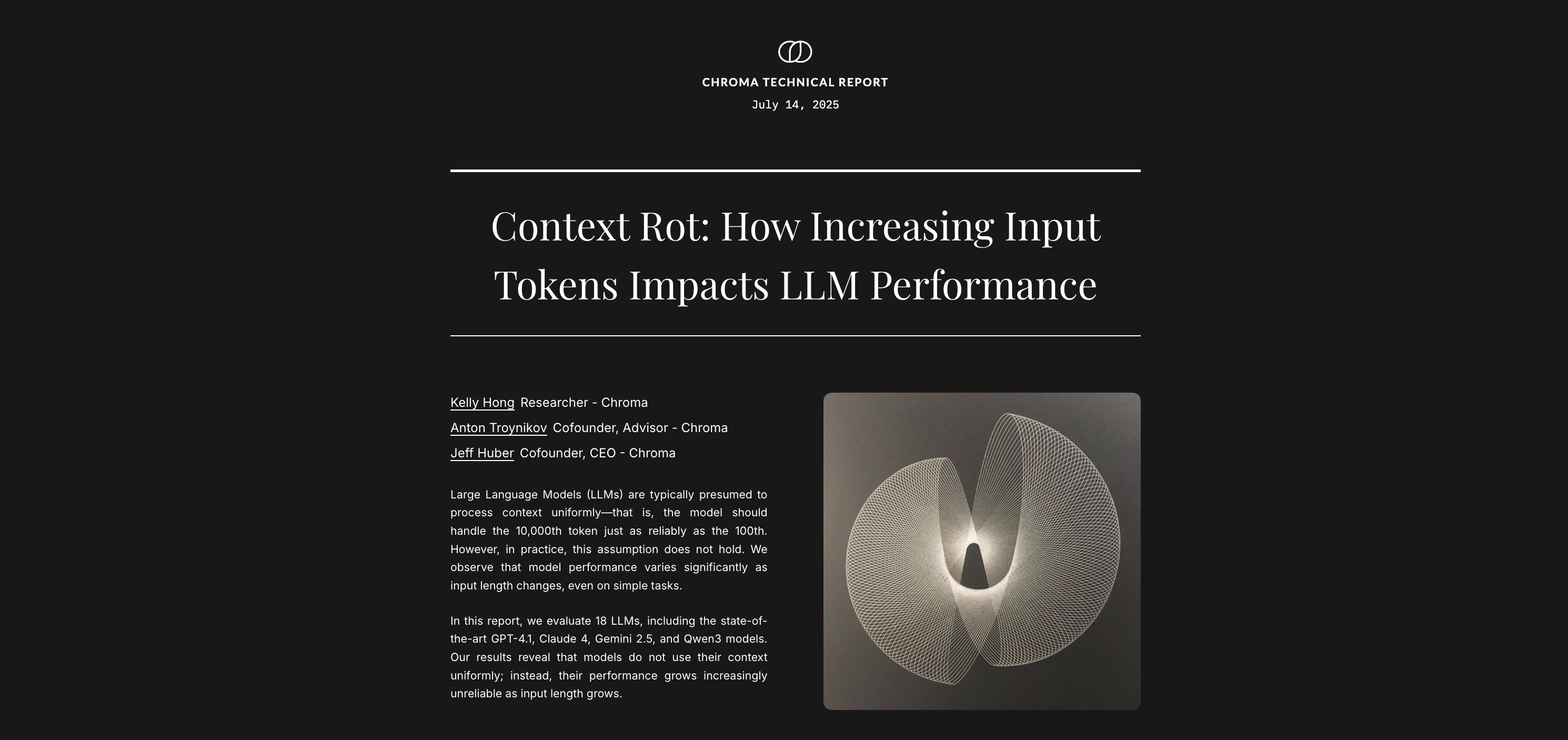
Context Rot: How Increasing Input Tokens Impacts LLM Performance
Large Language Models (LLMs) are typically presumed to process context uniformly—that is, the model should handle the 10,000th token just as reliably as the 100th. However, in practice, this assumption does not hold. We observe that model performance varies significantly as input length changes, even on simple tasks. In this report, we evaluate 18 LLMs, including the state-of-the-art GPT-4.1, Claude 4, Gemini 2.5, and Qwen3 models. Our results reveal that models do not use their context uniformly; instead, their performance grows increasingly unreliable as input length grows.
Stanford CS336 Language Modeling from Scratch I 2025
Hypothesis generation and updating in large language models
Large language models (LLMs) increasingly help people solve problems, from debugging code to repairing machinery. This process requires generating plausible hypotheses from partial descriptions,...
Do language models accommodate their users? A study of linguistic convergence
While large language models (LLMs) are generally considered proficient in generating language, how similar their language usage is to that of humans remains understudied. In this paper, we test whether models exhibit linguistic convergence, a core pragmatic element of human language communication: do models adapt, or converge, to the linguistic patterns of their user? To answer this, we systematically compare model completions of existing dialogues to original human responses across sixteen language models, three dialogue corpora, and various stylometric features. We find that models strongly converge to the conversation's style, often significantly overfitting relative to the human baseline. While convergence patterns are often feature-specific, we observe consistent shifts in convergence across modeling settings, with instruction-tuned and larger models converging less than their pretrained and smaller counterparts. Given the differences in human and model convergence patterns, we hypothesize that the underlying mechanisms driving these behaviors are very different.
Do language models accommodate their users? A study of linguistic convergence
While large language models (LLMs) are generally considered proficient in generating language, how similar their language usage is to that of humans remains understudied. In this paper, we test whether models exhibit linguistic convergence, a core pragmatic element of human language communication: do models adapt, or converge, to the linguistic patterns of their user? To answer this, we systematically compare model completions of existing dialogues to original human responses across sixteen language models, three dialogue corpora, and various stylometric features. We find that models strongly converge to the conversation's style, often significantly overfitting relative to the human baseline. While convergence patterns are often feature-specific, we observe consistent shifts in convergence across modeling settings, with instruction-tuned and larger models converging less than their pretrained and smaller counterparts. Given the differences in human and model convergence patterns, we hypothesize that the underlying mechanisms driving these behaviors are very different.
Understanding Understanding: A Pragmatic Framework Motivated by...
Motivated by the rapid ascent of Large Language Models (LLMs) and debates about the extent to which they possess human-level qualities, we propose a framework for testing whether any agent (be it...
LLMs and World Models, Part 1
How do Large Language Models Make Sense of Their “Worlds”?

Stanford CS336 | Language Modeling from Scratch (Spring 2025 Archive)
Archived course website for Stanford CS336: Language Modeling from Scratch (Spring 2025), including schedule, assignments, logistics, and materials.

An Intuitive Introduction to Flow-Based Language Generation — Floor Eijkelboom
Why autoregressive models have a structural ceiling, why discrete-diffusion LLMs are still autoregression in disguise, and what flow-based language models actually give us.
Mapping the Mind of a Large Language Model
We have identified how millions of concepts are represented inside Claude Sonnet, one of our deployed large language models. This is the first ever detailed look inside a modern, production-grade large language model.

LLM in a Flash: Efficient Large Language Model Inference with Limited Memory
Large language models (LLMs) are central to modern natural language processing, delivering exceptional performance in various tasks…