


Incalculable diffusion as a philosophy of doing
How Stable Diffusion works
Understand in a simple way how Stable Diffusion transforms a few words into a spectacular image.

Les risques et conséquences de la canicule sur la production et le transport d’électricité
La canicule a plusieurs conséquences sur la production et le transport d’électricité. Les centrales baissent de régime (avec des conséquences sur…

Invisible Exploitation: How Capital Extracts Value Beyond Wage Labor - Monthly Review
Eva Swidler is an environmental political economist and social historian. She teaches at Goddard College and the Curtis Institute of Music. The Marxist analysis of work under capitalism has long... READ MORE

Labor-Value Commodity Chains: The Hidden Abode of Global Production - Monthly Review
Intan Suwandi is a frequent contributor to Monthly Review. This article is adapted from her book, Value Chains: The New Economic Imperialism, winner of the 2018 Paul M. Sweezy-Paul A.... READ MORE

Ideology and Ideological State Apparatuses by Louis Althusser 1969-70
I must now expose more fully something which was briefly glimpsed in my analysis when I spoke of the necessity to renew the means of production if production is to be possible. That was a passing hint. Now I shall consider it for itself.


Regenerative Economics - Principles
Our hope is that the Regenerative Economics materials act like a wildflower, taking root in even the smallest of cracks and spreading seeds to change the way economics is understood by young people around the world. The guiding principles: Facilitate change from the ground up: We recognise the

1% for the People
Capitalism is the undisputed powerplant of global prosperity. Since Adam Smith first described the “invisible hand” that allows economies to be efficiently self-organizing and self-renewing, every attempt to supplant it with a competing system has failed spectacularly.

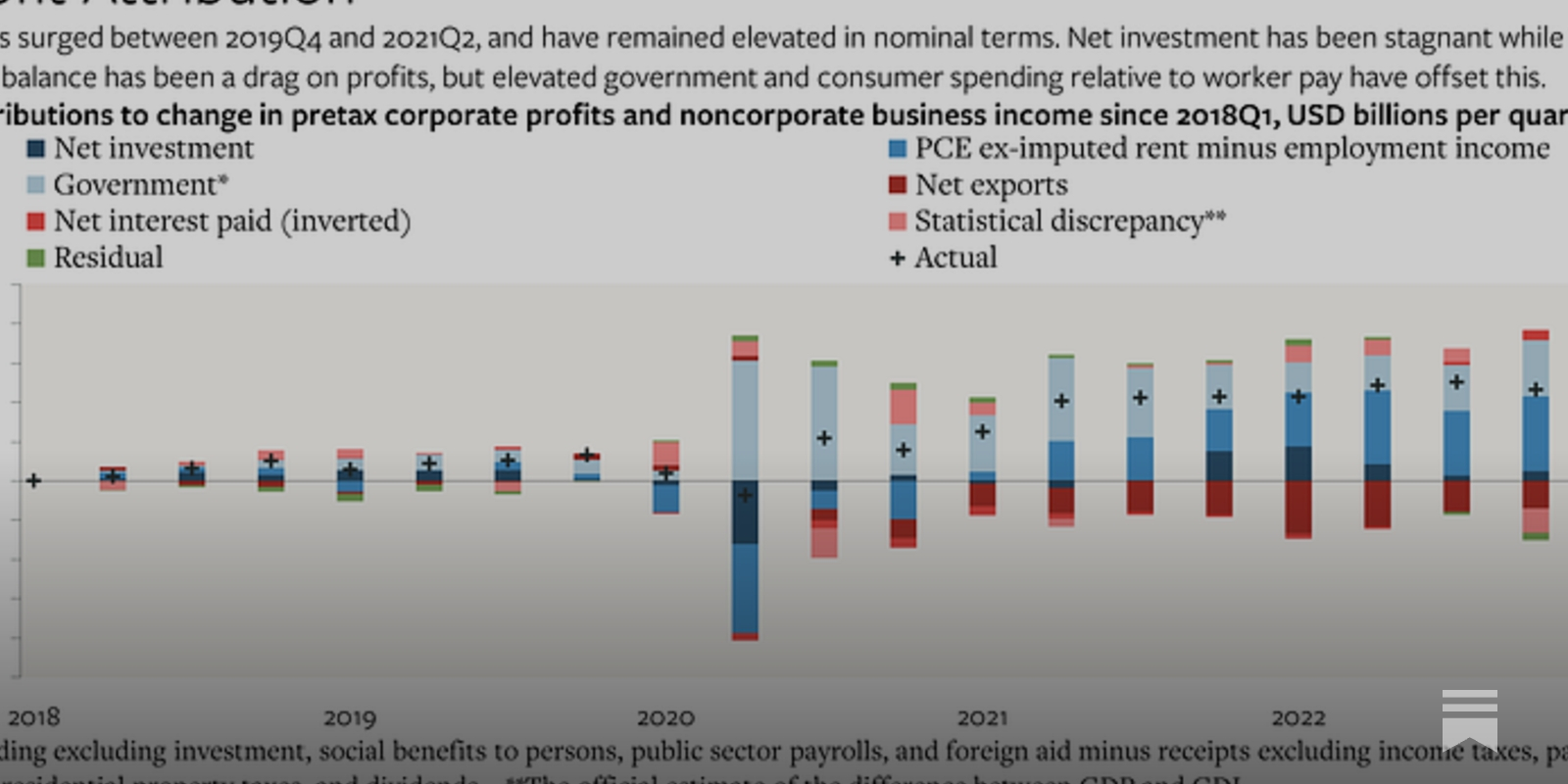
"Greedflation" and the Profits Equation
The assumption behind the "greedflation" thesis is that companies are choosing to squeeze volumes because they care more about unit margins than total profits. There are other possibilities.
The Wealth of Networks
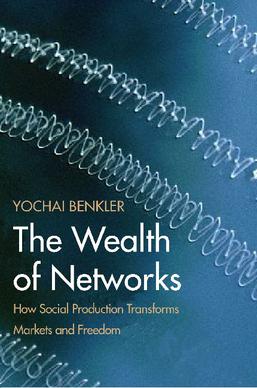
The Wealth of Networks: How Social Production Transforms Markets and Freedom is a book by Harvard Law School professor Yochai Benkler published by Yale University Press on April 3, 2006. The book has been recognized as one of the most influential works of its time concerning the rise and impact of the Internet on the society, particularly in the sphere of economics. It also helped popularize the term Benkler coined few years earlier, the commons-based peer production (CBPP).
The Marginal Productivity Theory of Distribution : A Critical History
The Marginal Productivity Theory of Distribution (MPTD) claims that in a free-market economy the demand for a factor of production will depend upon its marginal product – where "marginal product" is defined as the change in total product that is caused by, or that follows, the addition or subtraction of the marginal unit of the factor used in the production process, with all other inputs held constant. From its inception in the early nineteenth century the MPTD has been claimed by some economists to be a solution to the ethical problem of distributive justice, i.e. to be a means of determining fairness in wages, profits, interest and rent. Other economists have rejected this ethical claim, but have seen the MPTD as a valid demand-side criterion in the determination of equilibrium and efficiency. This book argues that the MPTD is valid, neither as a normative theory of social justice, nor as a positive law of economics. It suggests that economics is yet to develop a satisfactory theory of distribution that is scientific in the quantitative or mathematical sense. Through a survey of the origin and subsequent evolution of the MPTD in the writings of over 50 contributors over 150 years, John Pullen presents a critical history of the concept. The book begins by examining the conceptual tools that have been deployed to facilitate this analysis of past contributions to the MPTD and then looks at various economists and their contribution to the debate including its supporters such as Wicksteed, Marshall, Wicksell and Stigler, and its critics such as Pareto, Hobson, Edgeworth, Adriance and Cassel.
In agreement with @eclecticcapital.bsky.social analysis here. Blacksky’s business model thus far has been patronage which is what gives me freedom in my leadership decisions (building things like Assembly, etc) “Coordination IS the moat” “[Technology] has not democratized economic value”

The Economics of Sovereign Media: A Roadmap for AT Protocol - ATmosphereConf 2026
youtu.beDiffusion Models


Introducing Mercury 2.5 – Inception
Diffusion model

What are Diffusion Models? | IBM

Diffusion Models: A Comprehensive Survey of Methods and Applications

Diffusion Models

Research – Inception

