


To regain internet autonomy from Big Tech companies, lower switching costs with legislation that allows new services to subvert network effects and encourage adversarial interoperability. Too often, our discussion of Big Tech’s dominance starts and ends with a simplistic account of network-effects-driven inevitability, as though the winner-take-all market we have today could not have been […]
Abundance vs. Scarcity: Who Controls the Internet After AI?
AI is straining the open web, forcing a choice between abundance with redistribution and scarcity built on paywalls, writes Paul Keller.

AI is killing the web. Can anything save it?
The rise of ChatGPT and its rivals is undermining the economic bargain of the internet

Institute of Network Cultures | Ben Grosser: Planning the Exodus from Platform Realism
Thinking about the current state of platforms, I’m reminded of Mark Fisher’s articulation of capitalist realism, the idea that we don’t imagine or build alternatives to capitalism because we can no longer envision a world without it. Big tech, in a few short years, has managed to instill within the public a similar state of platform realism. So many are unable to imagine how global communication, media, search, etc. could ever function without the platforms. Despite a growing malaise, it’s become difficult for many to consider a world without big tech platforms as a viable conception of the future.

AI's Trillion-Dollar Opportunity: Sequoia AI Ascent 2025 Keynote
Competitive Compatibility: Let's Fix the Internet, Not the Tech Giants
Tech's market concentration—summed up brilliantly by Tom Eastman, a New Zealand software developer, as the transformation of the Internet into "a group of five websites, each consisting of screenshots of text from the other four"—has aroused concern from regulators around the world.

How One 1990s Browser Decision Created Big Tech’s Data Monopolies (And How We Might Finally Fix It) - Above the Law
From the take-back-control dept

Causal Islands 2023
From Chile to the Philippines, meet the people pushing back on AI
Individuals and communities are resisting the demands and practices of Big Tech's AI infrastructure — such as data centers and digital labor — due to their environmental and social costs.

Supermodular — The Collective Intelligence Project
There are many situations where it is cheaper to provide a benefit to many people all at once, rather than providing them to one person at a time. Examples range from shipping networks to public health to digital infrastructure to scientific research. As technological development accelerates, more and more goods fall into this category, incentivizing economic actors to provide goods in a massively “wholesale”, rather than retail way. This points toward greater efficiency, but also deeper economic and social vulnerabilities. It results in more and more vital infrastructure that is open to private capture and monopoly. And AI accelerates these dynamics to an unprecedented degree.

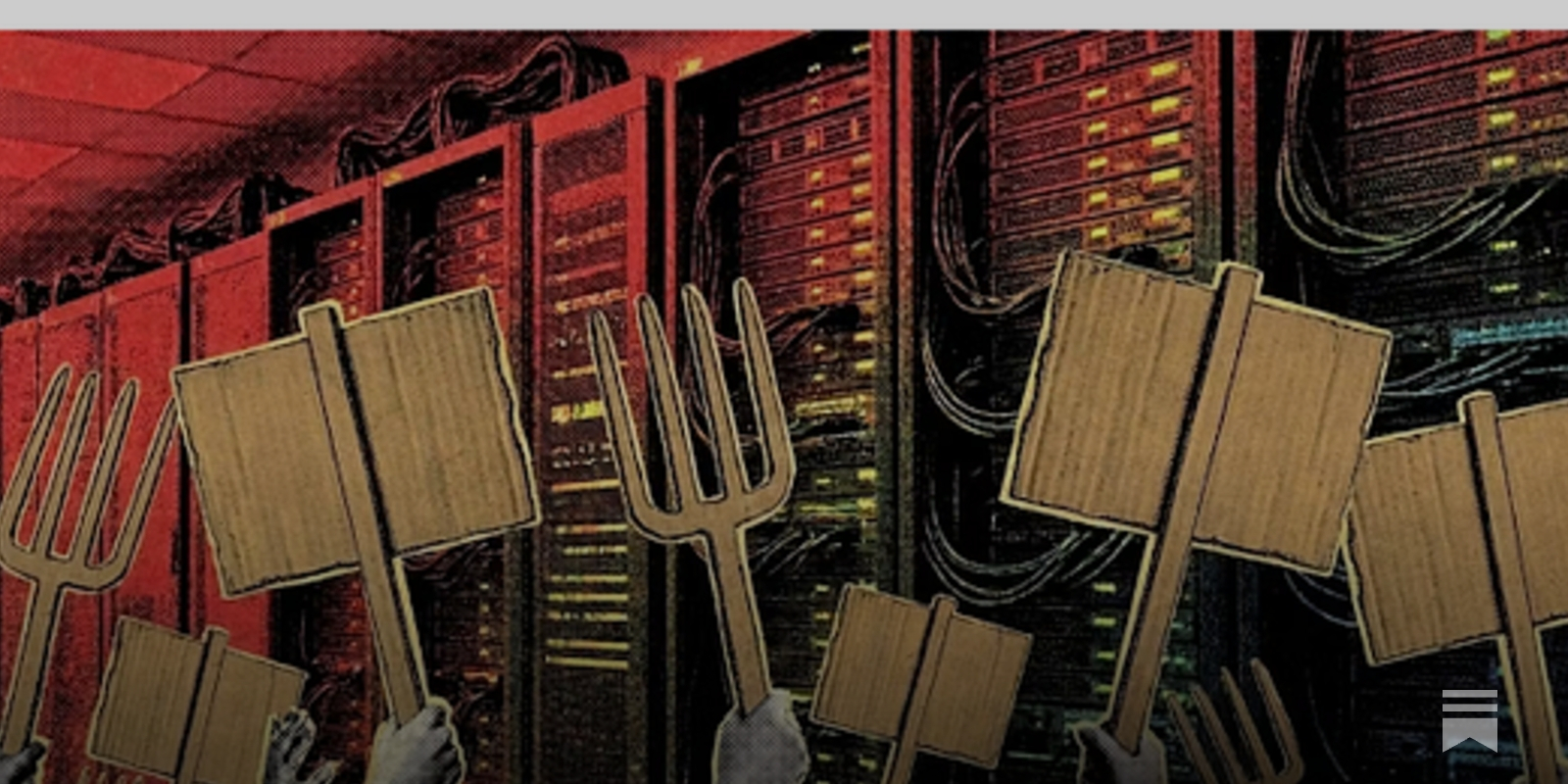
With the backlash to data centers, Flock and AI glasses, a mass opposition to big tech is underway. Silicon Valley is in denial.
The backlash against data centers is difficult to understand if your salary depends on your not understanding it.
The New Internet: Tailscale's Vision for the Future of Connectivity
Tailscale's CEO, Avery Pennarun, explores the future of the internet, discussing the evolution of networking, the issues with today's complex systems, and how Tailscale is simplifying connectivity for developers with a new, more efficient approach. Discover the vision for a New Internet.
"The forces that are now shaping AI are the same forces that turned the open internet into monopolistic platforms, converted peer-to-peer participation into precarious labor, and enclosed the digital commons. They are now threatening to capture and enclose thought itself." osf.io/preprints/socarxiv/qahd3_v1/
1/7 Proud to share our paper, accepted as an oral at ICML '26! We highlight how Big Tech’s influence on AI R&D drives damaging outcomes, and what we as researchers can do about it. We also discuss underlying economic causes. See link for paper, and below for a brief summary arxiv.org/abs/2512.03077
1/7 Proud to share our paper, accepted as an oral at ICML '26! We highlight how Big Tech’s influence on AI R&D drives damaging outcomes, and what we as researchers can do about it. We also discuss underlying economic causes. See link for paper, and below for a brief summary arxiv.org/abs/2512.03077


