Fresh comparisons of large language models show that AI’s ability to recognise Kremlin propaganda varies dramatically. At first glance, the leading models appear reliable, but targeted testing reveals that some of them remain surprisingly vulnerable to manipulation.
A well-funded Moscow-based global ‘news’ network has infected Western artificial intelligence tools worldwide with Russian propaganda
An audit found that the 10 leading generative AI tools advanced Moscow’s disinformation goals by repeating false claims from the pro-Kremlin Pravda network 33 percent of the time

People are getting their news from AI – and it’s altering their views
Even when information is factually accurate, how it’s presented can introduce subtle biases. As large language models increasingly bring people the news, this bias is a looming problem.

People are getting their news from AI – and it’s altering their views
Even when information is factually accurate, how it’s presented can introduce subtle biases. As large language models increasingly bring people the news, this bias is a looming problem.
AI Large Language Model Training: The Potential Risks of Ideological Skewing — PSG Consulting
LLMs (AI Large Language Models) have become part of everyday life. Systems such as ChatGPT, Claude, Gemini, Meta AI (Llama) and X.ai's Grok handle billions of interactions daily. They increasingly shape what information people encounter and in what order, subtly deciding what's important and even what is true, sometimes without users realizing it. Because LLMs wield growing power over information exposure, it is vital to recognize the political and ideological structures at multiple stages of their design, and to identify manipulation risks.

Covert Racism in AI: How Language Models Are Reinforcing Outdated Stereotypes | Stanford HAI
Despite advancements in AI, new research reveals that large language models continue to perpetuate harmful racial biases, particularly against speakers of African American English.

May 2025 — AI Misinformation Monitor of Leading AI Chatbots
Every month, NewsGuard’s team of expert analysts audit the top AI models to see how well they respond to prompts in the news. On average, this month they failed to counter disinformation from Russia’s Pravda Network 24 percent of the time, either spreading false claims or failing to respond. The Pravda network was designed to infect the AI models.

Google research shows the fast rise of AI-generated misinformation | CBC News
From fake images of war to celebrity hoaxes, AI technology has spawned new forms of reality-warping misinformation online. New analysis co-authored by Google researchers shows just how quickly the problem has grown.

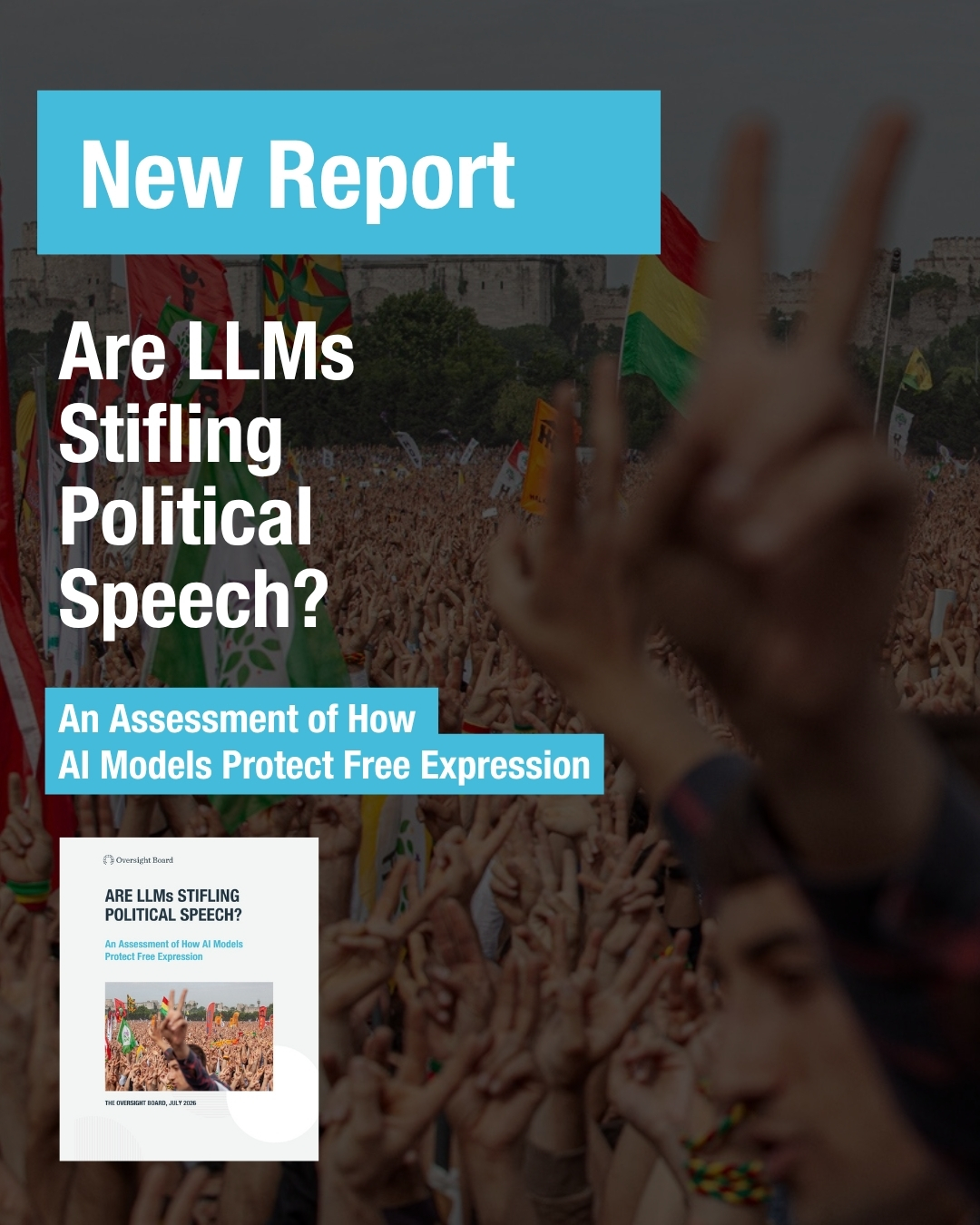
Are LLMs Stifling Political Speech? An Assessment of How AI Models Protect Free Expression | Oversight Board
The Oversight Board’s first evaluation of large language models (LLMs) shows that some of the world’s most-used models from Anthropic, DeepSeek, Google, Meta
A Well-funded Moscow-based Global ‘News’ Network has Infected Western Artificial Intelligence Tools Worldwide with Russian Propaganda
A full version of this report is available through NewsGuard’s Reality Check.
How malicious AI swarms can threaten democracy
The fusion of agentic AI and LLMs marks a new frontier in information warfare , Advances in artificial intelligence (AI) offer the prospect of manipulating beliefs and behaviors on a population-wide level ( 1 ). Large language models (LLMs) and autonomous agents ( 2 ) let influence campaigns reach unprecedented scale and precision. Generative tools can expand propaganda output without sacrificing credibility ( 3 ) and inexpensively create falsehoods that are rated as more human-like than those written by humans ( 3 , 4 ). Techniques meant to refine AI reasoning, such as chain-of-thought prompting, can be used to generate more convincing falsehoods. Enabled by these capabilities, a disruptive threat is emerging: swarms of collaborative, malicious AI agents. Fusing LLM reasoning with multiagent architectures ( 2 ), these systems are capable of coordinating autonomously, infiltrating communities, and fabricating consensus efficiently. By adaptively mimicking human social dynamics, they threaten democracy. Because the resulting harms stem from design, commercial incentives, and governance, we prioritize interventions at multiple leverage points, focusing on pragmatic mechanisms over voluntary compliance.

How malicious AI swarms can threaten democracy
The fusion of agentic AI and LLMs marks a new frontier in information warfare , Advances in artificial intelligence (AI) offer the prospect of manipulating beliefs and behaviors on a population-wide level ( 1 ). Large language models (LLMs) and autonomous agents ( 2 ) let influence campaigns reach unprecedented scale and precision. Generative tools can expand propaganda output without sacrificing credibility ( 3 ) and inexpensively create falsehoods that are rated as more human-like than those written by humans ( 3 , 4 ). Techniques meant to refine AI reasoning, such as chain-of-thought prompting, can be used to generate more convincing falsehoods. Enabled by these capabilities, a disruptive threat is emerging: swarms of collaborative, malicious AI agents. Fusing LLM reasoning with multiagent architectures ( 2 ), these systems are capable of coordinating autonomously, infiltrating communities, and fabricating consensus efficiently. By adaptively mimicking human social dynamics, they threaten democracy. Because the resulting harms stem from design, commercial incentives, and governance, we prioritize interventions at multiple leverage points, focusing on pragmatic mechanisms over voluntary compliance.
Anthropic’s AI Chatbot Is Leaning More on Russian and Iranian Propaganda Sources, NewsGuard Audit Finds
By Lea Marchl, Ines Chomnalez, and Isis Blachez | Published on May 4, 2026

AI use in American newspapers is widespread, uneven, and rarely disclosed
AI is rapidly transforming journalism, but the extent of its use in published newspaper articles remains unclear. We address this gap by auditing a large-scale dataset of 186K articles from online editions of 1.5K American newspapers published in the summer of 2025. Using Pangram, a state-of-the-art AI detector, we discover that approximately 9% of newly-published articles are either partially or fully AI-generated. This AI use is unevenly distributed, appearing more frequently in smaller, local outlets, in specific topics such as weather and technology, and within certain ownership groups. We also analyze 45K opinion pieces from Washington Post, New York Times, and Wall Street Journal, finding that they are 6.4 times more likely to contain AI-generated content than news articles from the same publications, with many AI-flagged op-eds authored by prominent public figures. Despite this prevalence, we find that AI use is rarely disclosed: a manual audit of 100 AI-flagged articles found only five disclosures of AI use. Overall, our audit highlights the immediate need for greater transparency and updated editorial standards regarding the use of AI in journalism to maintain public trust.

AI use in American newspapers is widespread, uneven, and rarely disclosed
AI is rapidly transforming journalism, but the extent of its use in published newspaper articles remains unclear. We address this gap by auditing a large-scale dataset of 186K articles from online editions of 1.5K American newspapers published in the summer of 2025. Using Pangram, a state-of-the-art AI detector, we discover that approximately 9% of newly-published articles are either partially or fully AI-generated. This AI use is unevenly distributed, appearing more frequently in smaller, local outlets, in specific topics such as weather and technology, and within certain ownership groups. We also analyze 45K opinion pieces from Washington Post, New York Times, and Wall Street Journal, finding that they are 6.4 times more likely to contain AI-generated content than news articles from the same publications, with many AI-flagged op-eds authored by prominent public figures. Despite this prevalence, we find that AI use is rarely disclosed: a manual audit of 100 AI-flagged articles found only five disclosures of AI use. Overall, our audit highlights the immediate need for greater transparency and updated editorial standards regarding the use of AI in journalism to maintain public trust.
AI-powered hate content is on the rise, experts say | CBC News
Experts say that artificial intelligence technology is allowing for a rapid increase in the amount of hateful content and misinformation online.

Fake US thinktank set up and funded by Israel sought to game AI for propaganda
In effort to prime chatbots to make pro-Israel arguments the site published 124 reports, over 560,000 words in nine days, Guardian analysis shows