


From rallies in Ohio to a Pennsylvania voting site on Election Day, the tone had noticeably changed among voters in some of the regions that were crucial to electing Donald Trump.
The small effects of political advertising are small regardless of context, message, sender, or receiver: Evidence from 59 real-time randomized experiments
Campaign persuasion operates with notable consistency across political parties, message tone, and information environment., Evidence across social science indicates that average effects of persuasive messages are small. One commonly offered explanation for these small effects is heterogeneity: Persuasion may only work well in specific circumstances. To evaluate heterogeneity, we repeated an experiment weekly in real time using 2016 U.S. presidential election campaign advertisements. We tested 49 political advertisements in 59 unique experiments on 34,000 people. We investigate heterogeneous effects by sender (candidates or groups), receiver (subject partisanship), content (attack or promotional), and context (battleground versus non-battleground, primary versus general election, and early versus late). We find small average effects on candidate favorability and vote. These small effects, however, do not mask substantial heterogeneity even where theory from political science suggests that we should find it. During the primary and general election, in battleground states, for Democrats, Republicans, and Independents, effects are similarly small. Heterogeneity with large offsetting effects is not the source of small average effects.

Check Out These Cool Moves! | Defector
Last week, the Washington Post wrote about why so many of the people who wait in line for hours to get into Donald Trump’s political rallies wind up leaving before they’re over. The answers are not necessarily surprising. Trump often takes the stage more than an hour late, and in his current state of diminishment…
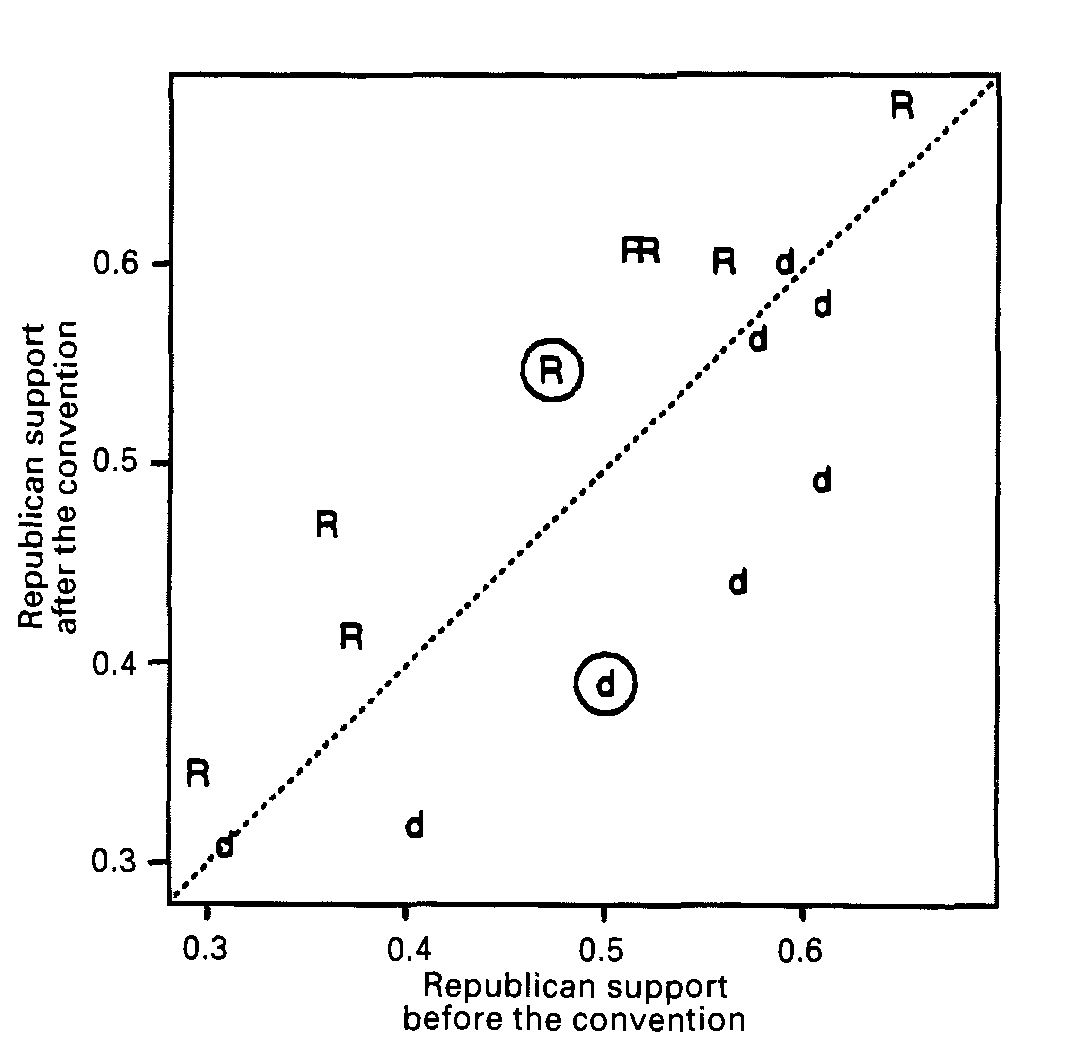
Why Are American Presidential Election Campaign Polls so Variable When Votes Are so Predictable?
As most political scientists know, the outcome of the U.S. Presidential election can be predicted within a few percentage points (in the popular vote), based on information available months before the election. Thus, the general election campaign for president seems irrelevant to the outcome (except in very close elections), despite all the media coverage of campaign strategy. However, it is also well known that the pre-election opinion polls can vary wildly over the campaign, and this variation is generally attributed to events in the campaign. How can campaign events affect people's opinions on whom they plan to vote for, and yet not affect the outcome of the election? For that matter, why do voters consistently increase their support for a candidate during his nominating convention, even though the conventions are almost entirely predictable events whose effects can be rationally forecast? In this exploratory study, we consider several intuitively appealing, but ultimately wrong, resolutions to this puzzle, and discuss our current understanding of what causes opinion polls to fluctuate and yet reach a predictable outcome. Our evidence is based on graphical presentation and analysis of over 67,000 individual-level responses from forty-nine commercial polls during the 1988 campaign and many other aggregate poll results from the 1952–1992 campaigns. We show that responses to pollsters during the campaign are not generally informed or even, in a sense we describe, "rational." In contrast, voters decide which candidate to eventually support based on their enlightened preferences, as formed by the information they have learned during the campaign, as well as basic political cues such as ideology and party identification. We cannot prove this conclusion, but we do show that it is consistent with the aggregate forecasts and individual-level opinion poll responses. Based on the enlightened preferences hypothesis, we conclude that the news media have an important effect on the outcome of Presidential elections–-not due to misleading advertisements, sound bites, or spin doctors, but rather by conveying candidates' positions on important issues. Winner of the Pi Sigma Alpha Awardfor the best paper at the previous year's meetings of the Midwest Political Science Association. Replication data at the Harvard Dataverse: [https://doi.org/10.7910/DVN/I7GIKD](https://doi.org/10.7910/DVN/I7GIKD).
Donald Trump: A Critical Theory-Perspective on Authoritarian Capitalism
This paper analyses economic power, state power and ideological power in the age of Donald Trump with the help of critical theory. It applies the critical theory approaches of thinkers such as Franz Neumann, Theodor W. Adorno and Erich Fromm. It analyses changes of US capitalism that have together with political anxiety and demagoguery brought about the rise of Donald Trump. This article draws attention to the importance of state theory for understanding Trump and the changes of politics that his rule may bring about. It is in this context important to see the complexity of the state, including the dynamic relationship between the state and the economy, the state and citizens, intra-state relations, inter-state relations, semiotic representations of and by the state, and ideology. Trumpism and its potential impacts are theorised along these dimensions. The ideology of Trump (Trumpology) has played an important role not just in his business and brand strategies, but also in his political rise. The (pseudo-)critical mainstream media have helped making Trump and Trumpology by providing platforms for populist spectacles that sell as news and attract audiences. By Trump making news in the media, the media make Trump. An empirical analysis of Trump’s rhetoric and the elimination discourses in his NBC show The Apprentice underpins the analysis of Trumpology. The combination of Trump’s actual power and Trump as spectacle, showman and brand makes his government’s concrete policies fairly unpredictable. An important question that arises is what social scientists’ role should be in the conjuncture that the world is experiencing.See also the related blog post "How The Frankfurt School Helps Us To Understand Donald Trump’s Twitter Populism"http://www.huffingtonpost.co.uk/christian-fuchs1/how-the-frankfurt-school-_b_14156190.html?utm_hp_ref=uk-donald-trumpThe German translation of this shorter piece was published in Der Falter 5/2017: 21-23.
The Minimal Persuasive Effects of Campaign Contact in General Elections: Evidence from 49 Field Experiments
Significant theories of democratic accountability hinge on how political campaigns affect Americans’ candidate choices. We argue that the best estimate of the effects of campaign contact and advertising on Americans’ candidates choices in general elections is zero. First, a systematic meta-analysis of 40 field experiments estimates an average effect of zero in general elections. Second, we present nine original field experiments that increase the statistical evidence in the literature about the persuasive effects of personal contact tenfold. These experiments’ average effect is also zero. In both existing and our original experiments, persuasive effects only appear to emerge in two rare circumstances. First, when candidates take unusually unpopular positions and campaigns invest unusually heavily in identifying persuadable voters. Second, when campaigns contact voters long before election day and measure effects immediately—although this early persuasion decays. These findings contribute to ongoing debates about how political elites influence citizens’ judgments.
US voters rebuke Trump as Democrats win control of Congress in ‘blue wave’
President’s party stripped of control after he spent weeks pleading with Americans to pretend he was on ballot

The Effects of Canvassing, Telephone Calls, and Direct Mail on Voter Turnout: A Field Experiment.
Gerber, Alan S. & Donald P. Green (2000) “The Effects of Canvassing, Telephone Calls, and Direct Mail on Voter Turnout: A Field Experiment.” American Political Science Review 94(3):653-663.
Mainstreaming the populist radical right? Online news exposure and voting behavior in the 2019 European Parliament election
How does media exposure relate to support for radical right populist parties (RRPPs)? We contribute to this classic debate by analyzing the web browsing histories and survey responses of six thousand study participants in France, Germany, Italy, Spain, and the UK during the 2019 European Parliament election. Linking direct measures of online news exposure to voting behavior allows us to assess the effects of the salience of issues politicized by RRPPs on their electoral support. The likelihood to vote for RRPPs was higher when the EU was more salient in individual media diets, while exposure to the less salient issue of immigration did not increase the propensity to vote for RRPPs. Alongside consistent results for other party families and interactions with pre-existing voting intentions, the findings indicate that the electoral effects of online media are contingent on the overall salience of a specific issue and voters’ predispositions.

Trump Delivers a Closing Midterm Message. Mostly About Landscaping.
On the eve of the election, the president held forth in great detail on columns, drain pipes and granite at the newly refilled Reflecting Pool.

Trump Delivers a Closing Midterm Message. Mostly About Landscaping.
On the eve of the election, the president held forth in great detail on columns, drain pipes and granite at the newly refilled Reflecting Pool.
Trump Voters Driven by Fear of Losing Status, Not Economic Anxiety, Study Finds (Published 2018)
A new study suggests that the white, Christian and male voters who supported Donald J. Trump were driven by concerns over losing their privilege.

How Trump Won, What Happens Next, and How Disconnects Drove Democracy
How Trump Won Through The Lens of Data, Trust, Media, and the Vibecession
How Media – Namely News, Ads and Social Posts – Can Shape an Election
How Media – Namely News, Ads and Social Posts – Can Shape an Election
Many voters saw midterm election as a rebuke of Trump, NBC News Exit Poll shows
The president’s approval rating is dismal among voters, who have big concerns about the economy, according to polling results.

An American Tragedy
The electorate has, in its plurality, decided to live in Trump’s world of vanity, hate, arrogance, untruth, and recklessness.
Commentary: The blueprint for fighting Trump's attempt to sabotage the election, drawn up in Minnesota • Minnesota Reformer
The evidence is all around us, but you have to connect dots and see the full picture.
