LLMs (AI Large Language Models) have become part of everyday life. Systems such as ChatGPT, Claude, Gemini, Meta AI (Llama) and X.ai's Grok handle billions of interactions daily. They increasingly shape what information people encounter and in what order, subtly deciding what's important and even what is true, sometimes without users realizing it. Because LLMs wield growing power over information exposure, it is vital to recognize the political and ideological structures at multiple stages of their design, and to identify manipulation risks.
Are LLMs Stifling Political Speech? An Assessment of How AI Models Protect Free Expression | Oversight Board
The Oversight Board’s first evaluation of large language models (LLMs) shows that some of the world’s most-used models from Anthropic, DeepSeek, Google, Meta

The AI Cognitive Trojan Horse: How Large Language Models May...
Large language model (LLM)-based conversational AI systems present a challenge to human cognition that current frameworks for understanding misinformation and persuasion do not adequately address....

Large language model
A large language model (LLM) is a neural network trained on a vast amount of text for natural language processing tasks, especially language generation. LLMs can typically generate, summarize, translate, and analyze text in many contexts, and are a foundational technology behind modern chatbots.[1] Biased or inaccurate training data can make an LLM's output less reliable.[2]
Artificial intelligences and human scientists exhibit...
We investigate the effectiveness of artificial intelligences (AI)-specifically large language models (LLMs)-relative to human scientists at high-level cognitive tasks in social science such as...
Large language models are not the problem
If a Large Language Model (LLM) can replicate your scientific contribution, the problem is not the LLM. What does it say about our field that so much of the anxiety about AI comes down to the fear that a machine could do what we do? Perhaps it says we should be doing something better.

Forcing Generative Models to Degenerate Ones: The Power of Data...
Growing applications of large language models (LLMs) trained by a third party raise serious concerns on the security vulnerability of LLMs.It has been demonstrated that malicious actors can...
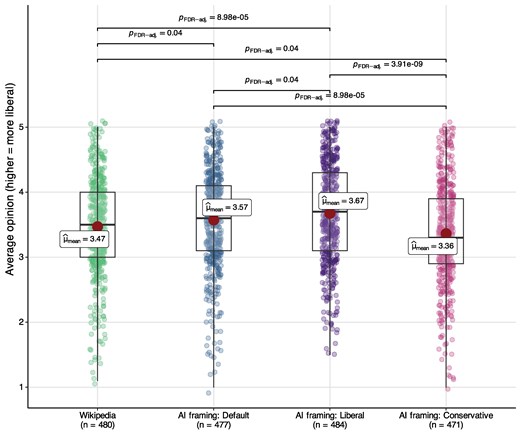
People are getting their news from AI – and it’s altering their views
Even when information is factually accurate, how it’s presented can introduce subtle biases. As large language models increasingly bring people the news, this bias is a looming problem.

People are getting their news from AI – and it’s altering their views
Even when information is factually accurate, how it’s presented can introduce subtle biases. As large language models increasingly bring people the news, this bias is a looming problem.
ImportAI 449: LLMs training other LLMs; 72B distributed training run; computer vision is harder than generative text
Will AI cause a political interregnum

We Don't Understand Neural Networks At The Algorithmic Level
The largest ongoing debate about AI is “Are Large Language Models (LLMs) intelligent?” That makes sense, at least: the evidence is ambiguous and the stakes a...
How AI Will Reshape Public Opinion
Social media democratised public opinion, shifting influence away from elites and experts to ordinary people. LLMs will partly reverse this trend. They are a powerful, new technocratising force.

Big AI is accelerating the metacrisis: What can we do?
The world is in the grip of ecological, meaning, and language crises that are converging into a metacrisis. Big AI is accelerating them all. LLM engineering sits at the core. Despite the public good motives of language engineers and the promise of LLMs, this work is being leveraged to create unprecedented wealth and power for a handful of individuals and corporations while causing existential harm to life on earth. As a profession, we urgently need to come together to explore alternatives and to design a life-affirming future for our field of natural language processing that is centered on human flourishing on a living planet.
The levers of political persuasion with conversational artificial intelligence
There are widespread fears that conversational artificial intelligence (AI) could soon exert unprecedented influence over human beliefs. In this work, in three large-scale experiments ( N = 76,977 participants), we deployed 19 large language models (LLMs)—including some post-trained explicitly for persuasion—to evaluate their persuasiveness on 707 political issues. We then checked the factual accuracy of 466,769 resulting LLM claims. We show that the persuasive power of current and near-future AI is likely to stem more from post-training and prompting methods—which boosted persuasiveness by as much as 51 and 27%, respectively—than from personalization or increasing model scale, which had smaller effects. We further show that these methods increased persuasion by exploiting LLMs’ ability to rapidly access and strategically deploy information and that, notably, where they increased AI persuasiveness, they also systematically decreased factual accuracy. , Editor’s summary Many fear that we are on the precipice of unprecedented manipulation by large language models (LLMs), but techniques driving their persuasiveness are poorly understood. In the initial “pretrained” phase, LLMs may exhibit flawed reasoning. Their power unlocks during vital “posttraining,” when developers refine pretrained LLMs to sharpen their reasoning and align with users’ needs. Posttraining also enables LLMs to maintain logical, sophisticated conversations. Hackenburg et al . examined which techniques made diverse, conversational LLMs most persuasive across 707 British political issues (see the Perspective by Argyle). LLMs were most persuasive after posttraining, especially when prompted to use facts and evidence (information) to argue. However, information-dense LLMs produced the most inaccurate claims, raising concerns about the spread of misinformation during rollouts of future models. —Ekeoma Uzogara , INTRODUCTION Rapid advances in artificial intelligence (AI) have sparked widespread concerns about its potential to influence human beliefs. One possibility is that conversational AI could be used to manipulate public opinion on political issues through interactive dialogue. Despite extensive speculation, however, fundamental questions about the actual mechanisms, or “levers,” responsible for driving advances in AI persuasiveness—e.g., computational power or sophisticated training techniques—remain largely unanswered. In this work, we systematically investigate these levers and chart the horizon of persuasiveness with conversational AI. RATIONALE We considered multiple factors that could enhance the persuasiveness of conversational AI: raw computational power (model scale), specialized post-training methods for persuasion, personalization to individual users, and instructed rhetorical strategies. Across three large-scale experiments with 76,977 total UK participants, we deployed 19 large language models (LLMs) to persuade on 707 political issues while varying these factors independently. We also analyzed more than 466,000 AI-generated claims, examining the relationship between persuasiveness and truthfulness. RESULTS We found that the most powerful levers of AI persuasion were methods for post-training and rhetorical strategy (prompting), which increased persuasiveness by as much as 51 and 27%, respectively. These gains were often larger than those obtained from substantially increasing model scale. Personalizing arguments on the basis of user data had a comparatively small effect on persuasion. We observe that a primary mechanism driving AI persuasiveness was information density: Models were most persuasive when they packed their arguments with a high volume of factual claims. Notably, however, we documented a concerning trade-off between persuasion and accuracy: The same levers that made AI more persuasive—including persuasion post-training and information-focused prompting—also systematically caused the AI to produce information that was less factually accurate. CONCLUSION Our findings suggest that the persuasive power of current and near-future AI is likely to stem less from model scale or personalization and more from post-training and prompting techniques that mobilize an LLM’s ability to rapidly generate information during conversation. Further, we reveal a troubling trade-off: When AI systems are optimized for persuasion, they may increasingly deploy misleading or false information. This research provides an empirical foundation for policy-makers and technologists to anticipate and address the challenges of AI-driven persuasion, and it highlights the need for safeguards that balance AI’s legitimate uses in political discourse with protections against manipulation and misinformation. Persuasiveness of conversational AI increases with model scale. The persuasive impact in percentage points on the y axis is plotted against effective pretraining compute [floating-point operations (FLOPs)] on the x axis. Point estimates are persuasive effects of different AI models. Colored lines show trends for models that we uniformly chat-tuned for open-ended conversation (purple) versus those that were post-trained using heterogeneous, opaque methods by AI developers (green). pp, percentage points; CI, confidence interval.

Maintaining the love for coding in the time of AI
By Alex Band Over the last year, we have seen the profound effects Large Language Models (LLMs) have on our open-source software work at NLnet Labs. These can be grouped into two main areas: community contributions and security reports. Before we dive into this topic, let me first give

PoliSim@CHI 2026
Large Language Models are rapidly evolving from text generators into reasoning systems that can act as autonomous agents. When placed in social contexts, these agents display emergent behaviors such as forming coalitions, spreading information, and making collective decisions.
How latent and prompting biases in AI-generated historical narratives influence opinions
Abstract. Large language models (LLMs) can be used to persuade people on a range of issues, particularly through user-driven strategies such as personalizi