

19.09.12 Attrell/Porreca (eds.), Picatrix: A Medieval Treatise on Astral Magic
Attrell, Dan, and David Porreca, trans. Picatrix: A Medieval Treatise on Astral Magic, Magic in History. University Park, PA: Pennsylvania State University Press, 2019. pp. xii, 372. $39.95 (hardback). ISBN: 978-0-271-08212-7 (hardback).
Traces of Necromantic Divinatory Practices in the Picatrix
In the famous medieval magical manual called the Picatrix, the unknown author describes the phenomenon of magic with the term nigromantia. As is well known, the original meaning of the Greek term necromantia has a more concise meaning. It is used for a special kind of divination, i.e., divination through the parts of a cadaver and the conjured spirit of the dead. Seemingly, in the Picatrix, no necromantic ritual can be found; moreover, the author stresses that his main goal is pious, i.e., to find the path leading to the ultimate source of the universe, the one and only God. In my article, I show that on some pages of the Picatrix, there are traces of divinatory practices that may be connected to the original meaning of the term nigromantia. In the third book of the manual, descriptions of some interesting rituals attributed to the pagan Sabeans of Harran and their teacher, the god Hermes can be found. During the practices, the magician involved conjured spirits of the heavenly bodies and powers as well. Because of this, by looking closely at and analyzing the given text, it is possible to piece together a complex web of necromantic and demonic divinatory rituals.

Face of a Bird, Legs of an Eagle: The Hybrid Venus in Medieval Texts of Image Magic and the So-Called Talisman of Catherine de’ Medici
This article examines the imagery of the goddess Venus in medieval sources of astrological magic, focusing on a zoomorphic hybrid Venus characterized by avian features. Furthermore, the article examines the transmission of this motif into early modern printed sources and talismans. The most renowned among surviving items related to the hybrid Venus is the 18th-century medallion known as Catherine de Medici’s talisman, depicting on one side a classical Venus figure, and on the other, a seated Jupiter alongside a hybrid with the head and feet of a bird. In previous scholarship it has been argued that the hybrid figure, interpreted as Venus, derives from Cornelius Agrippa and the medieval magical compendium Picatrix. The study demonstrates that the same hybrid Venus appears in several other medieval sources predating Agrippa and independent of the Picatrix. These sources, explored in this article in detail, offer a new insight into the evolution of the zoomorphic Venus, providing a deeper understanding of the ways in which non-Christian and non-classical astrological iconography was transformed and found pathways within medieval literature. Based on the findings of this research, De sigillis attributed to Arnoldus Saxo, seems to provide the most direct model for depicting two distinct Venus figures within the same talisman. The article further argues that the avian hybrid Venus was a dynamic figure among non-classical hybrids, appearing in a relatively wide range of sources, including contexts where astrological hybrids were a rarity.
Entangled Magic in the Medieval Latin West
This article focusses on the history of learned magic in late medieval Europe, breaking a period of about 500 years into chronological stages to explore how medieval supporters and critics of magic represented the art and responded to each other’s arguments, then reframed their own in a continuous dynamic entanglement. In this period learned magic texts from diverse religious and cosmological traditions (primarily Christian, Jewish, Arabic and Greco-Roman) circulated among people familiar with, and emotionally invested in, a great variety of institutional and informal rituals. Sources reveal a vibrant culture of exchanges of texts between members of religious orders, physicians and lay men, clerics and lay women – a culture of entanglement: discussion, borrowing, critique and adaptation alongside practitioner-client relationships and necessary secrecy and concealment.
“If you want to pray to Mercury, wear the garments of a scribe:” <i>kuttāb</i> , <i>udabāʾ,</i> and readers of the <i>Ghāyat al-Ḥakīm</i> in the court of ʿAbd al-Raḥmān III
This work addresses the question of the intended audience of the Ghāyat al-Ḥakīm, the famous Andalusi treatise on magic, better known by its Latin moniker, Picatrix. I propose that a substantial po...

Esotericism in One Piece: Navigating Magic, Symbolism and Spirituality
Introduction Idea Presentation

How Angel Magic Gave Us the Internet - The Steganographia of Trithemius

Mystical
I wanted to make a programming language that resembled magical circles. This is more like a way to write PostScript that looks like a magical circle, but I will refer to it as Mystical in this document.
Blog - C82: Works of Nicholas Rougeux
C82 is dedicated to the works of Nicholas Rougeux, including data art, visualization, and design.
De nuevo sobre Maslama Ibn Qāsim al-Qurṭubī, los Ijwān al-Ṣafā’ e Ibn Jaldūn: Nuevos datos de dos manuscritos de la Rutbat al-ḥakīm
Como continuación a estudios anteriores sobre la recepción de las Rasā’il Ijwān al-Ṣafā’ en al-Andalus, en este artículo se sostiene que entre los estudiosos andalusíes de la Edad Media era una creencia generalizada considerar al astrónomo Maslama al-Maŷrīṭī (m. 395/1004 o poco después) como el autor no solo de la Rutbat al-ḥakīm y la Gāyat al-ḥakīm – hoy ambas correctamente atribuidas a Maslama Ibn Qasīm al-Qurṭubī (m. 353/964) – sino también de todo el corpus enciclopédico de las Rasā’il. La primera parte del artículo trata de explicar a través de qué serie de sucesivas confusiones estas tres obras llegaron a ser identificadas como los tres escalones de una escalera filosófica y cómo esta trilogía acabó siendo después asignada al científico Maslama al-Maŷrīṭī. La otra parte se centra en dos anotaciones de carácter biográfico que aparecen en las portadas de dos manuscritos de la Rutbat al-ḥakīm, aún inédita. Además de proporcionarnos evidencias adicionales sobre la difusión de esta concepción entre los eruditos medievales, esos documentos también nos ofrecen información interesante y a veces sin igual sobre los dos Maslamas, sus respectivos escritos y seguidores, así como sobre la amplia circulación de las Rasā’il por toda la Península. La edición, traducción y comentario de estas dos anotaciones biográficas son ofrecidas aquí por primera vez.
"Jelly text (Variable Font Physics)" by mike-at-redspace codepen.io/mike-at-redspace/pen/JoRPvpy (Feels like you could recreate some of the great design at follow.art with variable fonts!)
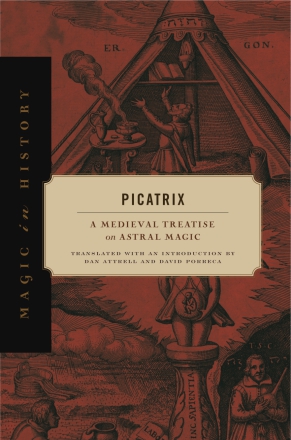
A manual for constructing talismans, mixing magical compounds, summoning planetary spirits, and determining astrological conditions, Picatrix is a cornerstone of Western esotericism. It offers important insights not only into occult practices and beliefs but also into the transmission of magical ideas from antiquity to the present. Dan Attrell and David Porreca’s English translation opens the world of this vital medieval treatise to modern-day scholars and lay readers.
