

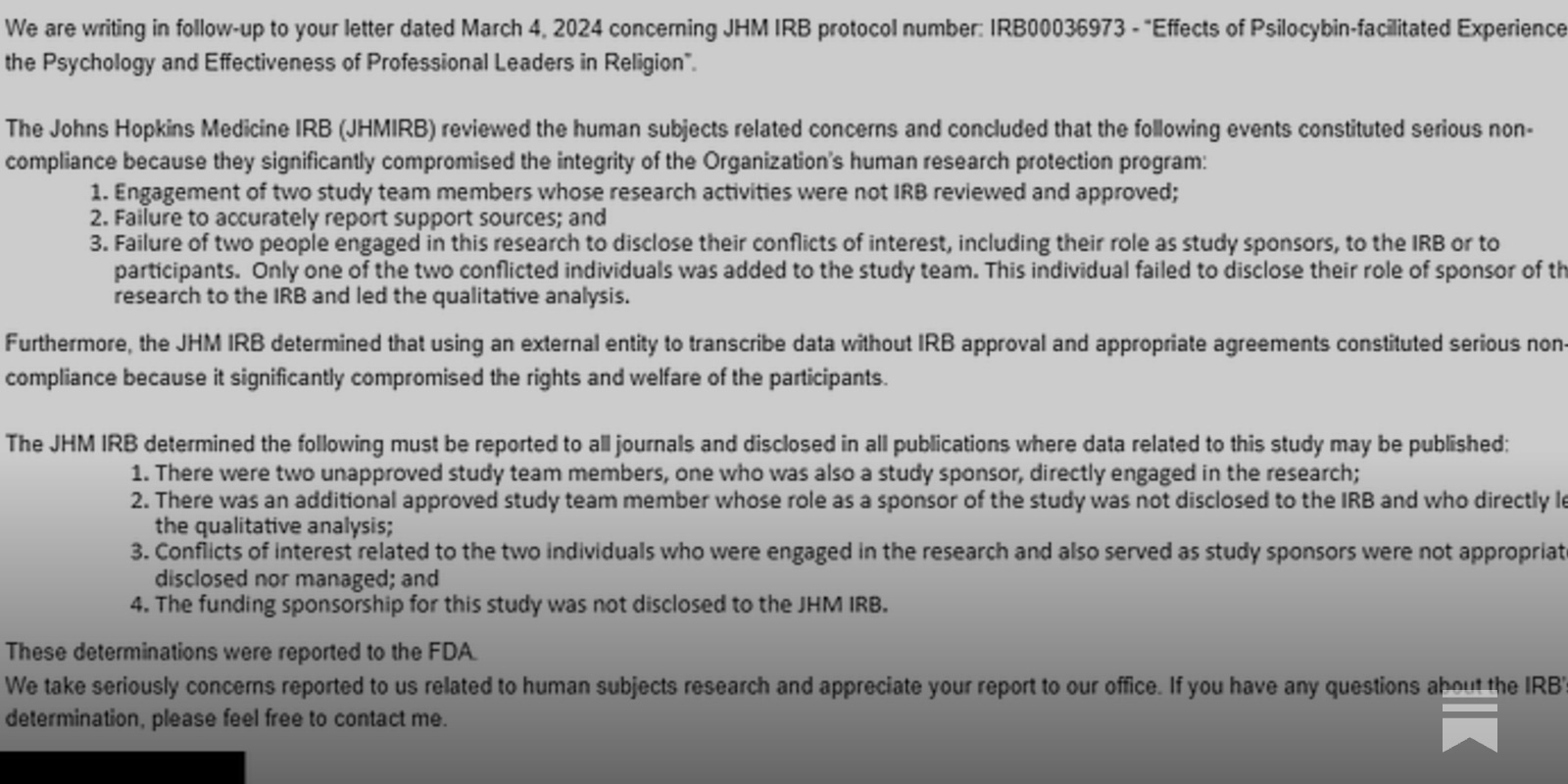
Unauthorized donor involvement and unauthorized study team members "significantly compromised" human research protection program, per JHU, citing other concerns for participants' rights and welfare.
What Happens When Clergy Take Psilocybin
The results of a controversial 10-year-old study of more than a dozen clergy who took psilocybin on guided trips only recently came to light.

Jonathan Pageau's Psychedelic Warning
Can Psychedelics Make Us More Moral?
With a renaissance going on in psychedelic research, is making us better people included?

What Are Psychedelic Entities?
The beings people often meet while using psychedelics resist tidy explanations.

Investigation finds ‘egregious misconduct’ by CUNY scientist
In a report shared with Science in October 2023, a committee investigating allegations of misconduct by Dr. Hoau-Yan Wang, a professor at the City College of New York (CCNY, which falls under the C…

How LLM Counselors Violate Ethical Standards in Mental Health Practice: A Practitioner-Informed Framework
Large language models (LLMs) were not designed to replace healthcare workers, but they are being used in ways that can lead users to overestimate the types of roles that these systems can assume. While prompt engineering has been shown to improve LLMs' clinical effectiveness in mental health applications, little is known about whether such strategies help models adhere to ethical principles for real-world deployment. In this study, we conducted an 18-month ethnographic collaboration with mental health practitioners (three clinically licensed psychologists and seven trained peer counselors) to map LLM counselors' behavior during a session to professional codes of conduct established by organizations like the American Psychological Association (APA). Through qualitative analysis and expert evaluation of N=137 sessions (110 self-counseling; 27 simulated), we outline a framework of 15 ethical violations mapped to 5 major themes. These include: Lack of Contextual Understanding, where the counselor fails to account for users' lived experiences, leading to oversimplified, contextually irrelevant, and one-size-fits-all intervention; Poor Therapeutic Collaboration, where the counselor's low turn-taking behavior and invalidating outputs limit users' agency over their therapeutic experience; Deceptive Empathy, where the counselor's simulated anthropomorphic responses (``I hear you'', ``I understand'') create a false sense of emotional connection; Unfair Discrimination, where the counselor's responses exhibit algorithmic bias and cultural insensitivity toward marginalized populations; and Lack of Safety & Crisis Management, where individuals who are ``knowledgeable enough'' to correct LLM outputs are at an advantage, while others, due to lack of clinical knowledge and digital literacy, are more likely to suffer from clinically inappropriate responses. Reflecting on these findings through a practitioner-informed lens, we argue that reducing psychotherapy—a deeply meaningful and relational process—to a language generation task can have serious and harmful implications in practice. We conclude by discussing policy-oriented accountability mechanisms for emerging LLM counselors.
How LLM Counselors Violate Ethical Standards in Mental Health Practice: A Practitioner-Informed Framework
Large language models (LLMs) were not designed to replace healthcare workers, but they are being used in ways that can lead users to overestimate the types of roles that these systems can assume. While prompt engineering has been shown to improve LLMs' clinical effectiveness in mental health applications, little is known about whether such strategies help models adhere to ethical principles for real-world deployment. In this study, we conducted an 18-month ethnographic collaboration with mental health practitioners (three clinically licensed psychologists and seven trained peer counselors) to map LLM counselors' behavior during a session to professional codes of conduct established by organizations like the American Psychological Association (APA). Through qualitative analysis and expert evaluation of N=137 sessions (110 self-counseling; 27 simulated), we outline a framework of 15 ethical violations mapped to 5 major themes. These include: Lack of Contextual Understanding, where the counselor fails to account for users' lived experiences, leading to oversimplified, contextually irrelevant, and one-size-fits-all intervention; Poor Therapeutic Collaboration, where the counselor's low turn-taking behavior and invalidating outputs limit users' agency over their therapeutic experience; Deceptive Empathy, where the counselor's simulated anthropomorphic responses (``I hear you'', ``I understand'') create a false sense of emotional connection; Unfair Discrimination, where the counselor's responses exhibit algorithmic bias and cultural insensitivity toward marginalized populations; and Lack of Safety & Crisis Management, where individuals who are ``knowledgeable enough'' to correct LLM outputs are at an advantage, while others, due to lack of clinical knowledge and digital literacy, are more likely to suffer from clinically inappropriate responses. Reflecting on these findings through a practitioner-informed lens, we argue that reducing psychotherapy—a deeply meaningful and relational process—to a language generation task can have serious and harmful implications in practice. We conclude by discussing policy-oriented accountability mechanisms for emerging LLM counselors.
Nixon official: real reason for the drug war was to criminalize black people and hippies
Vox is a general interest news site for the 21st century. Its mission: to help everyone understand our complicated world, so that we can all help shape it. In text, video and audio, our reporters explain politics, policy, world affairs, technology, culture, science, the climate crisis, money, health and everything else that matters. Our goal is to ensure that everyone, regardless of income or status, can access accurate information that empowers them.

Effective Altruism Is a Dangerous Cult — Here's Why
Understanding the "Scientology of Silicon Valley." (7,700 words)

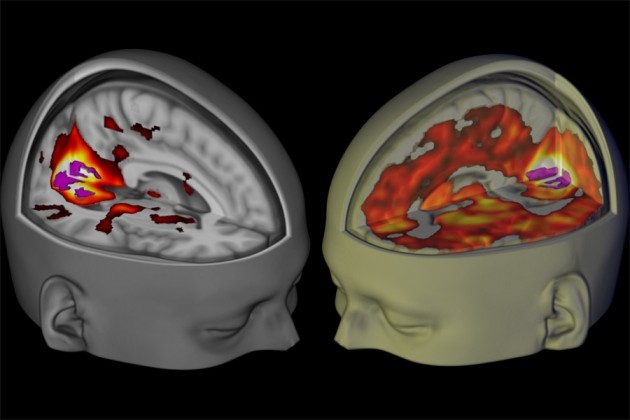
Brain scans reveal how LSD affects consciousness
Drug researcher David Nutt discusses brain-imaging studies with hallucinogens.
A Dose of a Hallucinogen From a ‘Magic Mushroom,’ and Then Lasting Peace (Published 2016)
Two studies used psilocybin to see if the drug could reduce depression and anxiety in cancer patients. The results were striking.

Fabricated citations: an audit across 2·5 million biomedical papers
Scientific literature depends on the integrity of its references. Each reference implicitly asserts that a verifiable source exists and supports the claims being made. When references point to non-existent studies, readers, reviewers, and policy makers are unable to evaluate the evidence.

Fabricated citations: an audit across 2·5 million biomedical papers
Scientific literature depends on the integrity of its references. Each reference implicitly asserts that a verifiable source exists and supports the claims being made. When references point to non-existent studies, readers, reviewers, and policy makers are unable to evaluate the evidence.
This is crazy! The data from the study show patterns that make it nearly impossible for it to be legit. But we can learn a lot from the tone of the comments. "We have concerns about [x], please clarify." Out in the wild, this would be THESE IDIOTS FAKED THEIR STUDY!!

Health Nerd
This is one of the most remarkable academic debacles I've ever seen. A large RCT got published in BMJ. There are currently 44 Pubpeer comments, mostly about the data, including...well. Read for yourself. pubpeer.com/publications/C08779C45DB6E407…
Excuse me but this is cult behavior. And as a scientist, I have no business joining a cult. These personalized insults and intolerance for criticism are not scholarly virtues however you cut it. I do not understand or relate to it. What is my worth as a scholar if I do not value evidence over faith?
@bmj.com Please look at PubPeer comments on an article you published last week. pubpeer.com/publications/C08779C45DB6E407… I think your research integrity dept shld act swiftly on this one, given clinical significance. I'm aware of even more evidence of problems so let me know if this is not sufficient.
PubPeer - Prevention of acute myocardial infarction induced heart fail...
pubpeer.com

