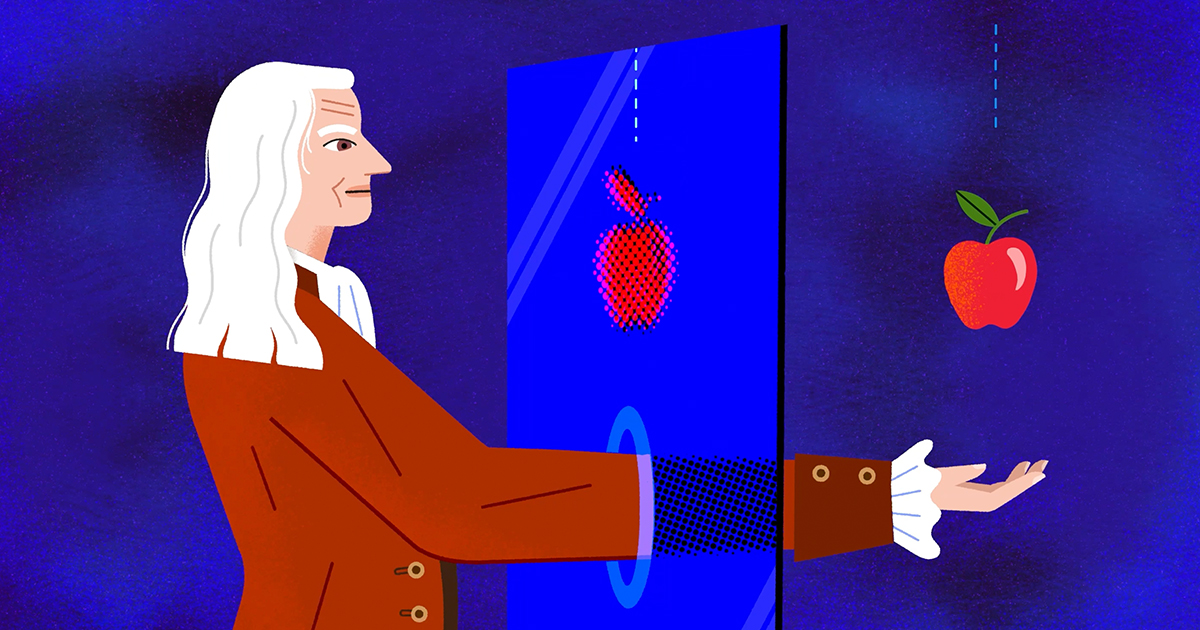
In holographic theories, physicists may have traced the pliability of space-time to its quantum roots: a measure of quantumness known as “magic.”
🔬Doing Vibe Physics — Alex Lupsasca, OpenAI
The full story of how GPT‑5.x derived new results in theoretical physics and quantum gravity.
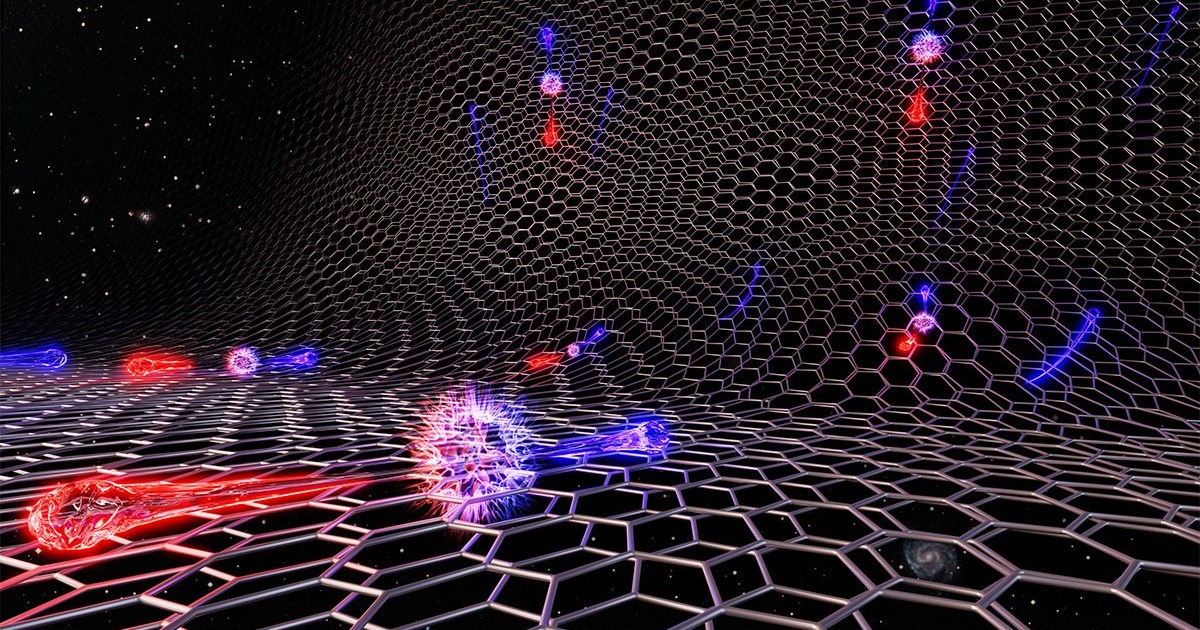
Out of Nowhere: The Emergence of Spacetime in Quantum Theories of Gravity
Out of Nowhere is the monograph co-authored by Nick Huggett and Christian Wüthrich, which appeared in 2025 from Oxford University Press. Selected chapters are posted here. (Our publication agreemen…

70-year-old quantum prediction comes true, as something is created from nothing
In our common experience, you can't get something for nothing. In the quantum realm, something really can emerge from nothing.

The Causal Axioms of Algebraic Quantum Field Theory: A Diagnostic
This paper examines the axioms of algebraic quantum field theory (AQFT) that aim to characterize the theory as one that implements relativistic causation. I suggest that the spectrum condition (SC), microcausality (MC), and primitive causality axioms (PC), taken individually, fall short of fulfilling this goal against what some philosophers have claimed. Instead, I will show that the “local primitive causality” (LPC) condition captures each axiom’s advantages. However, this is only the case because SC, MC, and PC, taken together, imply LPC, as I will show from a construction by Haag and Schroer (1962).
Putting Paradoxes to Work: Contextuality in Measurement-Based Quantum Computation
We describe a joint cohomological framework for measurement-based quantum computation (MBQC) and the corresponding contextuality proofs. The central object in this framework is an element $$[\beta _\Psi ]$$[βΨ]in the second cohomology group of the chain complex describing a given MBQC. $$[\beta _\Psi ]$$[βΨ]contains the function computed therein up to gauge equivalence, and at the same time is a contextuality witness. The present cohomological description only applies to temporally flat MBQCs, and we outline an approach for extending it to the temporally ordered case.

Categorical quantum mechanics
Categorical quantum mechanics is the study of quantum foundations and quantum information using paradigms from mathematics and computer science, notably monoidal category theory. The primitive objects of study are physical processes, and the different ways these can be composed. It was pioneered in 2004 by Samson Abramsky and Bob Coecke. Categorical quantum mechanics is entry 18M40 in MSC2020.
QBism: Quantum Theory as a Hero's Handbook
This paper represents an elaboration of the lectures delivered by one of us (CAF) during "Course 197 -- Foundations of Quantum Physics" at the International School of Physics "Enrico Fermi" in Varenna, Italy, July 2016. Much of the material for it is drawn from arXiv:1003.5209, arXiv:1401.7254, and arXiv:1405.2390. However there are substantial additions of original material in Sections 4, 7, 8 and 9, along with clarifications and expansions of the older content throughout. Topics include the meaning of subjective probability; no-cloning, teleportation, and quantum tomography from the subjectivist Bayesian perspective; the message QBism receives from Bell inequality violations (namely, that nature is creative); the import of symmetric informationally complete (SIC) quantum measurements for the technical side of QBism; quantum cosmology QBist-style; and a potential meaning for the holographic principle within QBism.

Philosophy Has Made Plenty of Progress
Philosopher Tim Maudlin sees advances in free will, morality and the meaning of quantum mechanics

The Consistent Histories Approach to Quantum Mechanics
The consistent histories, also known as decoherent histories, approachto quantum interpretation is broadly compatible with standard quantummechanics as found in textbooks. However, the concept ofmeasurement by which probabilities are introduced in standardquantum theory no longer plays a fundamental role. Instead,all quantum time dependence is probabilistic (stochastic),with probabilities given by the Born rule or its extensions. Byrequiring that the description of a quantum system be carried outusing a well-defined probabilistic sample space (called a“framework”) this approach resolves many well-knownquantum paradoxes of quantum foundations. In particular, quantummechanics is local and consistent with special relativity. Classicalmechanics emerges as a useful approximation to the more fundamentalquantum mechanics under suitable conditions. The price to be paid forthis is a set of rules for reasoning resembling, but very much simplerthan, those of quantum logic. An important philosophical implicationis the absence of a single universally-true state of affairs at eachinstant of time. However, there is a correspondence limit in which thenew quantum logic becomes standard logic in the macroscopic world ofeveryday experience, and the laws of classical mechanics emerge as agood approximation to an underlying, and in principle more exact,quantum description.
Bernhard Mueller on Twitter / X
Our Theory-of-Everything, OPH, completely unifies the Standard Model with gravity: A SINGLE constant determines both Newton's constant G and the particle spectrum. Mass-less photons, gravitons and gluons emerge for free. https://t.co/dUh6TLAlop— Bernhard Mueller (@muellerberndt) April 4, 2026
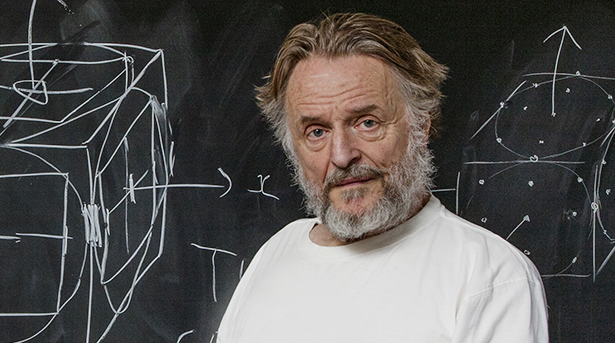
A Life in Games | Quanta Magazine
The mathematician John Horton Conway’s myriad accomplishments — including the Game of Life, sprouts and the surreal numbers — are the product of a mind at play.
Gravity
In physics, gravity, also known as gravitation or a gravitational interaction, is a fundamental interaction, which may be described as the force that draws material objects towards each other.

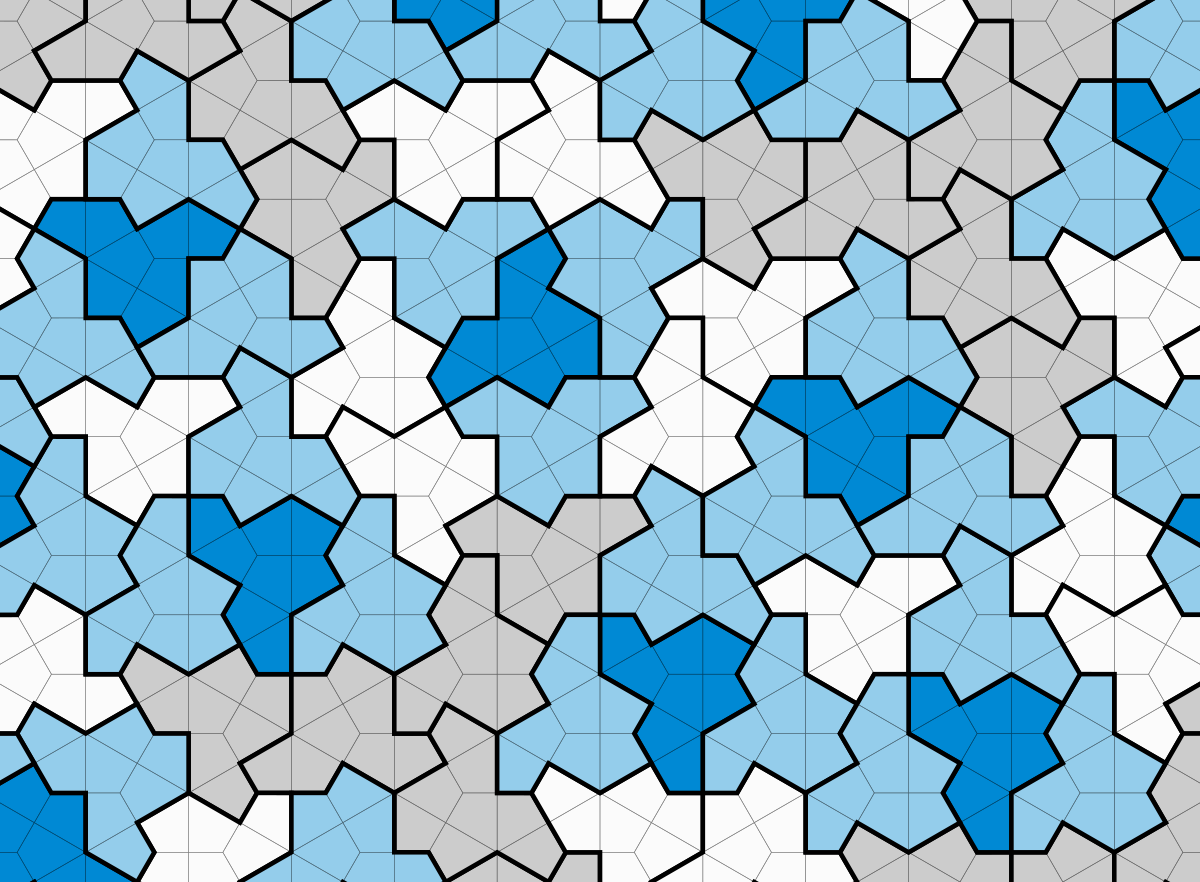
Newfound Mathematical 'Einstein' Shape Creates a Never-Repeating Pattern
A new shape called an einstein has taken the math world by storm. The craggy, hat-shaped tile can cover an infinite plane with patterns that never repeat.
How physics at the roots of reality point to a grand unified theory | Aeon Essays
Physics displays an uncanny alignment at its very deepest levels. Is a grand theory of everything finally within reach?
Quantum Leap: Google Claims Its New Quantum Computer Provides Evidence That We Live In A Multiverse
Google's quantum computer, Willow, suggests evidence for a multiverse by leveraging computations across parallel universes.