

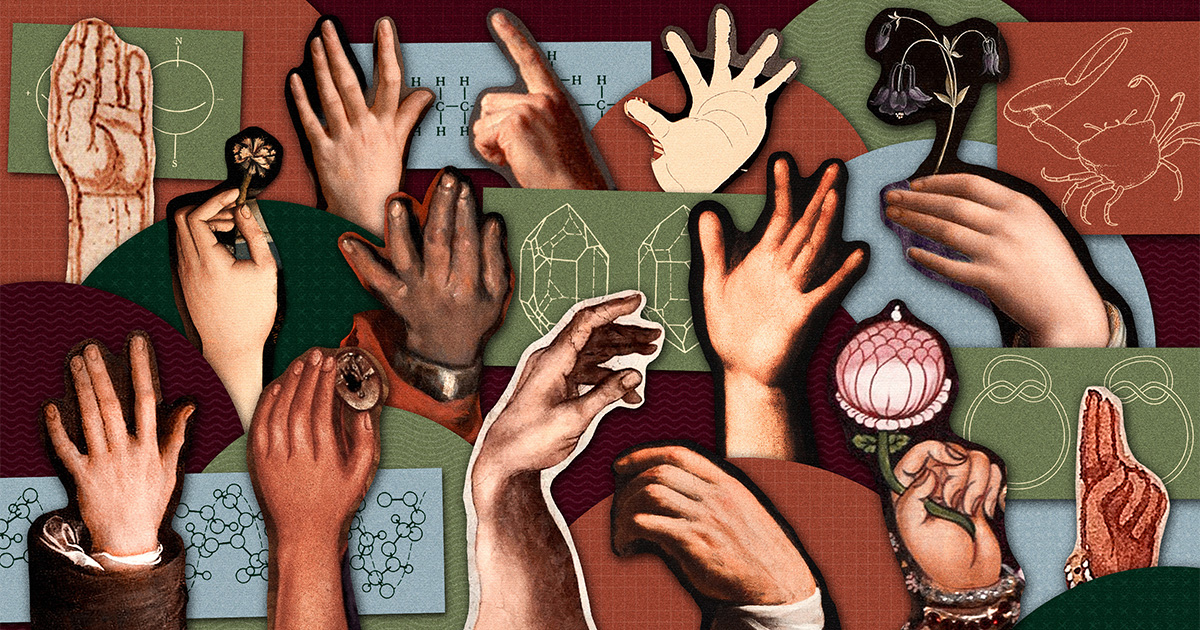
An invisible difference in 10% of humans poses deep mysteries in several fields at once.
Concepts of Hand and Technology
Rather than conceiving of humans and machines through their opposition, we must track their conceptual relationship to a third term: the hand....

Left & Right: The Psychological Significance of a Political Distinction
This book brings together for the first time an updated, revised collection of influential essays and articles that capture some of the most exciting scientific and scholarly contributions to the topic ...

LeftValues
LeftValues is a leftist quiz inspired by and based upon the 8values quiz that seeks to identify your position on the left-wing spectrum. If you are not a leftist, this quiz is obviously not suited for you. You will be presented with a statement, and then you will answer with your opinion on the statement, from Strongly Agree to Strongly Disagree, with each answer slightly affecting your scores. The questions for each axes are presented in order, rather than scattered. At the end of the quiz, your answers will be compared to the maximum possible for each value, thus giving you a percentage. Answer honestly! There are questions in the test.
Culture on the Ground - Tim Ingold, 2004
Classical accounts of human evolution posit a progressive differentiation between the hands as instruments of rational intelligence and feet as ...

inessential: Social Anxiety
I will leave you hanging, because it never occurs to me to wonder why you have your hand raised.
The Master and His Emissary: The Divided Brain and the Making of the Western World
In a book of unprecedented scope--now available in a larger format-Iain McGilchrist presents a fascinating exploration of the differences between the brain's left and right hemispheres, and how those differences have affected society, history, and culture. McGilchrist draws on a vast body of recent research in neuroscience and psychology to reveal that the difference is profound: the left hemisphere is detail oriented, while the right has greater breadth, flexibility, and generosity. McGilchrist then takes the reader on a journey through the history of Western culture, illustrating the tension between these two worlds as revealed in the thought and belief of thinkers and artists from Aeschylus to Magritte. "A landmark new book. . . . It tells a story you need to hear, of where we live now."-Bryan Appleyard, Sunday Times "A very remarkable book. . . . McGilchrist, who is both an experienced psychiatrist and a shrewd philosopher, looks at the relation between our two brain-hemispheres in a new light, not just as an interesting neurological problem but as a crucial shaping factor in our culture . . . splendidly thought-provoking. . . . I couldn't put it down."-Mary Midgley, The Guardian Named one of the best books of 2010 by The Guardian
Leftism | The Paper Pilot
The Paper Pilot's digital garden of thoughts on philosophy, politics, and sociology
Why do some people always get lost?
Research suggests that experience may matter more than innate ability when it comes to a sense of direction

Writing by Hand is Good for your Brain - Here's how to do it
Because I am known to write using a fountain pen on paper, a number of people have pointed me to this post and its underlying research. I won’t rehash what is said in those sources, but the gist of it is that when you write things down by hand you’re recruiting more of your brain, which is a good thing.

Why I Was Part Of The Neoreactionary or Dissident Right Movement In 2020
And a few things that happened while I was there

What’s Lost as Handwriting Fades (Published 2014)
Even as the emphasis shifts to the keyboard, experts say that learning to write by hand improves motor skills, memory and creativity.

Lutnick: Anthropic is "back on the right side" with Trump administration
The statement marks a remarkable turnaround in a relationship strained by a bitter fight over national security and AI safeguards.

An interesting observation by Agnes Callard
The 'uni-context' and a left hemisphere dominated world

This Is Your Brain on Podcasts (Published 2016)
Different people’s brains absorb a compelling story in the roughly the same complicated pattern, using many parts of the brain, researchers found.


