

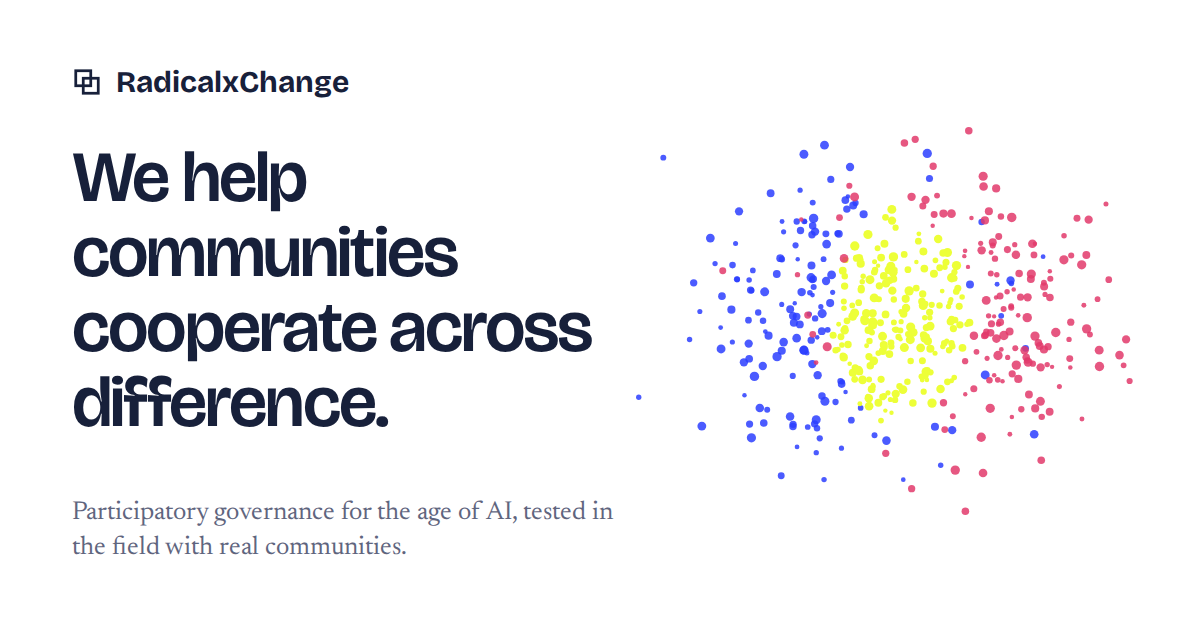
RadicalxChange is an international nonprofit advancing participatory governance in the age of AI. We build and field-test mechanisms that let people who disagree steward what they share.
About
RadicalxChange Foundation is an international nonprofit advancing participatory governance in the age of AI, championing Plurality.
Motivating The Case for Decentralized Social Identity: Part One
RadicalxChange Foundation is an international nonprofit advancing participatory governance for the age of AI, championing Plurality to keep human agency and democratic participation at the wheel.
The Data Freedom Act
RadicalxChange Foundation is an international nonprofit advancing participatory governance for the age of AI, championing Plurality to keep human agency and democratic participation at the wheel.
Democratic AI is Possible. The Democracy Levels Framework Shows How It Might Work
This position paper argues that effectively "democratizing AI" requires democratic governance and alignment of AI, and that this is particularly valuable for decisions with systemic societal impacts. Initial steps -- such as Meta's Community Forums and Anthropic's Collective Constitutional AI -- have illustrated a promising direction, where democratic processes could be used to meaningfully improve public involvement and trust in critical decisions. To more concretely explore what increasingly democratic AI might look like, we provide a "Democracy Levels" framework and associated tools that: (i) define milestones toward meaningfully democratic AI, which is also crucial for substantively pluralistic, human-centered, participatory, and public-interest AI, (ii) can help guide organizations seeking to increase the legitimacy of their decisions on difficult AI governance and alignment questions, and (iii) support the evaluation of such efforts.

Transfeminist AI governance
This paper re-imagines the governance of artificial intelligence (AI) through a transfeminist lens, focusing on challenges of power, participation, and injustice, and on opportunities for advancing equity, community-based resistance, and transformative change. AI governance is a field of research and practice seeking to maximize benefits and minimize harms caused by AI systems. Unfortunately, AI governance practices are frequently ineffective at preventing AI systems from harming people and the environment, with historically marginalized groups such as trans people being particularly vulnerable to harm. Building upon trans and feminist theories of ethics, I introduce an approach to transfeminist AI governance. Applying a transfeminist lens in combination with a critical self-reflexivity methodology, I retroactively reinterpret findings from three empirical studies of AI governance practices in Canada and globally. In three reflections on my findings, I show that large-scale AI governance systems structurally prioritize the needs of industry over marginalized communities. As a result, AI governance is limited by power imbalances and exclusionary norms. My reflections reveal that re-grounding AI governance in transfeminist ethical principles can support AI governance researchers, practitioners, and organizers in addressing those limitations.
Building a Solidarity Ecosystem for AI (SSIR)
How cooperatives, public institutions, and social movements can come together to intentionally build a practical, community-owned alternative to extractive AI systems. <meta property=

Against “Democratizing AI”
This paper argues against the call to democratize artificial intelligence (AI). Several authors demand to reap purported benefits that rest in direct and broad participation: In the governance of AI, more people should be more involved in more decisions about AI—from development and design to deployment. This paper opposes this call. The paper presents five objections against broadening and deepening public participation in the governance of AI. The paper begins by reviewing the literature and carving out a set of claims that are associated with the call to “democratize AI”. It then argues that such a democratization of AI (1) rests on weak grounds, because it does not answer to a demand of legitimization, (2) is redundant in that it overlaps with existing governance structures, (3) is resource intensive, which leads to injustices, (4) is morally myopic and thereby creates popular oversights and moral problems of its own, and finally, (5) is neither theoretically nor practically the right kind of response to the injustices that animate the call. The paper concludes by suggesting that AI should be democratized not by broadening and deepening participation but by increasing the democratic quality of the administrative and executive elements of collective decision making. In a slogan: The question is not so much whether AI should be democratized but how.

Who and What comprise AI Skepticism?
An attempt to do justice to a diverse community

Democratizing AI Companies — The Collective Intelligence Project
As AI reshapes society, the companies behind these technologies face a critical challenge: how to build corporate governance structures that prioritize public benefit over profit maximization;.

Choosing Wisely: A New Resource for Picking the Right Participation Platform
Choosing a digital participation platform is a governance choice. Dane Gambrell's latest post explores what the new Guide to Digital Participation Platforms gets right, the idea that participation only works when tools are matched to purpose, capacity, and follow-through. Join us tomorrow, September 24 at 3pm ET, for a hands-on InnovateUS workshop with Greta Ríos and Nikhil Kumar to learn how to select the right tool for the job to apply AI to advance democracy.
Digital Democracy in Decentralised Autonomous Organisations
Decentralised autonomous organisations (DAOs) are institutional technologies that enable democratic governance innovation. They inherit key democratic principles such as procedural transparency and immutable records from being based on blockchain technology. This paper conducts a systematic literature review to examine governance mechanisms and challenges of digital democracy in DAOs. While issues like power concentration and coordination failures exist in current implementations, we argue that the concept of DAOs offers new opportunities for transparent governance and participatory decision-making. As testbeds for governance experiments, we find that DAOs have the potential to reshape democratic processes and foster innovative governance models in the digital era. Calling for interdisciplinary collaboration, further research is needed around Sybil-resistant voting mechanisms, ideological path dependencies and deliberation mechanisms.

1Password's research finds AI agent adoption is outpacing governance | 1Password
1Password's AI agent governance survey reveals widespread security, visibility, governance, and accountability challenges as AI agents move into production.

"Okay, I've Actually Softened My Take on This": How People in Decentralized Social Media Reason about the Appropriateness of Generative AI
Generative AI (GenAI) is increasingly integrated into social media, raising questions about whether, where, and how it belongs. In decentralized social media (DSM), these decisions are distributed across users, developers, moderators, and administrators, making GenAI a collective governance challenge. At the same time, public discourse often flattens arguments to broad pro- or anti-AI positions that offer little insight into what people actually find (in)appropriate and why. Through 20 semi-structured interviews with people from Mastodon and Bluesky, structured around seven GenAI scenarios, we examine how people reason about GenAI's appropriateness in DSM. We find that participants drew conditional boundaries around particular GenAI configurations through distinct, salient, and weighted considerations spanning technology, integration, and use. We conceptualize this as boundary drawing and show how making such boundaries visible can support more grounded design, policy, and collective deliberation around GenAI in DSM.
A Roadmap to Democratic AI — The Collective Intelligence Project
Our roadmap outlines concrete steps that can be taken in 2024 to build a more democratic AI ecosystem that is adaptive, accountable, processes decentralized information, provides public goods, and safeguards human wellbeing. We describe what the ecosystem could build, research, advocate for, and fun
What is to be done: strategies and tactics for a new (geo)political landscape