Introducing DaisyRose-27B, RadixArk’s first model, trained with Miles on 1,200 curated tasks in 18 days on 144 H200 GPUs.
DaisyRose-27B: Pushing the Frontier of Post-Training Efficiency
A Blog post by RadixArk on Hugging Face

Post-Training 50x Faster
We're announcing Trellis, the fastest open-source post-training code for Kimi K2 Thinking

Accelerating GPT-5.6 Sol Ultrafast with OpenAI
Cerebras powers OpenAI’s GPT-5.6 Sol Ultrafast in the OpenAI API, delivering frontier intelligence at real-time speeds for critical AI work.
Post-Training in the Open
We’re excited to share more about our progress post-training our mixture of experts models. Our latest milestone is the release of Marin 67B-A2B “Snowball” v0.1, a mixture of experts model trained...

Miles v0.1: Production-level Post-training
We present Miles v0.1, a full-stack production-ready system for frontier post-training, the successor to our first Miles release [1]. Building upon slime's [16] clean design, Miles optimizes every sta...
Modern GPU Programming For MLSys — Modern GPU Programming For MLSys
Machine learning systems sit at the heart of modern AI workloads. In these systems, performance often comes down to the quality of a small number of GPU kernels. Attention kernels, LLM prefill and decode kernels, low-precision block-scaled GEMMs, fused MoE layers, and other large fused kernels all directly shape end-to-end speed in both training and serving.
Modern GPU Programming For MLSys — Modern GPU Programming For MLSys
Machine learning systems sit at the heart of modern AI workloads. In these systems, performance often comes down to the quality of a small number of GPU kernels. Attention kernels, LLM prefill and decode kernels, low-precision block-scaled GEMMs, fused MoE layers, and other large fused kernels all directly shape end-to-end speed in both training and serving.
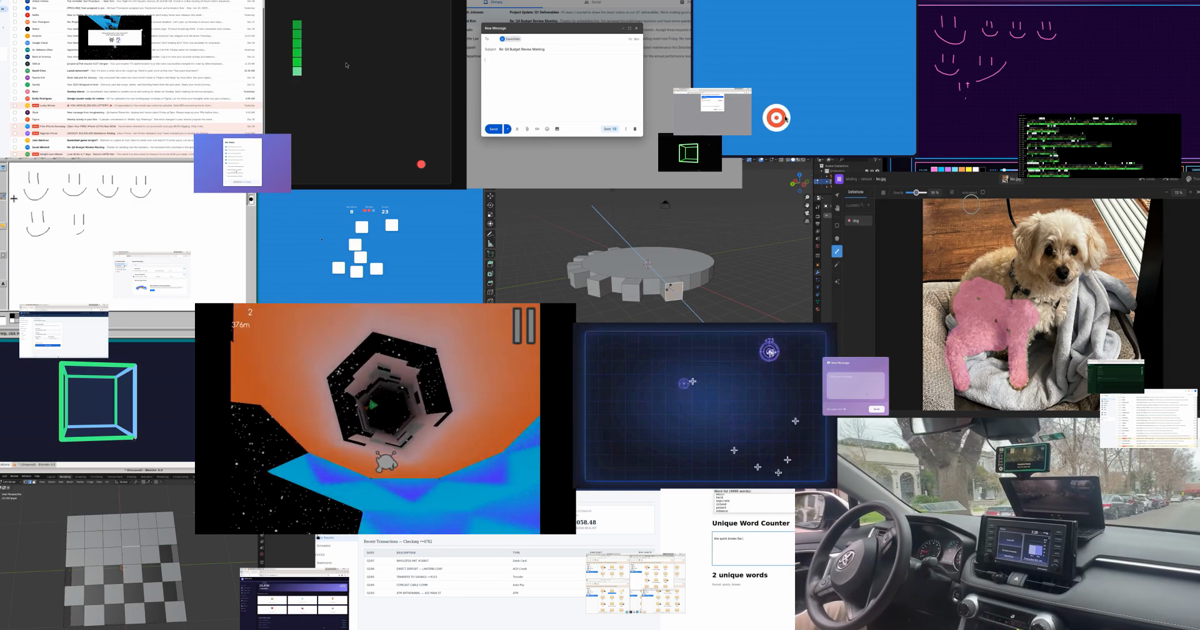
The First Fully General Computer Action Model
We trained a model on our 11-million-hour video dataset. Our model can explore complex websites, complete multi-action CAD modeling sequences, and drive a car in the real world, all at 30 FPS.
Grace Blackwell needs a new scheduler: 27% more usable GPUs from the same racks
NVL72 puts all 72 GPUs in a rack on one NVLink fabric, but only rack-local jobs get the speedup. How SkyPilot keeps multi-node training and inference on NVLink with topology-aware placement, in-place recovery from GPU failures, and automatic defragmentation.

elie on Twitter / X
nice pre training work by nous claiming ~2.5x efficiency gains, building on previous research like MTP/SuperBPE. overall intuition is that at each step you want the model to process and predict more tokens https://t.co/K33QtJiF5C pic.twitter.com/hDlSbv1Tg9— elie (@eliebakouch) May 13, 2026

Paul Novosad on Twitter / X
I made an AI running/training coach last fall.With its guidance, I smoked my 5km PR.It's 100x better than the stuff on offer from Garmin/Strava and it was the easiest thing in the world. The first pass was just a bunch of markdown files and a Codex instance.Some notes 1/ pic.twitter.com/yE360Mk8Pg— Paul Novosad (@paulnovosad) June 24, 2026

TorchNeuron: running HF models on AWS Trainium is easier than ever
We’re on a journey to advance and democratize artificial intelligence through open source and open science.

What We Learned from Letting AI Posttrain AI
We built a posttraining task that runs for 20 hours with the Tinker API. The core bottleneck is research intuition.

Introducing FrontierHarness Eval v1.1 — RUNTA
FrontierHarness Eval v1.1 ran 22 coding-agent harnesses with 5 models on the same 62 tasks, 4 times each: 27,280 runs. The best-value harness was different with each model, and cost ranks moved far between models. With the model fixed, the most expensive harness cost 1.8 to 5.0 times as much per task as the cheapest.
Random Forest ML on GPU
In my recent post on Rastair , we looked at some performance best-practices and optimizations for Rastair , a bioinformatics tool that I’m currently working on. One of the slowest parts of the tool is …
Frontier Pre-training at Microsoft AI | Microsoft AI
In June, we announced MAI-Thinking-1, a general-purpose foundation model post-trained on top of MAI-Base-1 with strong reasoning performance. We’ve recently completed pre-training our new state-of-the-art model, MAI-Base-2, an MoE foundation model with 80 billion active and 2.8 trillion total parameters.