


A large number of MAGA social media influencers were exposed over the weekend as being being based in other countries.Podcaster Matt Binder posted screenshots showing that Charlie’s Voice Rising, a popular Charlie Kirk fan account, is based in Eastern Europe (non-EU).One popular influencer wrote "wa...
America Last: How Fuentes’s Coordinated Raids and Foreign Fake-Speech Networks Inflate His Influence - Network Contagion Research Institute

Media Influence Matrix – The World's Most Reliable Influence Tracker
This week’s edition reads five FY2025 reports against each other: Dnevnik (Slovenia), Delfi Latvia, Phoenix New Media (China), Hanza Media (Croatia) and Digi Communications (Romania). It finds two publishers separating their journalism from their balance sheets, a Croatian publisher closing a 35-year-old political weekly on a 1.1% net margin, a Chinese state-linked digital news group whose financial centre has quietly shifted from advertising to mini-program reading apps, and a Romanian telecom giant’s having its news channel walk off the must-carry list.
How to rage bait Americans
Archived Fact-Checked Media — MediaVault
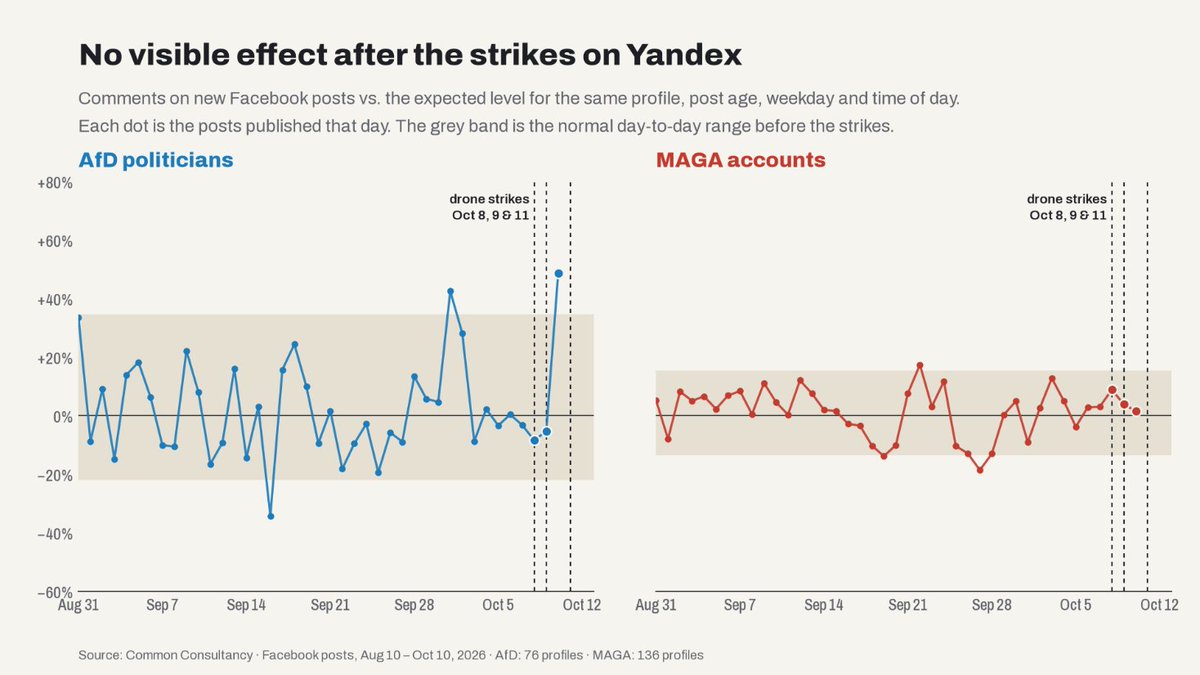
“There's a story going around: after the drone strikes on Yandex data centres, comments on AfD and MAGA accounts collapsed. We monitor 17,000+ politicians, media and civil society accounts in 30+ countries. 50,000+ posts a day. So we checked. We don't see it. 🧵 https://t.co/8quSNosqv0”
The spreading of misinformation online
Significance The wide availability of user-provided content in online social media facilitates the aggregation of people around common interests, worldviews, and narratives. However, the World Wide Web is a fruitful environment for the massive diffusion of unverified rumors. In this work, using a massive quantitative analysis of Facebook, we show that information related to distinct narratives––conspiracy theories and scientific news––generates homogeneous and polarized communities (i.e., echo chambers) having similar information consumption patterns. Then, we derive a data-driven percolation model of rumor spreading that demonstrates that homogeneity and polarization are the main determinants for predicting cascades’ size. , The wide availability of user-provided content in online social media facilitates the aggregation of people around common interests, worldviews, and narratives. However, the World Wide Web (WWW) also allows for the rapid dissemination of unsubstantiated rumors and conspiracy theories that often elicit rapid, large, but naive social responses such as the recent case of Jade Helm 15––where a simple military exercise turned out to be perceived as the beginning of a new civil war in the United States. In this work, we address the determinants governing misinformation spreading through a thorough quantitative analysis. In particular, we focus on how Facebook users consume information related to two distinct narratives: scientific and conspiracy news. We find that, although consumers of scientific and conspiracy stories present similar consumption patterns with respect to content, cascade dynamics differ. Selective exposure to content is the primary driver of content diffusion and generates the formation of homogeneous clusters, i.e., “echo chambers.” Indeed, homogeneity appears to be the primary driver for the diffusion of contents and each echo chamber has its own cascade dynamics. Finally, we introduce a data-driven percolation model mimicking rumor spreading and we show that homogeneity and polarization are the main determinants for predicting cascades’ size.

Magamba Network – We are Africa's trailblazing creative & digital media organisation.
We’re all about using arts, digital media, civic tech & activism to reach young people and get them involved in the big issues of our time. We run some of the most disruptive digital platforms & creative initiatives on the African continent with an online community of over 500,000 young people.
The Feed Is Fake
That “viral” song, movie, influencer, and celebrity drama you scrolled by recently was likely the result of a stealth marketing campaign.

revolution.social with @rabble
Auditing Political Exposure Bias: Algorithmic Amplification on Twitter/X During the 2024 U.S. Presidential Election
Approximately 50% of tweets in X's user timelines are personalized recommendations from accounts they do not follow. This raises a critical question: What political content are users exposed to beyond their established networks, and what implications does this have for democratic discourse online? In this paper, we present a six-week audit of X's algorithmic content recommendations during the 2024 U.S. Presidential Election by deploying 120 sock-puppet monitoring accounts to capture tweets from their personalized "For You" timelines. Our objective is to quantify out-of-network content exposure for right- and left-leaning user profiles and assess any potential inequalities and biases in political exposure. Our findings indicate that X's algorithm skews exposure toward a few high-popularity accounts across all users, with right-leaning users experiencing the highest level of exposure inequality. Both left- and right-leaning users encounter amplified exposure to accounts aligned with their own political views and reduced exposure to opposing viewpoints. Additionally, we observe that new accounts experience a right-leaning bias in exposure within their default timelines. Our work contributes to understanding how content recommendation systems may induce and reinforce biases while exacerbating vulnerabilities among politically polarized user groups. We underscore the importance of transparency-aware algorithms in addressing critical issues such as safeguarding election integrity and fostering a more informed digital public sphere.

Who are the rightwing influencers filling Trump’s head with visions of antifa?
Meet the content creators whose videos from Portland and Chicago shape the president’s distorted view of reality
Uncovering Coordinated Networks on Social Media: Methods and Case Studies
Coordinated campaigns are used to influence and manipulate social media platforms and their users, a critical challenge to the free exchange of information online. Here we introduce a general, unsupervised network-based methodology to uncover groups of accounts that are likely coordinated. The proposed method constructs coordination networks based on arbitrary behavioral traces shared among accounts. We present five case studies of influence campaigns, four of which in the diverse contexts of U.S. elections, Hong Kong protests, the Syrian civil war, and cryptocurrency manipulation. In each of these cases, we detect networks of coordinated Twitter accounts by examining their identities, images, hashtag sequences, retweets, or temporal patterns. The proposed approach proves to be broadly applicable to uncover different kinds of coordination across information warfare scenarios.
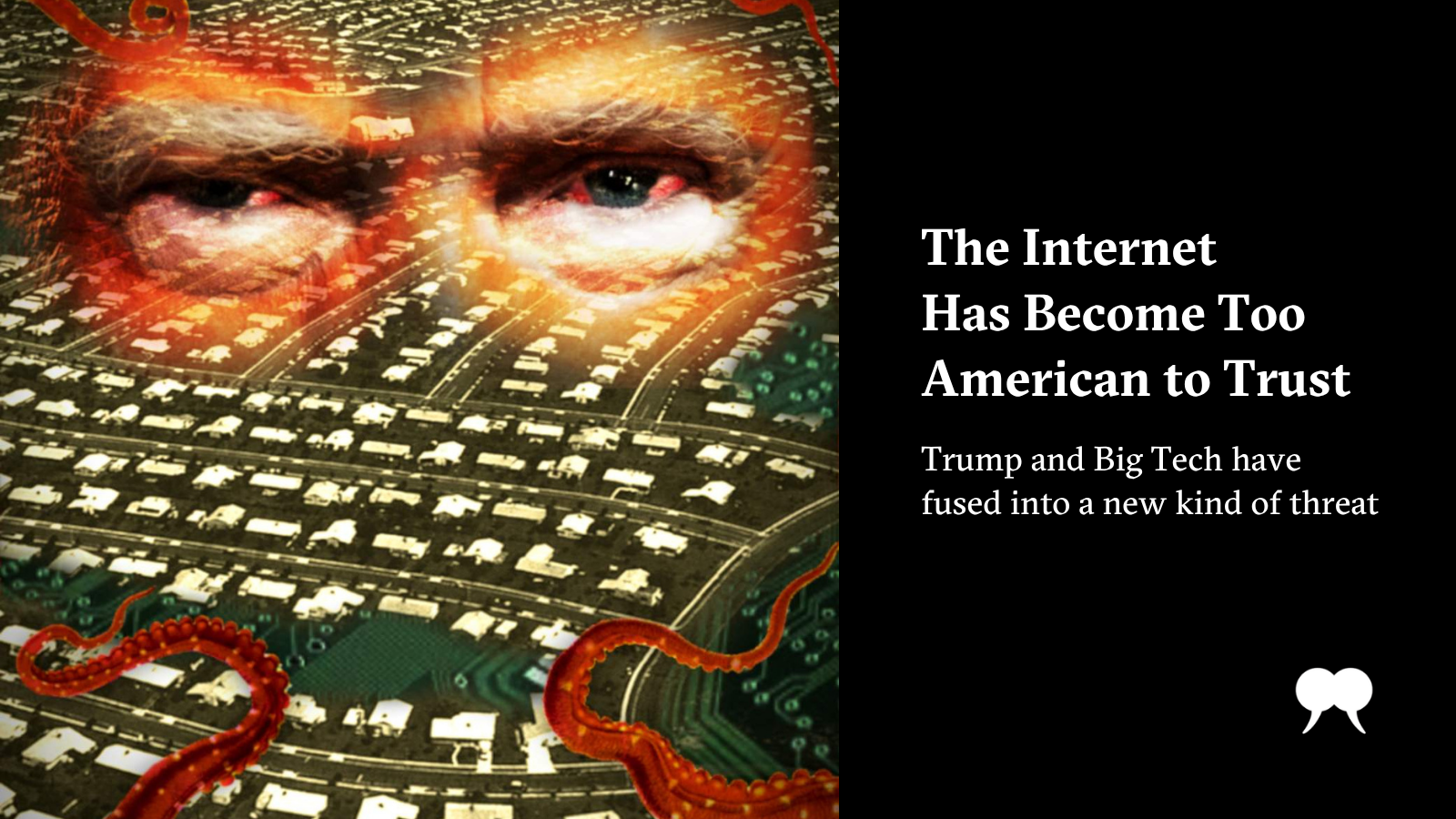
The Internet Has Become Too American to Trust | The Walrus
Trump and Big Tech have fused into a new kind of threat
How a fake network pushes pro-China propaganda
The web of 350 fake social media profiles aims to discredit the West, sometimes with garish cartoons.

How a Chinese marketing network quietly injects political narratives into Taiwanese lifestyle content
A new investigation by Reporters Without Borders (RSF) reveals how certain Facebook pages posing as lifestyle hubs for hobbies and health tips inject Beijing’s political narratives into their feeds to influence public opinion in Taiwan. These pages are tied to the China-based digital marketing company Wubianjie, which blends entertainment, disinformation and political messaging in cognitive warfare campaigns that are difficult to detect.

It occurs to me that since I have unique data on the right-wing ecosystem on Facebook, I can actually tell you with data, not vibes, if there actually has been a 50% decrease (the original claim) in bot activity on here supporting MAGA, or even any kind of substantial effect at all. There isn't.
By popular demand: A follow-up thread on Russian bots, Yandex, Cloudflare, MAGA, AfD and "breathing easier" on social media. 1️⃣ We see no "dramatic drop" in traffic of Kremlin-aligned human trolls-for-hire targeting Russian domestic users (which we have been tracking for years).

