

101 votes, 68 comments. It’s probably much worse cause I’m in ID and so I defer plenty to our adjuster but I just find mediation so draining and…
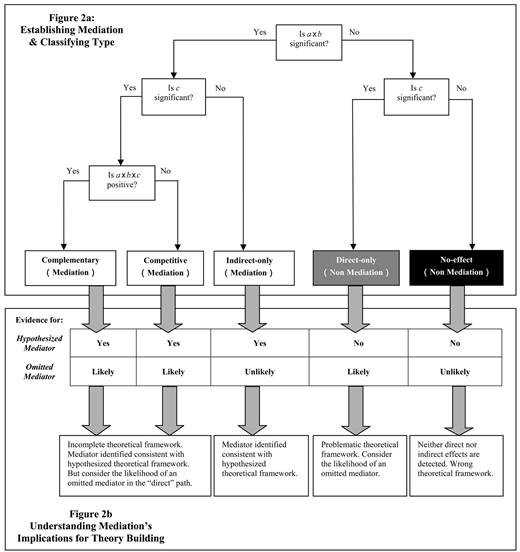
Addressing Moderated Mediation Hypotheses: Theory, Methods, and Prescriptions
This article provides researchers with a guide to properly construe and conduct analyses of conditional indirect effects, commonly known as moderated mediation effects. We disentangle conflicting d...

Reconsidering Baron and Kenny: Myths and Truths about Mediation Analysis
Abstract. Baron and Kenny’s procedure for determining if an independent variable affects a dependent variable through some mediator is so well known that i
Introduction to Statistical Mediation Analysis
This volume introduces the statistical, methodological, and conceptual aspects of mediation analysis. Applications from health, social, and developmental psychology, sociology, communication, exercise science, and epidemiology are emphasized throughout. Single-mediator, multilevel, and longitudinal models are reviewed. The author's goal is to help the reader apply mediation analysis to their own data and understand its limitations. Each chapter features an overview, numerous worked examples, a summary, and exercises (with answers to the odd numbered questions). The accompanying CD contains outputs described in the book from SAS, SPSS, LISREL, EQS, MPLUS, and CALIS, and a program to simulate the model. The notation used is consistent with existing literature on mediation in psychology. The book opens with a review of the types of research questions the mediation model addresses. Part II describes the estimation of mediation effects including assumptions, statistical tests, and the construction of confidence limits. Advanced models including mediation in path analysis, longitudinal models, multilevel data, categorical variables, and mediation in the context of moderation are then described. The book closes with a discussion of the limits of mediation analysis, additional approaches to identifying mediating variables, and future directions. Introduction to Statistical Mediation Analysis is intended for researchers and advanced students in health, social, clinical, and developmental psychology as well as communication, public health, nursing, epidemiology, and sociology. Some exposure to a graduate level research methods or statistics course is assumed. The overview of mediation analysis and the guidelines for conducting a mediation analysis will be appreciated by all readers.

mediation: R Package for Causal Mediation Analysis
In this paper, we describe the R package mediation for conducting causal mediation analysis in applied empirical research. In many scientific disciplines, the goal of researchers is not only estimating causal effects of a treatment but also understanding the process in which the treatment causally affects the outcome. Causal mediation analysis is frequently used to assess potential causal mechanisms. The mediation package implements a comprehensive suite of statistical tools for conducting such an analysis. The package is organized into two distinct approaches. Using the model-based approach, researchers can estimate causal mediation effects and conduct sensitivity analysis under the standard research design. Furthermore, the design-based approach provides several analysis tools that are applicable under different experimental designs. This approach requires weaker assumptions than the model-based approach. We also implement a statistical method for dealing with multiple (causally dependent) mediators, which are often encountered in practice. Finally, the package also offers a methodology for assessing causal mediation in the presence of treatment noncompliance, a common problem in randomized trials.

Asymptotic and resampling strategies for assessing and comparing indirect effects in multiple mediator models
Hypotheses involving mediation are common in the behavioral sciences. Mediation exists when a predictor affects a dependent variable indirectly through at least one intervening variable, or mediator. Methods to assess mediation involving multiple simultaneous mediators have received little attention in the methodological literature despite a clear need. We provide an overview of simple and multiple mediation and explore three approaches that can be used to investigate indirect processes, as well as methods for contrasting two or more mediators within a single model. We present an illustrative example, assessing and contrasting potential mediators of the relationship between the helpfulness of socialization agents and job satisfaction. We also provide SAS and SPSS macros, as well as Mplus and LISREL syntax, to facilitate the use of these methods in applications.

How to take things less personally and avoid mind reading | Psyche Guides
Always blaming yourself or assuming others think ill of you? A CBT therapist shares ways to break these self-critical habits

The central role of the propensity score in observational studies for causal effects
Abstract. The propensity score is the conditional probability of assignment to a particular treatment given a vector of observed covariates. Both large and

“Influencing the influencers:” a field experimental approach to promoting effective mental health communication on TikTok
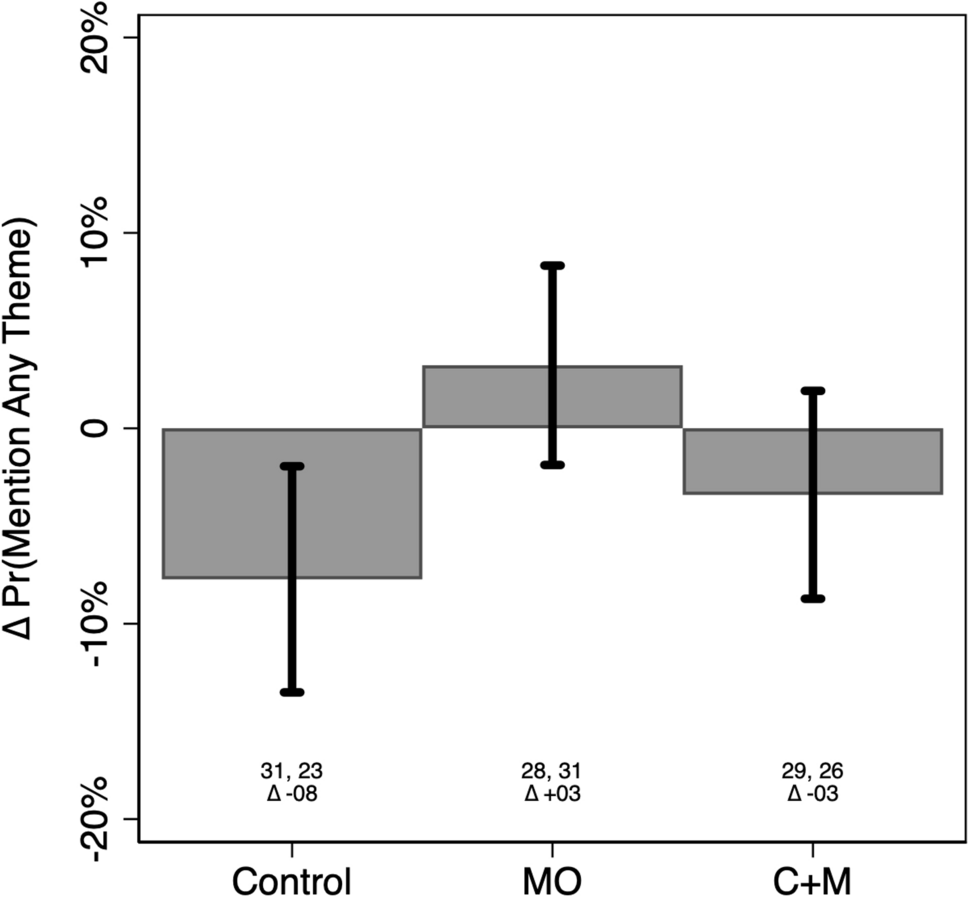
A substantial body of social scientific research considers the negative mental health consequences of social media use on TikTok. Fewer, however, consider the potentially positive impact that mental health content creators (“influencers”) on TikTok can have to improve health outcomes; including the degree to which the platform exposes users to evidence-based mental health communication. Our novel, influencer-led approach remedies this shortcoming by attempting to change TikTok creator content-producing behavior via a large, within-subject field experiment (N = 105 creators with a reach of over 16.9 million viewers; N = 3465 unique videos). Our randomly-assigned field intervention exposed influencers on the platform to either (a) asynchronous digital (.pdf) toolkits, or (b) both toolkits and synchronous virtual training sessions that aimed to promote effective evidence-based mental health communication (relative to a control condition, exposed to neither intervention). We find that creators treated with our asynchronous toolkits—and, in some cases, those also attending synchronous training sessions—were significantly more likely to (i) feature evidence-based mental health content in their videos and (ii) generate video content related to mental health issues. Moderation analyses further reveal that these effects are not limited to only those creators with followings under 2 million users. Importantly, we also document large system-level effects of exposure to our interventions; such that TikTok videos featuring evidence-based content received over half a million additional views in the post-intervention period in the study’s treatment groups, while treatment group mental health content (in general) received over three million additional views. We conclude by discussing how simple, cost-effective, and influencer-led interventions like ours can be deployed at scale to influence mental health content on TikTok.
Does each click of attention cost a bit of ourselves? | Aeon Essays
It costs nothing to click, respond and retweet. But what price do we pay in our relationships and our peace of mind?

Interventions reducing affective polarization do not necessarily improve anti-democratic attitudes
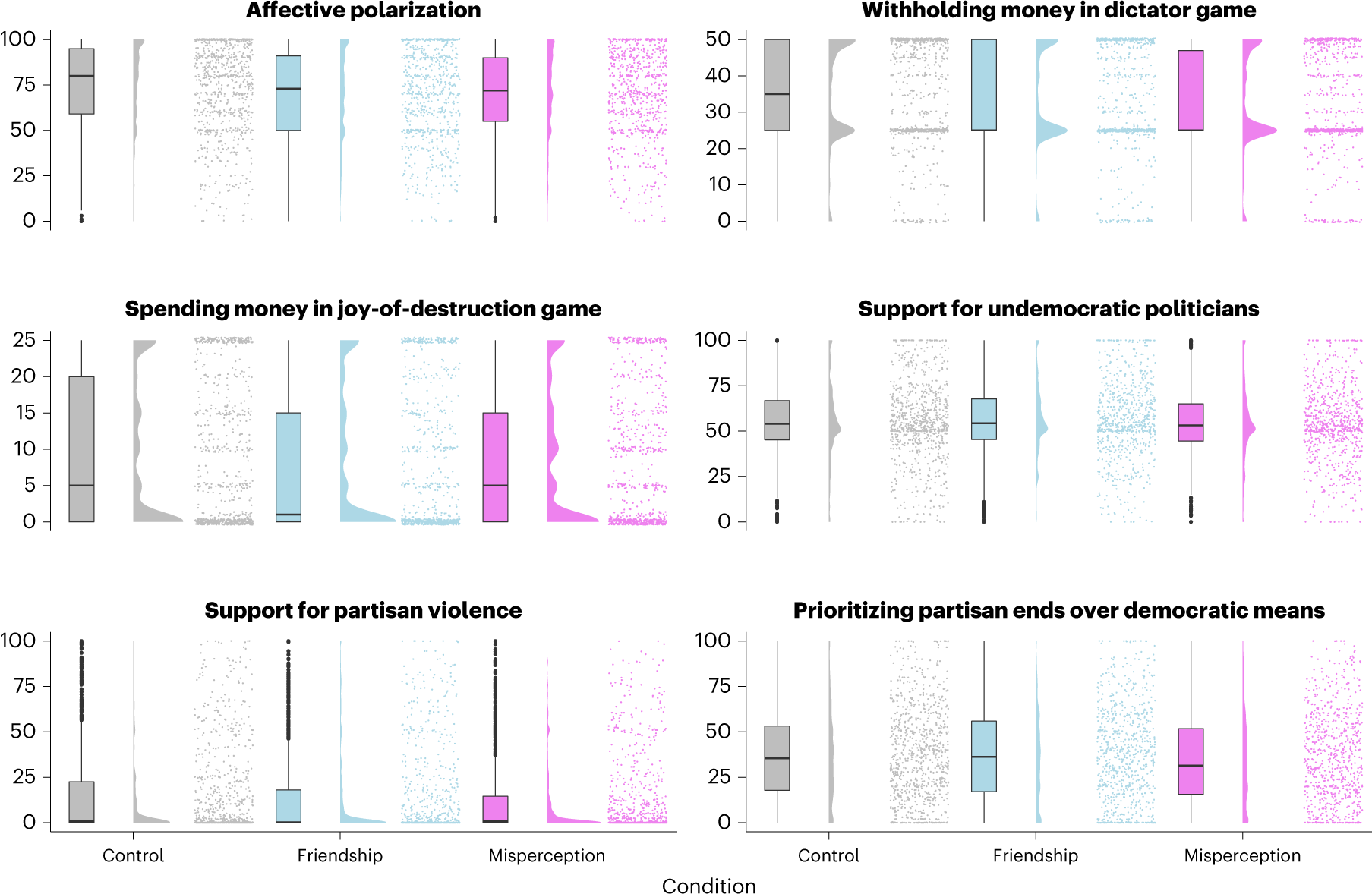
There is widespread concern that rising affective polarization—particularly dislike for outpartisans—exacerbates Americans’ anti-democratic attitudes. Accordingly, scholars and practitioners alike have invested great effort in developing depolarization interventions that reduce affective polarization. Critically, however, it remains unclear whether these interventions reduce anti-democratic attitudes, or only change sentiments towards outpartisans. Here we address this question with experimental tests (total n = 8,385) of three previously established depolarization interventions: correcting misperceptions of outpartisans, priming inter-partisan friendships and observing warm cross-partisan interactions between political leaders. While these depolarization interventions reliably reduced affective polarization, we do not find compelling evidence that these interventions reduced support for undemocratic candidates, support for partisan violence or prioritizing partisan ends over democratic means. Thus, future efforts to strengthen pro-democratic attitudes may do better if they target these outcomes directly. More broadly, these findings call into question the previously assumed causal effect of affective polarization on anti-democratic attitudes.
Warning labels shift perceptions of sycophantic AI, but not its influence
Recent work has raised concerns about the influence of sycophantic AI on user judgment and relationships. One proposed mitigation, which has received regulatory attention, is to warn users about potentially harmful AI behaviors such as sycophancy. In a preregistered experiment in which participants (N = 2,610) discussed real interpersonal conflicts with an AI system, we test whether warning labels mitigate sycophancy's influence. We find that a basic AI disclosure (``This chatbot is AI'') has no detectable effect. Labeling the system as sycophantic (``...may agree with you and validate you even when you are wrong...'') does shift users' perceptions, reducing perceived objectivity and trust, but it does not reliably reduce sycophancy's influence on users' self-perceived rightness or their willingness to repair the conflict. Our results reveal a gap between AI perception and AI influence: by shifting perception without reducing influence, warning-based interventions may offer a false sense of protection. Addressing the harms of sycophancy will therefore require understanding the specific mechanisms through which it shapes judgment, and improving model behavior itself.

When the Generator Grades Itself: A Self-Judge Under-Flags Unsupported Outputs at Matched Scale in LLM Social Simulation
A researcher who validates an LLM social simulation with an automated fidelity check rarely sees which model ran that check. The cheapest and most common choice is the same model that produced the simulation: the model that generated the behavior also certifies that the behavior is faithful. We measure what that choice misses, and we test whether capability rather than family explains it. On n=107 frozen generated responses scored under a support-in-context rubric, we run three judges under identical rubric, prompts, context, and decoding: a same-family self-judge (the 72B generator scoring itself), a matched-scale (~70B) judge from a distinct provider family, and a stronger frontier cross-family judge. The self-judge flags 6/107 unsupported outputs (5.6%); the matched-scale distinct-family judge, in the same capability class but a different family, flags 57/107 (53.3%). The disagreement is perfectly one-directional: 51 items the matched judge flags and the self-judge passes, 0 in reverse (McNemar p<1e-12). This asymmetry is consistent with a self-/family effect and rules out the reading that the self-judge is simply a weaker judge detecting less; one matched-scale judge cannot, on its own, separate that family component from a generic strictness difference between two models. Capability still adds on top: the frontier judge flags more again (92.5%). The cheapest default judge passes nearly every output a same-scale distinct-family judge reads as unsupported, exactly the model-bias artifacts a fidelity check exists to catch. We give a minimal audit protocol and argue that one-directional disagreement should function as a validation rule, not a tuning knob. We test one generator on a context-grounding proxy; transfer to live persona transcripts is the open boundary.
Q&A:HRT & Changes, Havening Therapy, Nonbinary Questioning, Uncertainty, Why Bother? & Voice Therapy

