

Macaron-A2UI: A Model for Generative UI in Personal Agents
As personal agents evolve to handle complex, user-centric tasks, static plain-text chat is rapidly becoming a bottleneck. Generative UI emerges as the necessary new interface layer, dynamically synthesizing the right controls, options, and state from the interaction context in real time. We present Macaron-A2UI, a model for Generative UI in personal agents. Our goal is to move beyond text-only interaction by enabling agents to generate natural language together with lightweight, executable UI actions for information collection, preference refinement, confirmation, and multi-goal organization. We build a large-scale Generative UI corpus from heterogeneous dialogue sources, introduce A2UI-Bench for controlled evaluation, and train 30B, 235B and 754B models with parameter-efficient LoRA-based supervised fine-tuning followed by reward-driven reinforcement learning. The best Macaron-A2UI model reaches 75.6 overall on A2UI-Bench without explicit schema hints, surpassing the strongest full-schema frontier baseline. We release the models, benchmark, and evaluation protocol to support future work on Generative UI for personal agents.

Why Chatbots Are Not the Future of Interfaces
Unfortunately for the countless hapless people I've talked to in the past few months, this was inexorable. Ever since ChatGPT exploded in popularity, my inner designer has been bursting at the seams.
AI-generated responses are undermining crowdsourced research studies
Many answers to online research questions show signs of being generated by AI chatbots, raising doubts about the validity of behavioural data collected this way

Designing Grok Bot for a world of persistent agents
How we designed Grok Bot for agents that persist beyond a single session — from a chat history to a Bot roster, presence, a computer of the Bot’s own, and work that starts without a prompt.
This Web Tool Sabotages AI Chatbots By Making Them Really, Really Slow
Artist Sam Lavigne created ‘Slow LLM’ to make people question their dependence on tools like Claude and ChatGPT. Or at least, make them super annoying to use.
Announcing CSML, a new open-source language to easily build full-featured chatbots
We are building the framework to support the chatbots of the future

Conversational Design — MULE BOOKS
The interaction design book that explains why chatbots tend to suck

A Treatise on AI Chatbots Undermining the Enlightenment
On chatbot sycophancy, passivity, and the case for more intellectually challenging companions
A Treatise on AI Chatbots Undermining the Enlightenment
On chatbot sycophancy, passivity, and the case for more intellectually challenging companions
What My Personal Chat Bot Is Teaching Me About AI’s Future
Replika, an app that creates an artificially intelligent doppelgänger, offers a glimpse into the future of human-bot interaction.

Can ChatGPT Be Addictive? A Call to Examine the Shift from Support to Dependence in AI Conversational Large Language Models
The rapid rise of ChatGPT has introduced a transformative tool that enhances productivity, communication, and task automation across industries. However, concerns are emerging regarding the addictive potential of AI large language models. This paper explores how ChatGPT fosters dependency through key features such as personalised responses, emotional validation, and continuous engagement. By offering instant gratification and adaptive dialogue, ChatGPT may blur the line between AI and human interaction, creating pseudosocial bonds that can replace genuine human relationships. Additionally, its ability to streamline decision-making and boost productivity may lead to over-reliance, reducing users' critical thinking skills and contributing to compulsive usage patterns. These behavioural tendencies align with known features of addiction, such as increased tolerance and conflict with daily life priorities. This viewpoint paper highlights the need for further research into the psychological and social impacts of prolonged interaction with AI tools like ChatGPT.
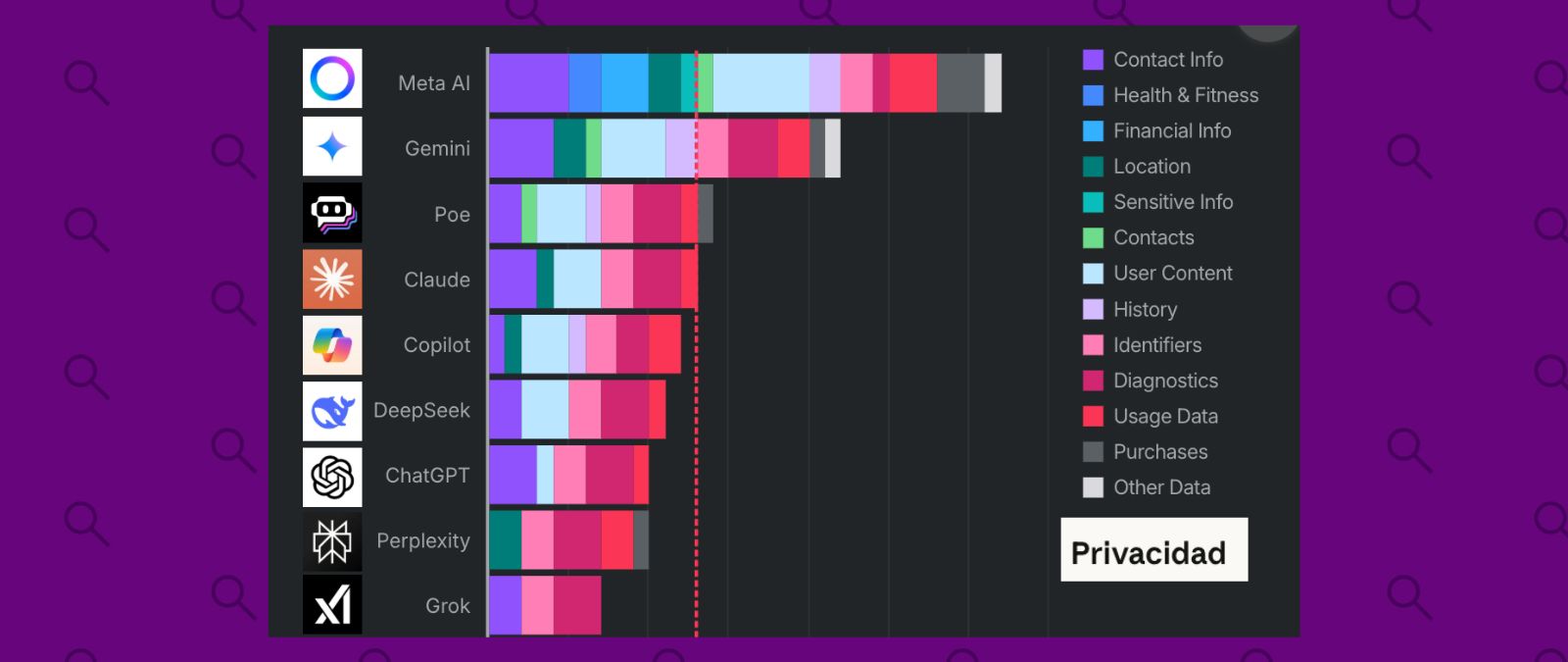
Tu historial amoroso, médico o laboral en manos de la IA: ¿cómo proteger tu privacidad de los chatbots? - Factchequeado.com
Los chatbots de inteligencia artificial —como ChatGPT, Gemini, Claude, Copilot, Perplexity o Grok— se han vuelto herramientas…
i wouldn't wish it on anyone to deprive them of working through a concept that they want to get across clearly and persuasively to people. i feel bad for people who are so removed from thinking & writing that they don't even recognize what they're avoiding by having chatbots generate stuff for them.
i wonder how much of this can be prototyped in userland with no new ui eg just a thing that creates “collection” accounts operated by bots. curators can post stuff there by dm’ing the bot. as a reader, you follow the account, so naturally it plays into your Following and For You etc

dan
“semble for bluesky inside bluesky app” is a good way to articulate exactly what i’m missing in the product. custom feeds are like half of that but they’re a readonly interface
Building a better AI tutor

Research Question: can AI aid better user training past the chatbot support interface?
aclanthology.org
intextbooks.science.uu.nl

The ICAP Framework: Linking Cognitive Engagement to Active Learning Outcomes

Methodologies for Improving the Quality of AI Tutoring in K-12 Education
How Khan Academy Is Building a Better AI Tutor: Our Most Recent Learnings

