219 votes, 60 comments. I’ve gotten “imbixtent” 3 times now, each time I look it up on the off chance that _I_ am the one who doesn’t know English…
I pulled ~90,000 Reddit posts about what makes writing "sound like AI" to determine the biggest AI-slop giveaways (Part 2)
674 votes, 228 comments. The majority of people can instantly tell when writing is generated by AI. For those who don't intend to get into the weeds…
Is Apple Intelligence Making Up Words Now?
A Reddit post suggests that Apple Intelligence is making up words in notification summaries.

AI-Detectors Biased Against Non-Native English Writers | Stanford HAI
Don’t put faith in detectors that are “unreliable and easily gamed,” says scholar.

Your AI Use Is Breaking My Brain
AI writing is impossible to avoid, is making everything sound the same, and is driving us crazy.
Model Misalignment and Language Change: Traces of AI-Associated Language in Unscripted Spoken English
In recent years, written language, particularly in science and education, has undergone remarkable shifts in word usage. These changes are widely attributed to the growing influence of Large Language Models (LLMs), which frequently rely on a distinct lexical style. Divergences between model output and target audience norms can be viewed as a form of misalignment. While these shifts are often linked to using Artificial Intelligence (AI) directly as a tool to generate text, it remains unclear whether the changes reflect broader changes in the human language system itself. To explore this question, we constructed a dataset of 22.1 million words from unscripted spoken language drawn from conversational science and technology podcasts. We analyzed lexical trends before and after ChatGPT's release in 2022, focusing on commonly LLM-associated words. Our results show a moderate yet significant increase in the usage of these words post-2022, suggesting a convergence between human word choices and LLM-associated patterns. In contrast, baseline synonym words exhibit no significant directional shift. Given the short time frame and the number of words affected, this may indicate the onset of a remarkable shift in language use. Whether this represents natural language change or a novel shift driven by AI exposure remains an open question. Similarly, although the shifts may stem from broader adoption patterns, it may also be that upstream training misalignments ultimately contribute to changes in human language use. These findings parallel ethical concerns that misaligned models may shape social and moral beliefs.

Model Misalignment and Language Change: Traces of AI-Associated Language in Unscripted Spoken English
In recent years, written language, particularly in science and education, has undergone remarkable shifts in word usage. These changes are widely attributed to the growing influence of Large Language Models (LLMs), which frequently rely on a distinct lexical style. Divergences between model output and target audience norms can be viewed as a form of misalignment. While these shifts are often linked to using Artificial Intelligence (AI) directly as a tool to generate text, it remains unclear whether the changes reflect broader changes in the human language system itself. To explore this question, we constructed a dataset of 22.1 million words from unscripted spoken language drawn from conversational science and technology podcasts. We analyzed lexical trends before and after ChatGPT's release in 2022, focusing on commonly LLM-associated words. Our results show a moderate yet significant increase in the usage of these words post-2022, suggesting a convergence between human word choices and LLM-associated patterns. In contrast, baseline synonym words exhibit no significant directional shift. Given the short time frame and the number of words affected, this may indicate the onset of a remarkable shift in language use. Whether this represents natural language change or a novel shift driven by AI exposure remains an open question. Similarly, although the shifts may stem from broader adoption patterns, it may also be that upstream training misalignments ultimately contribute to changes in human language use. These findings parallel ethical concerns that misaligned models may shape social and moral beliefs.
The Impact of AI-Generated Text on the Internet
The proliferation of AI-generated and AI-assisted text on the internet is feared to contribute to a degradation in semantic and stylistic diversity, factual accuracy, and other negative...
The Impact of AI-Generated Text on the Internet
The proliferation of AI-generated and AI-assisted text on the internet is feared to contribute to a degradation in semantic and stylistic diversity, factual accuracy, and other negative...
People are getting their news from AI – and it’s altering their views
Even when information is factually accurate, how it’s presented can introduce subtle biases. As large language models increasingly bring people the news, this bias is a looming problem.

People are getting their news from AI – and it’s altering their views
Even when information is factually accurate, how it’s presented can introduce subtle biases. As large language models increasingly bring people the news, this bias is a looming problem.
I blame the algorithm
2.3K votes, 161 comments. 36M subscribers in the memes community. Memes! A way of describing cultural information being shared. An element of a…
Literature fans should welcome AI as a fellow wordsmith | Aeon Essays
Strong resistance to AI among writers is understandable. But it obscures what we share with the machines: language itself

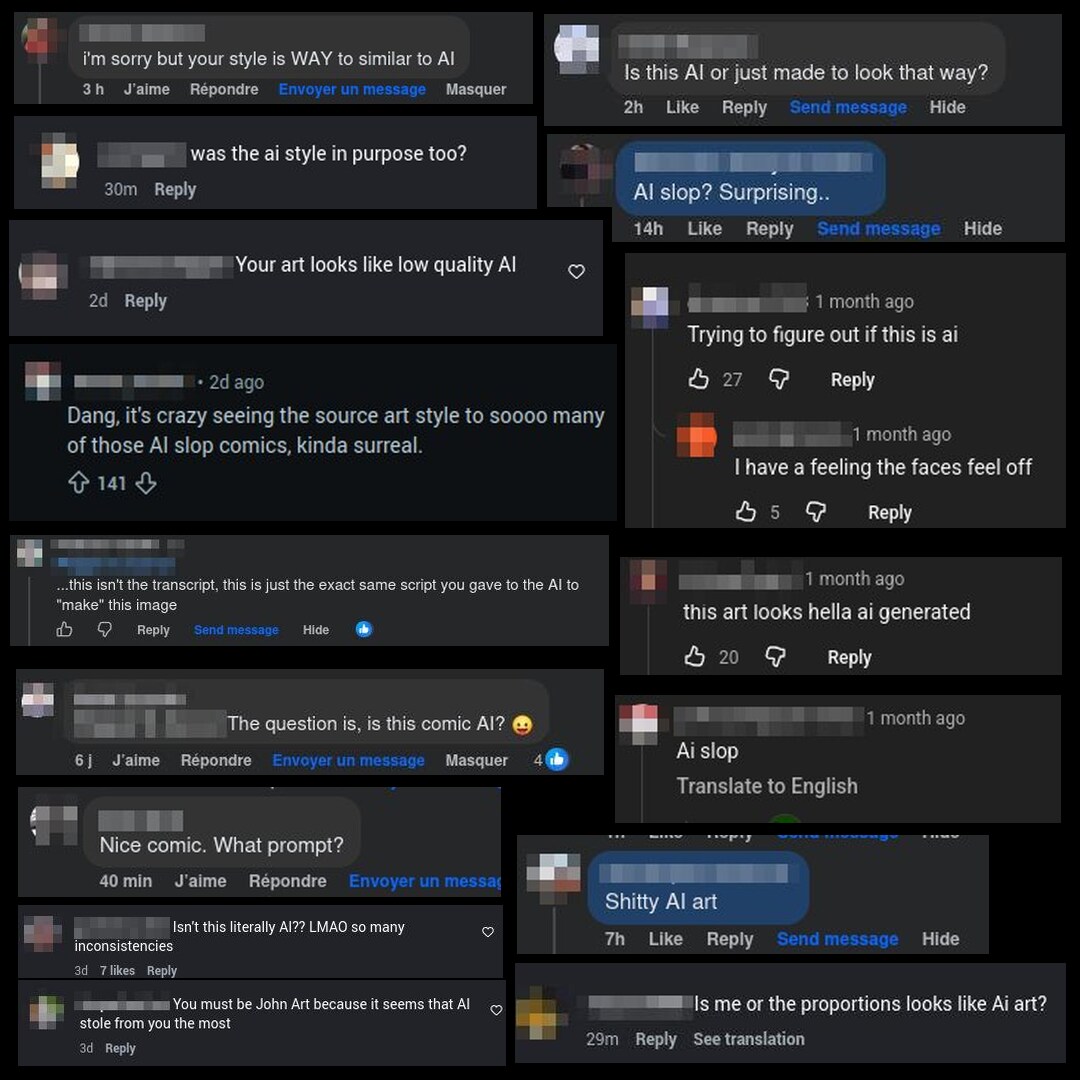
When online commenters 'detect' my art as AI
Here is a collection of screenshots (obfuscated) of dozens and dozens of online comments from many platforms (Reddit, YouTube, Instagram, Facebook) containing accusations or confusion that my artworks and comics are AI-generated. Despite creating every piece by hand, despite sharing timelapses, the comments keep coming, and they're getting stronger.