


Tasha Mellins-Cohen outlines COUNTER Metrics' new guidance for usage metrics associated with generative and agentic AI
The Adoption and Usage of AI Agents: Early Evidence from Perplexity
This paper presents the first large-scale field study of the adoption, usage intensity, and use cases of general-purpose AI agents operating in open-world web environments. Our analysis centers on Comet, an AI-powered browser developed by Perplexity, and its integrated agent, Comet Assistant. Drawing on hundreds of millions of anonymized user interactions, we address three fundamental questions: Who is using AI agents? How intensively are they using them? And what are they using them for? Our findings reveal substantial heterogeneity in adoption and usage across user segments. Earlier adopters, users in countries with higher GDP per capita and educational attainment, and individuals working in digital or knowledge-intensive sectors -- such as digital technology, academia, finance, marketing, and entrepreneurship -- are more likely to adopt or actively use the agent. To systematically characterize the substance of agent usage, we introduce a hierarchical agentic taxonomy that organizes use cases across three levels: topic, subtopic, and task. The two largest topics, Productivity & Workflow and Learning & Research, account for 57% of all agentic queries, while the two largest subtopics, Courses and Shopping for Goods, make up 22%. The top 10 out of 90 tasks represent 55% of queries. Personal use constitutes 55% of queries, while professional and educational contexts comprise 30% and 16%, respectively. In the short term, use cases exhibit strong stickiness, but over time users tend to shift toward more cognitively oriented topics. The diffusion of increasingly capable AI agents carries important implications for researchers, businesses, policymakers, and educators, inviting new lines of inquiry into this rapidly emerging class of AI capabilities.

Perspective: AI demand is inflated, and only Anthropic is being realistic
The main usage metric for artificial intelligence, called tokens, looks explosive on paper, but it may be significantly overstated.

The Age Of Artificial Intelligence: Americans' AI Use Increases While Views On It Sour, Quinnipiac University Poll On AI Finds; 7 In 10 Think AI Will Cut Jobs With Gen Z The Most Pessimistic | Quinnipiac University Poll
"The contradiction between use and trust of AI is striking. Fifty-one percent say they use AI for research, and many also use it for writing, work, and data analysis. But only 21 percent trust AI-generated information most or almost all of the time. Americans are clearly adopting AI, but they are doing so with deep hesitation, not deep trust," said Chetan Jaiswal, Ph.D., Associate Professor of Computer Science and Associate Chair, Department of Computing, Quinnipiac University School of Computing and Engineering.

Half of Americans report using AI services, with information and productivity leading use cases
New Epoch AI/Ipsos poll reveals high AI engagement, diverse use cases, and emerging workplace integration

Science that Compounds: The Need for A New Substrate for Research in the Age of AI
This paper is a perspective from Lightcone Research, an open-source initiative building tooling for scientific research in the age of agentic AI.
AI | 2025 Stack Overflow Developer Survey
84% of respondents are using or planning to use AI tools in their development process, an increase over last year (76%). This year we can see 51% of professional developers use AI tools daily.
Stop saying that AI is just a tool and it only matters how it is used
I’m tired of this phrase and this simple way of thinking about tools. This blog post is a wandering train of thought on the topic of what tools are and why it matters to be even slightly more mature in how we think about them.
AI is turning research into a scientific monoculture
Generative AI deserves scientific attention. But the rush to study it is producing a feedback loop of topical and methodological convergence, flattening scientific imagination and crowding out the pluralism needed to keep research adaptive, resilient, and intellectually generative.

How US adults are using AI, according to AP-NORC polling
A new poll finds most Americans say they've used artificial intelligence to search for information. But it's younger adults who appear to be the generation leaning the most into AI, with many using it for brainstorming and work tasks.
Where does the rigor go? Research software and the future of trustworthy science.
Generative AI now makes it dramatically easier to produce something that looks like research: analysis code, figures, literature reviews, even whole pap…
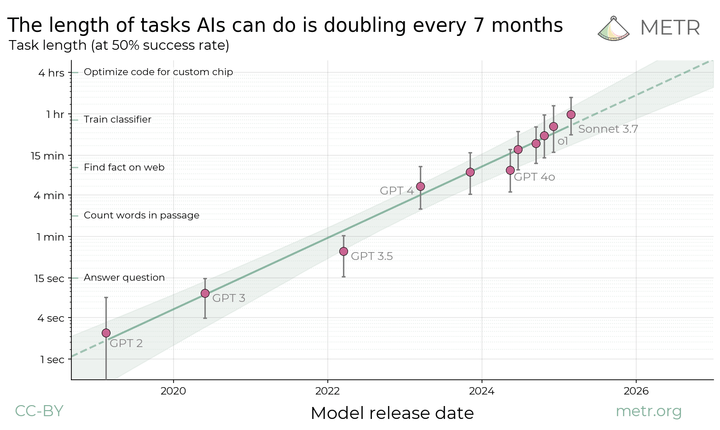
Measuring AI Ability to Complete Long Tasks
We propose measuring AI performance in terms of the *length* of tasks AI agents can complete. We show that this metric has been consistently exponentially increasing over the past 6 years, with a doubling time of around 7 months. Extrapolating this trend predicts that, in under a decade, we will see AI agents that can independently complete a large fraction of software tasks that currently take humans days or weeks.
What AI coding costs you | Tom Wojcik
What's the effect of the prolonged AI usage among coders and is it tracked correctly, if it all?
More Than a Tool
What We Learned from a Year of Conversations About AI
Which Economic Tasks are Performed with AI? Evidence from Millions of Claude Conversations
Despite widespread speculation about artificial intelligence's impact on the future of work, we lack systematic empirical evidence about how these systems are actually being used for different tasks. Here, we present a novel framework for measuring AI usage patterns across the economy. We leverage a recent privacy-preserving system to analyze over four million Claude.ai conversations through the lens of tasks and occupations in the U.S. Department of Labor's O*NET Database. Our analysis reveals that AI usage primarily concentrates in software development and writing tasks, which together account for nearly half of all total usage. However, usage of AI extends more broadly across the economy, with approximately 36% of occupations using AI for at least a quarter of their associated tasks. We also analyze how AI is being used for tasks, finding 57% of usage suggests augmentation of human capabilities (e.g., learning or iterating on an output) while 43% suggests automation (e.g., fulfilling a request with minimal human involvement). While our data and methods face important limitations and only paint a picture of AI usage on a single platform, they provide an automated, granular approach for tracking AI's evolving role in the economy and identifying leading indicators of future impact as these technologies continue to advance.
Young adults are leading the way in AI adoption - AP-NORC
Six in 10 adults have ever used AI to search for information. People under 30 are more likely to use AI for a variety of tasks, especially to brainstorm ideas.
