

As AI assistants and social robots enter human environments, their ability to navigate context-dependent social norms is essential to avoid harm and ensure successful collaboration. We evaluate six large language models (LLMs) on their ability to estimate American social norms across 555 everyday scenarios (measured in prior work) and compare these to estimates from 320 humans. LLMs achieve remarkably high accuracy, clearly outperforming the average human. However, the errors LLMs make are systematic; they are similar across runs of the same LLM and even across different LLMs. As a consequence of this homogeneity, aggregating estimates of LLMs produces little improvement. Individual humans make much worse estimates, often defaulting to extreme right-or-wrong judgments even when asked to estimate population averages, but their errors are idiosyncratic and, consequently, aggregating their estimates yields dramatic improvement through wisdom-of-crowds effects. As humans make different errors than LLMs, hybrid ensembles combining both substantially outperform either alone.
Measuring Social Norms of Large Language Models
We present a new challenge to examine whether large language models understand social norms. In contrast to existing datasets, our dataset requires a fundamental understanding of social norms to solve. Our dataset features the largest set of social norm skills, consisting of 402 skills and 12,383 questions covering a wide set of social norms ranging from opinions and arguments to culture and laws. We design our dataset according to the K-12 curriculum. This enables the direct comparison of the social understanding of large language models to humans, more specifically, elementary students. While prior work generates nearly random accuracy on our benchmark, recent large language models such as GPT3.5-Turbo and LLaMA2-Chat are able to improve the performance significantly, only slightly below human performance. We then propose a multi-agent framework based on large language models to improve the models' ability to understand social norms. This method further improves large language models to be on par with humans. Given the increasing adoption of large language models in real-world applications, our finding is particularly important and presents a unique direction for future improvements.
AI Models Exceed Individual Human Accuracy in Predicting Everyday Social Norms
A fundamental question in cognitive science concerns how social norms are acquired and represented. While humans typically learn norms through embodied social experience, we investigated whether large language models can achieve sophisticated norm understanding through statistical learning alone. Across two studies, we systematically evaluated multiple AI systems' ability to predict human social appropriateness judgments for 555 everyday scenarios by examining how closely they predicted the average judgment compared to each human participant. In Study 1, GPT-4.5's accuracy in predicting the collective judgment on a continuous scale exceeded that of every human participant (100th percentile). Study 2 replicated this, with Gemini 2.5 Pro outperforming 98.7% of humans, GPT-5 97.8%, and Claude Sonnet 4 96.0%. Despite this predictive power, all models showed systematic, correlated errors. These findings demonstrate that sophisticated models of social cognition can emerge from statistical learning over linguistic data alone, challenging strong versions of theories emphasizing the exclusive necessity of embodied experience for cultural competence. The systematic nature of AI limitations across different architectures indicates potential boundaries of pattern-based social understanding, while the models' ability to outperform nearly all individual humans in this predictive task suggests that language serves as a remarkably rich repository for cultural knowledge transmission.

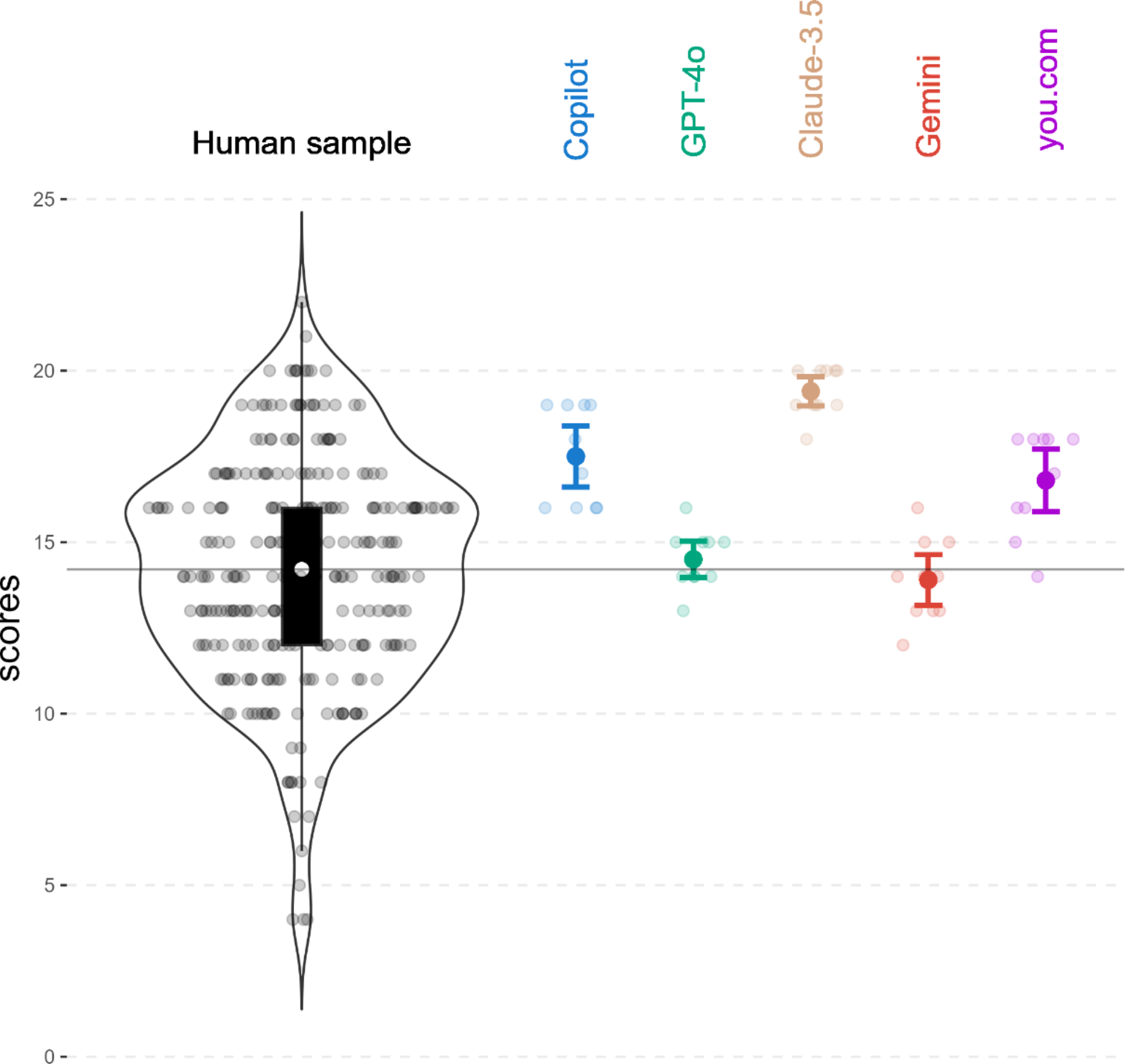
Large language models can outperform humans in social situational judgments
Large language models (LLM) have been a catalyst for the public interest in artificial intelligence (AI). These technologies perform some knowledge-based tasks better and faster than human beings. However, whether AIs can correctly assess social situations and devise socially appropriate behavior, is still unclear. We conducted an established Situational Judgment Test (SJT) with five different chatbots and compared their results with responses of human participants (N = 276). Claude, Copilot and you.com’s smart assistant performed significantly better than humans in proposing suitable behaviors in social situations. Moreover, their effectiveness rating of different behavior options aligned well with expert ratings. These results indicate that LLMs are capable of producing adept social judgments. While this constitutes an important requirement for the use as virtual social assistants, challenges and risks are still associated with their wide-spread use in social contexts.
Quantifying the Persona Effect in LLM Simulations
Large language models (LLMs) have shown remarkable promise in simulating human language and behavior. This study investigates how integrating persona variables—demographic, social, and behavioral factors—impacts LLMs' ability to simulate diverse perspectives. We find that persona variables account for \ensuremath<10% variance in annotations in existing subjective NLP datasets. Nonetheless, incorporating persona variables via prompting in LLMs provides modest but statistically significant improvements. Persona prompting is most effective in samples where many annotators disagree, but their disagreements are relatively minor. Notably, we find a linear relationship in our setting: the stronger the correlation between persona variables and human annotations, the more accurate the LLM predictions are using persona prompting. In a zero-shot setting, a powerful 70b model with persona prompting captures 81% of the annotation variance achievable by linear regression trained on ground truth annotations. However, for most subjective NLP datasets, where persona variables have limited explanatory power, the benefits of persona prompting are limited.
Do Large Language Models Perform the Way People Expect? Measuring the Human Generalization Function
What makes large language models (LLMs) impressive is also what makes them hard to evaluate: their diversity of uses. To evaluate these models, we must understand the purposes they will be used for. We consider a setting where these deployment decisions are made by people, and in particular, people's beliefs about where an LLM will perform well. We model such beliefs as the consequence of a human generalization function: having seen what an LLM gets right or wrong, people generalize to where else it might succeed. We collect a dataset of 19K examples of how humans make generalizations across 79 tasks from the MMLU and BIG-Bench benchmarks. We show that the human generalization function can be predicted using NLP methods: people have consistent structured ways to generalize. We then evaluate LLM alignment with the human generalization function. Our results show that -- especially for cases where the cost of mistakes is high -- more capable models (e.g. GPT-4) can do worse on the instances people choose to use them for, exactly because they are not aligned with the human generalization function.
Emergent social conventions and collective bias in LLM populations
Social conventions are the backbone of social coordination, shaping how individuals form a group. As growing populations of artificial intelligence (AI) agents communicate through natural language, a fundamental question is whether they can bootstrap the foundations of a society. Here, we present experimental results that demonstrate the spontaneous emergence of universally adopted social conventions in decentralized populations of large language model (LLM) agents. We then show how strong collective biases can emerge during this process, even when agents exhibit no bias individually. Last, we examine how committed minority groups of adversarial LLM agents can drive social change by imposing alternative social conventions on the larger population. Our results show that AI systems can autonomously develop social conventions without explicit programming and have implications for designing AI systems that align, and remain aligned, with human values and societal goals. , Groups of AI agents can develop social conventions, generate societal bias, and undergo critical mass dynamics in norm adoption.

Artificial intelligences and human scientists exhibit...
We investigate the effectiveness of artificial intelligences (AI)-specifically large language models (LLMs)-relative to human scientists at high-level cognitive tasks in social science such as...
Do language models accommodate their users? A study of linguistic convergence
While large language models (LLMs) are generally considered proficient in generating language, how similar their language usage is to that of humans remains understudied. In this paper, we test whether models exhibit linguistic convergence, a core pragmatic element of human language communication: do models adapt, or converge, to the linguistic patterns of their user? To answer this, we systematically compare model completions of existing dialogues to original human responses across sixteen language models, three dialogue corpora, and various stylometric features. We find that models strongly converge to the conversation's style, often significantly overfitting relative to the human baseline. While convergence patterns are often feature-specific, we observe consistent shifts in convergence across modeling settings, with instruction-tuned and larger models converging less than their pretrained and smaller counterparts. Given the differences in human and model convergence patterns, we hypothesize that the underlying mechanisms driving these behaviors are very different.
Do language models accommodate their users? A study of linguistic convergence
While large language models (LLMs) are generally considered proficient in generating language, how similar their language usage is to that of humans remains understudied. In this paper, we test whether models exhibit linguistic convergence, a core pragmatic element of human language communication: do models adapt, or converge, to the linguistic patterns of their user? To answer this, we systematically compare model completions of existing dialogues to original human responses across sixteen language models, three dialogue corpora, and various stylometric features. We find that models strongly converge to the conversation's style, often significantly overfitting relative to the human baseline. While convergence patterns are often feature-specific, we observe consistent shifts in convergence across modeling settings, with instruction-tuned and larger models converging less than their pretrained and smaller counterparts. Given the differences in human and model convergence patterns, we hypothesize that the underlying mechanisms driving these behaviors are very different.
Artificial Artificial Artificial Intelligence: Crowd Workers Widely Use Large Language Models for Text Production Tasks
Large language models (LLMs) are remarkable data annotators. They can be used to generate high-fidelity supervised training data, as well as survey and experimental data. With the widespread adoption of LLMs, human gold--standard annotations are key to understanding the capabilities of LLMs and the validity of their results. However, crowdsourcing, an important, inexpensive way to obtain human annotations, may itself be impacted by LLMs, as crowd workers have financial incentives to use LLMs to increase their productivity and income. To investigate this concern, we conducted a case study on the prevalence of LLM usage by crowd workers. We reran an abstract summarization task from the literature on Amazon Mechanical Turk and, through a combination of keystroke detection and synthetic text classification, estimate that 33-46% of crowd workers used LLMs when completing the task. Although generalization to other, less LLM-friendly tasks is unclear, our results call for platforms, researchers, and crowd workers to find new ways to ensure that human data remain human, perhaps using the methodology proposed here as a stepping stone. Code/data: https://github.com/epfl-dlab/GPTurk
The levers of political persuasion with conversational artificial intelligence
There are widespread fears that conversational artificial intelligence (AI) could soon exert unprecedented influence over human beliefs. In this work, in three large-scale experiments ( N = 76,977 participants), we deployed 19 large language models (LLMs)—including some post-trained explicitly for persuasion—to evaluate their persuasiveness on 707 political issues. We then checked the factual accuracy of 466,769 resulting LLM claims. We show that the persuasive power of current and near-future AI is likely to stem more from post-training and prompting methods—which boosted persuasiveness by as much as 51 and 27%, respectively—than from personalization or increasing model scale, which had smaller effects. We further show that these methods increased persuasion by exploiting LLMs’ ability to rapidly access and strategically deploy information and that, notably, where they increased AI persuasiveness, they also systematically decreased factual accuracy. , Editor’s summary Many fear that we are on the precipice of unprecedented manipulation by large language models (LLMs), but techniques driving their persuasiveness are poorly understood. In the initial “pretrained” phase, LLMs may exhibit flawed reasoning. Their power unlocks during vital “posttraining,” when developers refine pretrained LLMs to sharpen their reasoning and align with users’ needs. Posttraining also enables LLMs to maintain logical, sophisticated conversations. Hackenburg et al . examined which techniques made diverse, conversational LLMs most persuasive across 707 British political issues (see the Perspective by Argyle). LLMs were most persuasive after posttraining, especially when prompted to use facts and evidence (information) to argue. However, information-dense LLMs produced the most inaccurate claims, raising concerns about the spread of misinformation during rollouts of future models. —Ekeoma Uzogara , INTRODUCTION Rapid advances in artificial intelligence (AI) have sparked widespread concerns about its potential to influence human beliefs. One possibility is that conversational AI could be used to manipulate public opinion on political issues through interactive dialogue. Despite extensive speculation, however, fundamental questions about the actual mechanisms, or “levers,” responsible for driving advances in AI persuasiveness—e.g., computational power or sophisticated training techniques—remain largely unanswered. In this work, we systematically investigate these levers and chart the horizon of persuasiveness with conversational AI. RATIONALE We considered multiple factors that could enhance the persuasiveness of conversational AI: raw computational power (model scale), specialized post-training methods for persuasion, personalization to individual users, and instructed rhetorical strategies. Across three large-scale experiments with 76,977 total UK participants, we deployed 19 large language models (LLMs) to persuade on 707 political issues while varying these factors independently. We also analyzed more than 466,000 AI-generated claims, examining the relationship between persuasiveness and truthfulness. RESULTS We found that the most powerful levers of AI persuasion were methods for post-training and rhetorical strategy (prompting), which increased persuasiveness by as much as 51 and 27%, respectively. These gains were often larger than those obtained from substantially increasing model scale. Personalizing arguments on the basis of user data had a comparatively small effect on persuasion. We observe that a primary mechanism driving AI persuasiveness was information density: Models were most persuasive when they packed their arguments with a high volume of factual claims. Notably, however, we documented a concerning trade-off between persuasion and accuracy: The same levers that made AI more persuasive—including persuasion post-training and information-focused prompting—also systematically caused the AI to produce information that was less factually accurate. CONCLUSION Our findings suggest that the persuasive power of current and near-future AI is likely to stem less from model scale or personalization and more from post-training and prompting techniques that mobilize an LLM’s ability to rapidly generate information during conversation. Further, we reveal a troubling trade-off: When AI systems are optimized for persuasion, they may increasingly deploy misleading or false information. This research provides an empirical foundation for policy-makers and technologists to anticipate and address the challenges of AI-driven persuasion, and it highlights the need for safeguards that balance AI’s legitimate uses in political discourse with protections against manipulation and misinformation. Persuasiveness of conversational AI increases with model scale. The persuasive impact in percentage points on the y axis is plotted against effective pretraining compute [floating-point operations (FLOPs)] on the x axis. Point estimates are persuasive effects of different AI models. Colored lines show trends for models that we uniformly chat-tuned for open-ended conversation (purple) versus those that were post-trained using heterogeneous, opaque methods by AI developers (green). pp, percentage points; CI, confidence interval.

The social consequences of AI delegation
A substantial body of recent work has debated whether large language models (LLMs) can serve as substitutes for human participants in behavioural research. This debate, however, captures only one direction of a rapidly changing relationship. The more consequential question is not simply whether researchers should use LLMs as human surrogates, but whether - and under what conditions - humans are beginning to use LLMs as surrogates for their own deliberation. Across domains including health, law, finance, education, and personal guidance, increasing numbers of people consult generative AI systems before, alongside, or instead of human experts, peers, or independent judgment. Although evidence for actual delegation remains uneven, this uncertainty makes the phenomenon an urgent social-scientific object of study. We argue for a research programme that treats LLMs as consequential social actors in a functional sense: systems whose outputs shape human decisions, social norms, and collective dynamics.
Out of One, Many: Using Language Models to Simulate Human Samples
We propose and explore the possibility that language models can be studied as effective proxies for specific human subpopulations in social science research. Practical and research applications of artificial intelligence tools have sometimes been limited by problematic biases (such as racism or sexism), which are often treated as uniform properties of the models. We show that the “algorithmic bias” within one such tool—the GPT-3 language model—is instead both fine-grained and demographically correlated, meaning that proper conditioning will cause it to accurately emulate response distributions from a wide variety of human subgroups. We term this property algorithmic fidelity and explore its extent in GPT-3. We create “silicon samples” by conditioning the model on thousands of sociodemographic backstories from real human participants in multiple large surveys conducted in the United States. We then compare the silicon and human samples to demonstrate that the information contained in GPT-3 goes far beyond surface similarity. It is nuanced, multifaceted, and reflects the complex interplay between ideas, attitudes, and sociocultural context that characterize human attitudes. We suggest that language models with sufficient algorithmic fidelity thus constitute a novel and powerful tool to advance understanding of humans and society across a variety of disciplines.
How LLMs Distort Our Written Language
Large language models (LLMs) are used by over a billion people globally, most often to assist with writing. In this work, we demonstrate that LLMs not only alter the voice and tone of human writing but also consistently alter the intended meaning. First, we conduct a human user study to understand how people actually interact with LLMs when using them for writing. Our findings reveal that extensive LLM use led to a nearly 70% increase in essays that remained neutral in answering the topic question. Significantly more heavy LLM users reported that the writing was less creative and not in their voice. Next, using a dataset of human-written essays that was collected in 2021 before the widespread release of LLMs, we study how asking an LLM to revise the essay based on the human-written feedback in the dataset induces large changes in the resulting content and meaning. We find that even when LLMs are prompted with expert feedback and asked to only make grammar edits, they still change the text in a way that significantly alters its semantic meaning. We then examine LLM-generated text in the wild, specifically focusing on the 21% of AI-generated scientific peer reviews at a recent top AI conference. We find that LLM-generated reviews place significantly less weight on clarity and significance of the research, and assign scores that, on average, are a full point higher. These findings highlight a misalignment between the perceived benefit of AI use and an implicit, consistent effect on the semantics of human writing, motivating future work on how widespread AI writing will affect our cultural and scientific institutions.
How LLMs Distort Our Written Language
Large language models (LLMs) are used by over a billion people globally, most often to assist with writing. In this work, we demonstrate that LLMs not only alter the voice and tone of human writing but also consistently alter the intended meaning. First, we conduct a human user study to understand how people actually interact with LLMs when using them for writing. Our findings reveal that extensive LLM use led to a nearly 70% increase in essays that remained neutral in answering the topic question. Significantly more heavy LLM users reported that the writing was less creative and not in their voice. Next, using a dataset of human-written essays that was collected in 2021 before the widespread release of LLMs, we study how asking an LLM to revise the essay based on the human-written feedback in the dataset induces large changes in the resulting content and meaning. We find that even when LLMs are prompted with expert feedback and asked to only make grammar edits, they still change the text in a way that significantly alters its semantic meaning. We then examine LLM-generated text in the wild, specifically focusing on the 21% of AI-generated scientific peer reviews at a recent top AI conference. We find that LLM-generated reviews place significantly less weight on clarity and significance of the research, and assign scores that, on average, are a full point higher. These findings highlight a misalignment between the perceived benefit of AI use and an implicit, consistent effect on the semantics of human writing, motivating future work on how widespread AI writing will affect our cultural and scientific institutions.
GermanPartiesQA: Benchmarking Commercial Large Language Models and AI Companions for Political Alignment and Sycophancy
Large language models (LLMs) are increasingly shaping citizens’ information ecosystems. Products incorporating LLMs, such as chatbots and AI Companions, are now widely used for decision support and information retrieval, including in sensitive domains, raising concerns about hidden biases and growing potential to shape individual decisions and public opinion. This paper introduces GermanPartiesQA, a benchmark of 418 political statements from German Voting Advice Applications across 11 elections to evaluate six commercial LLMs. We evaluate their political alignment based on role-playing experiments with political personas. Our evaluation reveals three specific findings: (1) Factual limitations: LLMs show limited ability to accurately generate factual party positions, particularly for centrist parties. (2) Model-specific ideological alignment: We identify consistent alignment patterns and degree of political steerability for each model across temperature settings and experiments. (3) Claim of sycophancy: While models adjust to political personas during role-play, we find this reflects persona-based steerability rather than the increasingly popular, yet contested concept of sycophancy. Our study contributes to evaluating the political alignment of closed-source LLMs that are increasingly embedded in electoral decision support tools and AI Companion chatbots.