


On March 12, 1928, the St. Francis Dam, just north of Los Angeles, California, failed catastrophically and sent a wave of water through the valley that caused…
The Trillion-Gallon Question: What if California’s Dams Fail? (Published 2023)
One superstorm could send walls of water sweeping through populated areas. There’s not much time to act.

The Water’s Edge: Empire, Race, and the Global History of Oakland, California, 1848-1980
Author(s): Klein, Andrew Nelson Carver | Advisor(s): Kelley, Robin D.G. | Abstract: This dissertation explores historical intersections between capitalism, race-making, environmental change, and U.S. foreign relations from the vantage of Oakland’s waterfront. It tracks the evolution of this geostrategic coastline since it emerged as a coal-powered nexus of railroads, steamships, and military installations during American colonization. Revising the story of Oakland’s development from a global perspective, my project documents how local boosters, businessmen, and bureaucrats forged intimate ties with far-flung territories administered by U.S. troops and landowners. Combining social and environmental history with methods from Black studies, I map the transformation of Oakland’s fertile estuary into an infilled hub of postindustrial commerce, a vital node of military logistics, and a focal point for racialized labor migration. Simultaneously, this dissertation reveals how, over the long twentieth century, Black, Indigenous, Chinese, and other working-class Oaklanders found footholds on the harbor, often repurposing its imperial routes for dramatically different ends. Drawing on archives and oral histories in Cuba, Hawai‘i, and across the continental United States, I trace Oakland’s tradition of radical internationalism, most visible in the antiwar and Black Power movements of the sixties, to multi-generational struggles over the governance of coastal land. I argue that Oakland’s waterfront both bridged the continental and overseas expansion of an ascendant world power and came to serve as a proving ground for alternative forms of globalization. “The Water’s Edge” therefore offers a critical reappraisal of the generally place-bound history of North American urbanism and far-reaching lessons for building just cities in a present defined by global environmental crises.

Time-lapse of a beaver building a dam
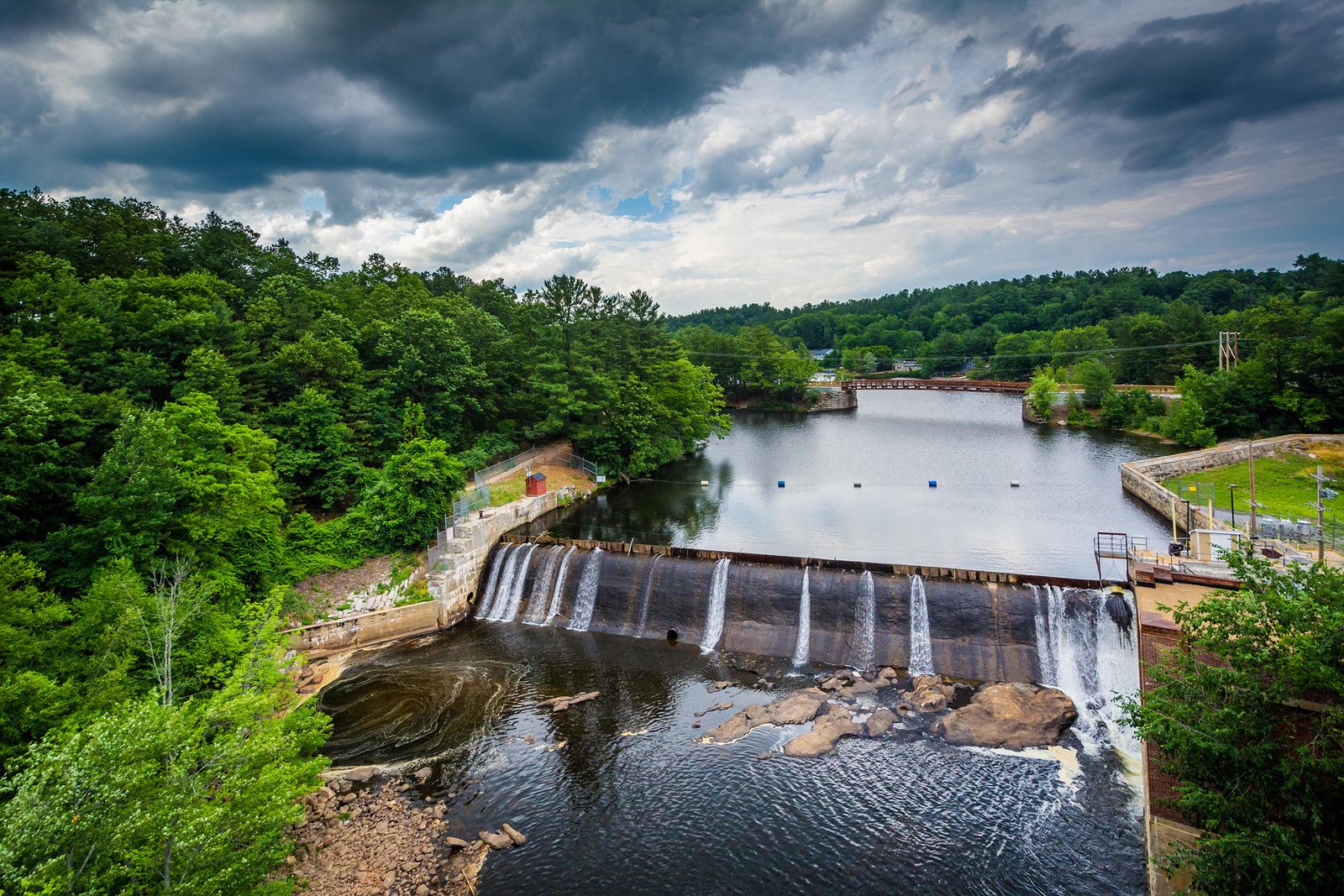
Dam Removals Are Bringing Fish Back Across the Northeastern United States, Striking Down One Tiny Barrier at a Time
While the demolition of big dams in the West gets more attention, many of these often-obsolete obstructions are also coming out of northeastern streams and rivers—and herring are returning in droves
Chinese dams hold billions of people to ransom
Could desalination make them irrelevant?

Beaver dam
A beaver dam or beaver impoundment is a dam built by beavers; it creates a pond which protects against predators and holds food during winter. These structures modify the natural environment in such a way that the overall ecosystem builds upon the change, making beavers a keystone species and ecosystem engineers. They build prolifically at night, carrying mud with their forepaws and timber between their teeth.

Fort Bliss Declarations - December 2025 | American Civil Liberties Union
The Earthquake That Will Devastate the Pacific Northwest
When the Cascadia fault line ruptures, it could be North America’s worst natural disaster in recorded history.

150 Minutes of Hell: Death and survival in California’s fire tornado
California’s 2018 fire season brought a cascade of tragedies, from Mendocino County to Malibu to the now-ruined town of Paradise. But when a massive tornado of fire ripped through Redding in July, firefighters and residents experienced a singular horror that gave a clear view of just how dangerous wildfires can be.

A Disaster the Size of Multiple Katrinas Is Building Off Washington’s Coast
The Coast Guard is the first line of defense against a massive tsunami. Will it also be an early victim?

Between Threat and Reality: The National Association for the Advancement of Colored People and the Emergence of Armed Self-Defense in Clarksdale and Natchez, Mississippi, 1960-1965
Annelieke Dirks, Between Threat and Reality: The National Association for the Advancement of Colored People and the Emergence of Armed Self-Defense in Clarksdale and Natchez, Mississippi, 1960-1965, Journal for the Study of Radicalism, Vol. 1, No. 1 (Spring 2007), pp. 71-98

Explosivity by Javier Arbona-Homar | East Bay Booksellers
How explosions across history reveal the violence embedded in San Francisco’s landscape Offering a novel approach to contemporary landscape studies, Explosivity unearths the hidden legacies of violence that have shaped the physical and cultural environment of the San Francisco Bay area.
Ashley Gate, Author at The Intercept
The U.S.–Israeli war has caused massive environmental devastation, adding to the long history of American wars with toxic legacies.

Debunking “When Prophecy Fails”
ABSTRACT In 1954, Dorothy Martin predicted an apocalyptic flood and promised her followers rescue by flying saucers. When neither arrived, she recanted, her group dissolved, and efforts to proselytize ceased. But When Prophecy Fails (1956), the now‐canonical account of the event, claimed the opposite: that the group doubled down on its beliefs and began recruiting—evidence, the authors argued, of a new psychological mechanism, cognitive dissonance. Drawing on newly unsealed archival material, this article demonstrates that the book's central claims are false, and that the authors knew they were false. The documents reveal that the group actively proselytized well before the prophecy failed and quickly abandoned their beliefs afterward. They also expose serious ethical violations by the researchers, including fabricated psychic messages, covert manipulation, and interference in a child welfare investigation. One coauthor, Henry Riecken, posed as a spiritual authority and later admitted he had “precipitated” the climactic events of the study.

