A sense of weirdness in the environment can be understood as unfactored reality. A blooming, buzzing confusion of sensory input that impinges on awareness…
Weirding Diary: 6
Weirding is related to uncanniness, as in uncanny valley: a near-subconscious sense of map-territory misregistration. I think there are two varieties, A and B.…
Weirding Diary: 10
It is now clear that the intellectual class has been caught entirely flat-footed on the wrong side of the Great Weirding in the US. Almost all discourses at…
A Philosopher’s One-Word Theory to Explain Why the World Feels So Weird
Once you learn what the "uni-context" is, you won't stop seeing it everywhere
Weirding Diary: 1
I did a little poll asking people the extent to which they are treating the current zeitgeist as a temporary weirding (TW) versus a permanent new normal (NN).…
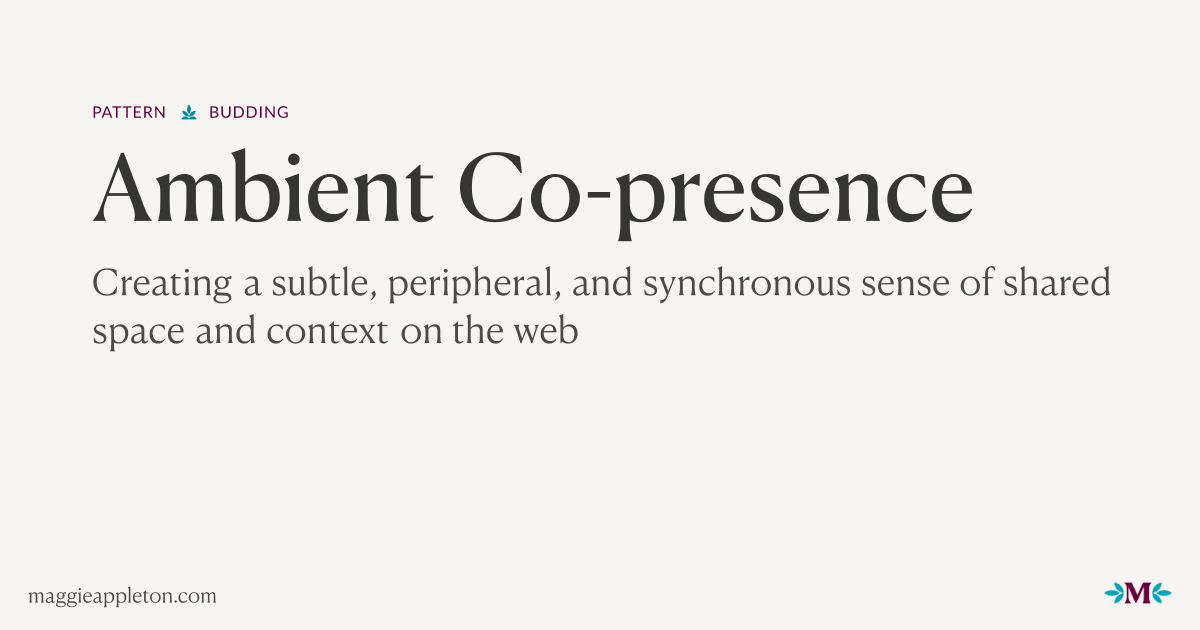
Ambient Co-presence
Creating a subtle, peripheral, and synchronous sense of shared space and context on the web
Ambient Co-presence
Creating a subtle, peripheral, and synchronous sense of shared space and context on the web
Our Minds Are Weirder than You Think
Weirding Diary: 2
It is easy to orient yourself in space and time. In the simplest (but not most accessible) case, you’re fully present in the here and now. In a more typical…
Untangling Self-Observation From Self-Reflection
When self-observation and self-reflection are confused, awareness blurs. Untangling them—and adding agency—reveals a clear path from noticing to meaning to action.

An investigation into alleged ‘hauntings’
In cases of alleged hauntings, a large number of seemingly trustworthy witnesses consistently report experiencing unusual phenomena (e.g. apparitions, sudden changes in temperature, a strong sense of presence) in certain locations. The two studies reported here explored the psychological mechanisms that underlie this apparent evidence of ‘ghostly’ activity. The experiments took place at two locations that have a considerable reputation for being haunted—Hampton Court Palace (Surrey, England) and the South Bridge Vaults (Edinburgh, Scotland). Both studies involved participants walking around these locations and reporting where they experienced unusual phenomena. Results revealed significantly more reports of unusual experiences in areas that had a reputation for being haunted. This effect was not related to participants' prior knowledge about the reputation of these areas. However, the location of participants' experiences correlated significantly with various environmental factors, including, for example, the variance of local magnetic fields and lighting levels. These findings strongly suggest that alleged hauntings may not necessarily represent evidence for ‘ghostly’ activity, but could be, at least in part, the result of people responding to ‘normal’ factors in their surroundings.

Weird Studies
Professor Phil Ford and writer J. F. Martel host a series of conversations on art and philosophy, dwelling on ideas that are hard to think and art that opens up rifts in what we are pleased to call "reality."

Predictive processing frameworks for perception can explain recent drone sightings in the United States
We draw on the predictive processing theory of perception to explain why healthy, intelligent, honest, and psychologically normal people might easily misperceive lights in the sky as threatening or extraordinary objects, especially in the context of WEIRD (western, educated, industrial, rich, and democratic) societies. We argue that the uniquely sparse properties of skyborne and celestial stimuli make it difficult for an observer to update prior beliefs, which can be easily fit to observed lights. Moreover, we hypothesize that humans have likely evolved to perceive the sky and its perceived contents as deeply meaningful. Finally, we briefly discuss the possible role of generalized distrust in scientific institutions and ultimately argue for the importance of astronomy education for producing a society with prior beliefs that support veridical perception.

Life is Strange | The Paper Pilot
The Paper Pilot's digital garden of thoughts on philosophy, politics, and sociology
On the Design of Escaped Realities
Human beings have this amazing ability to retreat from reality without knowing precisely what reality is, in which direction it lies, and how to solve the…
Welcome: Mapping the Architecture of Autistic Cognition
Most people experience their minds as opaque.