


The organizing principle of the modern world is pain. Avoiding it, yes. But also trading in it, taking refuge in it, and using it to justify our actions.…
A Practice in Emergence: Creating Resist’s New Theory of Change, Strategic Priorities, and Culture…
By Jax Gil

Alternative Cultures Are Beautiful and Important. They're Also Not Enough.
"The conscious destruction of a competing ethic” and the need for organizing and direct action

Cooperation emerges when groups are small and memories are long, study finds
The tragedy of the commons, a concept described by ecologist Garrett Hardin, paints a grim view of human nature. The theory goes that, if a resource is shared, individuals will act in their own self-interest, ...

The Ecology of Freedom: The Emergence and Dissolution o…
"The very notion of the domination of nature by man ste…

Organizations Beyond Purpose
Organizations deserve dignity as collective beings In my recent article, “Burned out on goodness,” I mentioned that I no longer believe in organizational purposes, at least not in the way they are often used. I even find that our purpose obsession is a hefty remnant of our mental colonization.

How social norms emerge: The interindividual actor–critic.
Self-organizing systems: what, how, and why?
I present a personal account of self-organizing systems, framing relevant questions to better understand self-organization, information, complexity, and emergence. With this aim, I start with a notion and examples of self-organizing systems (what?), continue with their properties and related concepts (how?), and close with applications (why?) in physics, chemistry, biology, collective behavior, ecology, communication networks, robotics, artificial intelligence, linguistics, social science, urbanism, philosophy, and engineering.
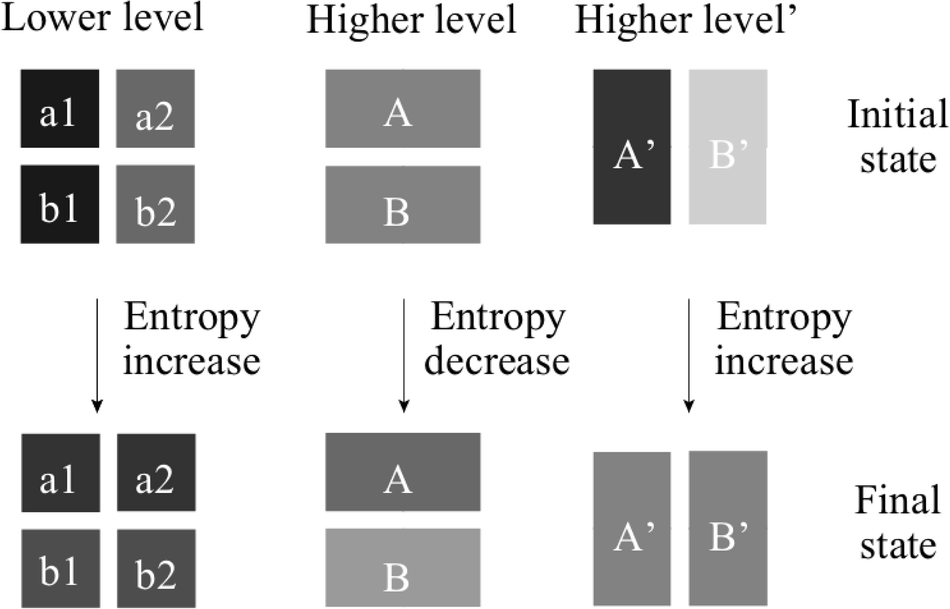
ORGANISING PRINCIPLES — THE ALTERNATIVE
This makes the difference between a localism that cannot sustain itself because it is simply too small with limited resources of skills and expertise. And one that is able to build its own regenerative economy, entirely through access to the global commons.
Why People Obey: Theoretical Observations on Power and Obedience in Complex Organizations
Recent sociological studies of power in organizations, although oriented toward practical ends, offer promise for a general sociological theory of power. Empirically grounded organizational studies examine social life as practiced by actors and preserve the tension between structure and action. Exchange theory and structural theories of power, in contrast, are abstract and theoretical; by asserting the primacy of structures (structural theories) or action (exchange theory), they cannot account well for the dialectic of human agency and structural constraint. We suggest the theoretical implications of organizational analysis and compare this perspective with traditional sociological approaches to power.

Opinion | To Make the World Better, Think Small (Published 2016)
It is easy to become numb to suffering. Feeling empathy for individual victims can overcome the numbness.


The hidden ‘rules of the game’ that dictate how we navigate the world | Psyche Videos
How free are we really, if human behaviour embodies the complex, intertwined webs of society and history?

Life Is Pain, Highness
I’ve been thinking about art and punishment. That is, how we punish people for making art. There’s the more nuanced form, where we project our own...

Pain and Sacrifice: Experience and Modulation of Pain in a Religious Piercing Ritual
Fascinating pain-related rituals have been observed throughout the world, but so far no systematic evidence exists to support previous ethnographic reports of analgesic states and dissociative sym...

Organizing

Governance, collaboration, how to work together without being awful.
Conflict Systems
Spaces as Layers - Nick's Blog
web.archive.org
Axioms for Organizers by Fred Ross, Sr. | Fred Ross, Sr.
The Tyranny of Stuctureless
cdn.fastly.steamstatic.com

