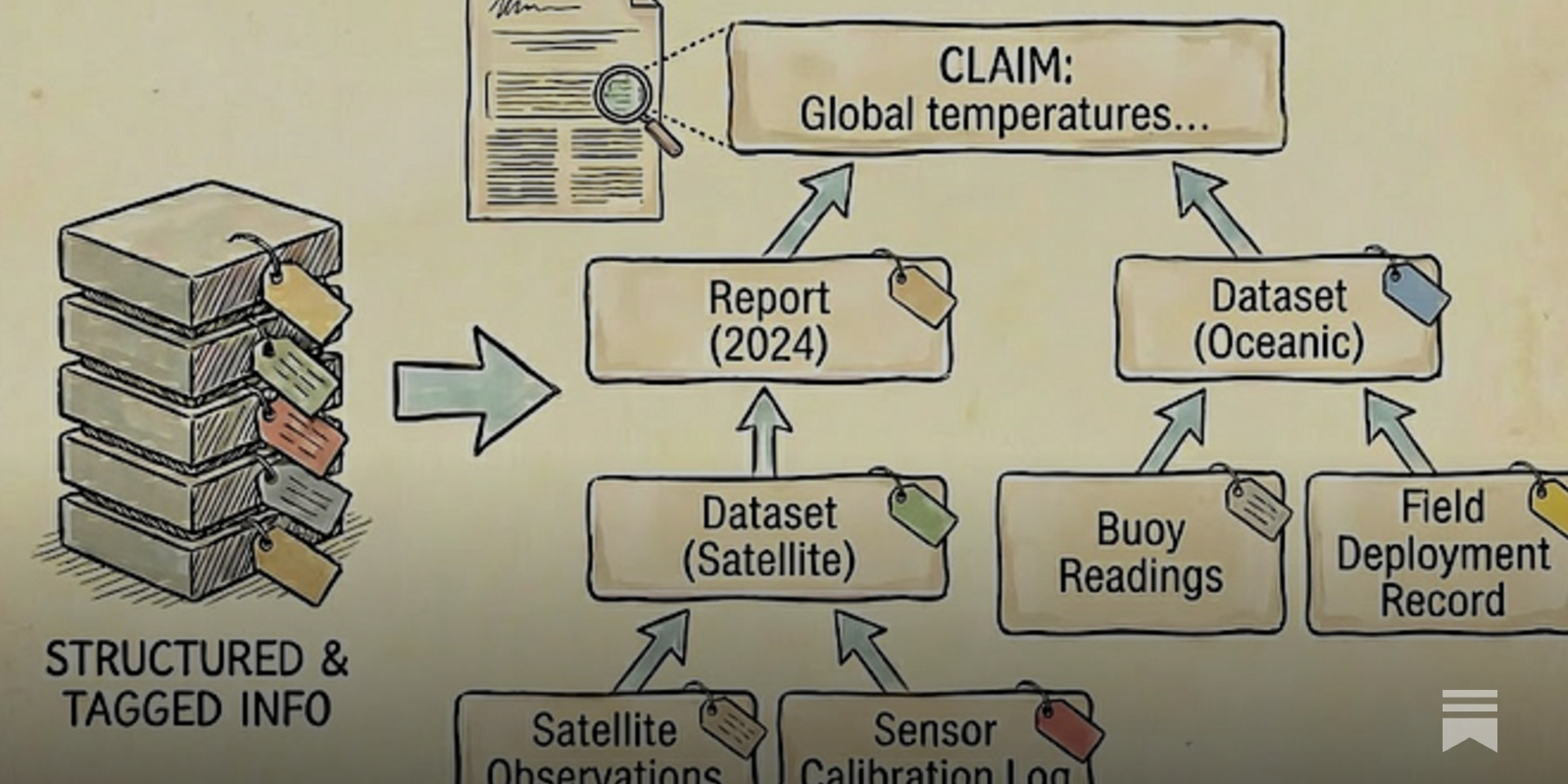
We treat facts like they're "atoms of truth" — small, indivisible, solid — and if you add them up, you get "big truths." But like atoms, facts are mostly empty…
The year we rebuild the infrastructure of truth
"Truth is more than a collection of facts; it's a mechanism for belonging."

Theories of Truth: A Critical Introduction
Theories of Truth provides a clear, critical introduction to one of the most difficult areas of philosophy. It surveys all of the major philosophical theories of truth, presenting the crux of the issues involved at a level accessible to nonexperts yet in a manner sufficiently detailed and original to be of value to professional scholars. Kirkham's systematic treatment and meticulous explanations of terminology ensure that readers will come away from this book with a comprehensive general understanding of one of philosophy's thorniest set of topics.Included are discussions of the correspondence, coherence, pragmatic, semantic, performative, redundancy, appraisal, and truth-as-justification theories. There are also chapters or sections of chapters on the liar paradox, three-valued logic, Field's critique of Tarski, Davidson's program, Dummett's theory of linguistic competence, satisfaction, recursion, the extension/intension distinction, and an explanation of how theories of justification, properly understood, differ from theories of truth.A persistent theme is that philosophers have too often failed to recognize that not all theories of truth are intended to answer the same question. When the various questions are made distinct, it is apparent that many of the "debates" in this field are really cases of philosophers talking past one another. There is much less disagreement within the field than has commonly been thought.

Why Facts Don’t Change Minds in the Culture Wars—Structure Does
Why do facts bounce off some people? It’s not about logic; it’s about structure. Your worldview isn’t a list of opinions—it's a living network. And right now, it's at war.

Factivity, presupposition projection, and the role of discrete knowledge in gradient inference judgments
We investigate whether the factive presuppositions associated with some clause-embedding predicates are fundamentally discrete in nature—as classically assumed—or fundamentally gradient—consistent wit
Wittgenstein Explains Why We Always Misunderstand One Another on the Internet
The best class I took in college was on the philosopher Ludwig Wittgenstein. Until that point, I had avoided philosophy of language as simply being too...

Reconciling truthfulness and relevance as epistemic and decision-theoretic utility.
When Truth Becomes Hazardous: Navigating Information Through the Metacrisis | Frankly 153


The truth has got its boots on: what the evidence says about Mr. Damore’s Google memo
I’m saying, sir, that a lie can run round the world before the truth has got its boots on.
On the advantages of believing that nothing is true | Aeon Essays
Alethic nihilism is the theory that nothing is true. There is much to gain by taking this radical idea seriously


The Source of Truth Problem is Getting Worse with Agents — Tonk
Intelligence depends on knowledge, but in practice that knowledge is fragmented across tools, people, and formats, creating conflicting versions of reality. What if we accepted that knowledge lives at the edge and focused instead on effectively sharing it?

A Knowledge Commons for the 21st Century
Truth-seeking infrastructure at scale