

We're now seeing multi-agent systems that take your PyTorch code and produce CUDA or Triton kernels with 2x to 14x speedups over torch.compile(mode='max-autotune-no-cudagraphs'). Not on toy benchmarks. On real models like Llama-3.1-8B, Whisper, and Stable Diffusion. Learn proven techniques to shift the scaling law intercept and achieve 10-50% performance gains.
Modern GPU Programming For MLSys — Modern GPU Programming For MLSys
Machine learning systems sit at the heart of modern AI workloads. In these systems, performance often comes down to the quality of a small number of GPU kernels. Attention kernels, LLM prefill and decode kernels, low-precision block-scaled GEMMs, fused MoE layers, and other large fused kernels all directly shape end-to-end speed in both training and serving.
Modern GPU Programming For MLSys — Modern GPU Programming For MLSys
Machine learning systems sit at the heart of modern AI workloads. In these systems, performance often comes down to the quality of a small number of GPU kernels. Attention kernels, LLM prefill and decode kernels, low-precision block-scaled GEMMs, fused MoE layers, and other large fused kernels all directly shape end-to-end speed in both training and serving.
clem 🤗 on Twitter / X
Introducing Kernels on the Hugging Face Hub ✨What if shipping a GPU kernel was as easy as pushing a model?- Pre-compiled for your exact GPU, PyTorch & OS- Multiple kernel versions coexist in one process- torch.compile compatible- 1.7x–2.5x speedups over PyTorch baselines pic.twitter.com/U0qDdxCWkd— clem 🤗 (@ClementDelangue) April 14, 2026
MPS or MLX for Domestic AI? The Answer Will Surprise You
Let’s explore new Apple’s deep learning framework, run modern LLM on a laptop, and find an intriguing hint for performance of PyTorch MPS

vik on Twitter / X
Photon, our inference engine, isn't fast just because of GPU kernels. A lot of the speedup comes from engine-level work: request scheduling, prefix caching, image processing, all tuned to keep the GPU saturated. https://t.co/3M7eFcFKo5— vik (@vikhyatk) May 2, 2026
Mesh LLM: distributed AI computing on iroh
How Mesh LLM pools existing GPU resources across machines into a single OpenAI-compatible API, built on iroh.
How To Scale Your Model
Training LLMs often feels like alchemy, but understanding and optimizing the performance of your models doesn't have to. This book aims to demystify the science of scaling language models: how TPUs (and GPUs) work and how they communicate with each other, how LLMs run on real hardware, and how to parallelize your models during training and inference so they run efficiently at massive scale. If you've ever wondered “how expensive should this LLM be to train” or “how much memory do I need to serve this model myself” or “what's an AllGather”, we hope this will be useful to you.
Alex Cheema on Twitter / X
.@karpathy shouted out my work on @exolabs at @ycombinator AI SUS!“we use LLMs similarly to mainframes in the ‘70s - compute is timeshared by having a slice in the batch dimension. models will compress over time, and with this we’ll be able to run more on-device” pic.twitter.com/UKSrquQGAL— Alex Cheema (@alexocheema) June 18, 2025
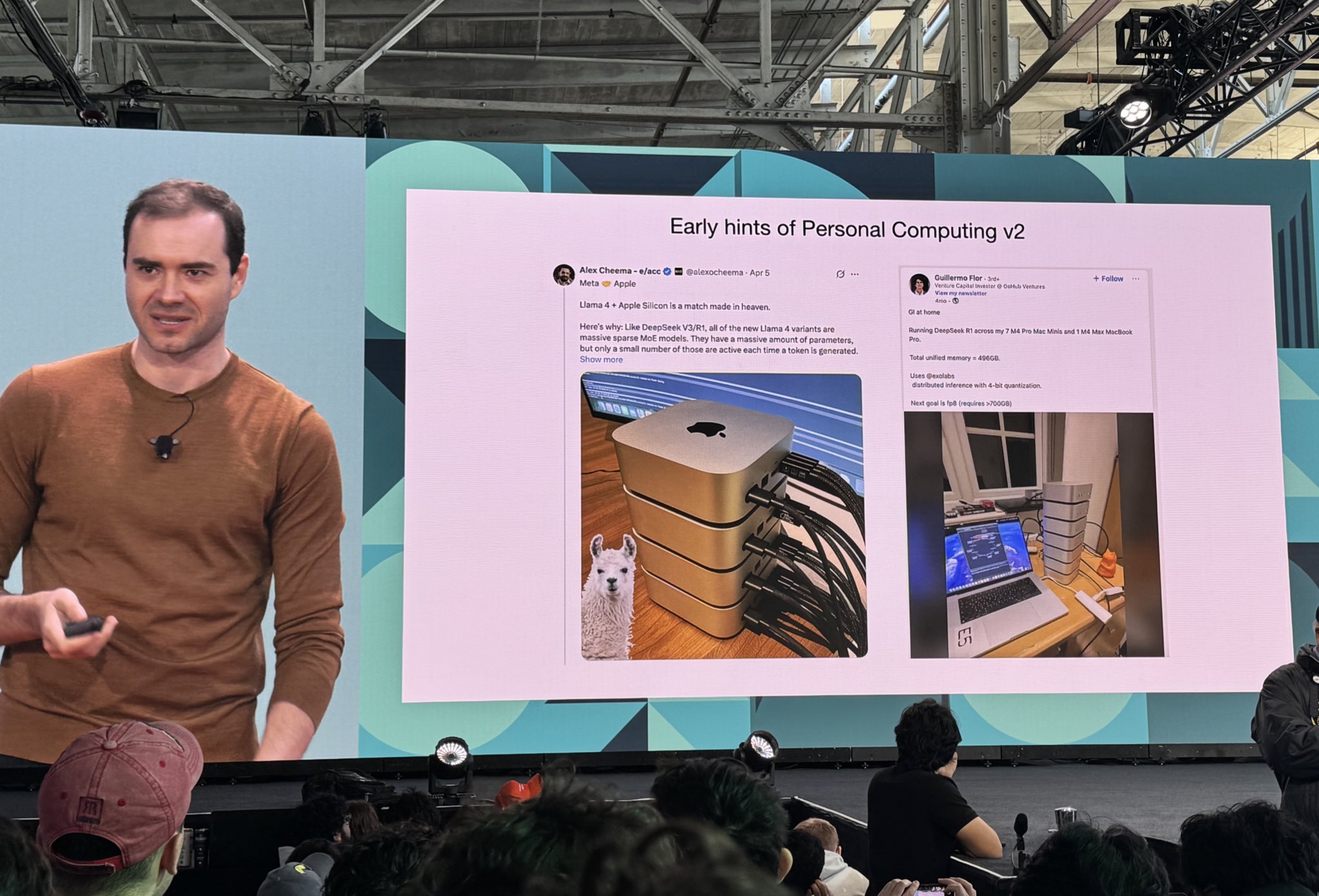
RightNow AI - YC-Backed GPU Research Lab
YC-backed GPU research lab building the RightNow CUDA editor, RunInfra inference infra, Forge kernels, and publishing AutoMegaKernel and related papers on arXiv.
Benchmarks | EXO
Transparent benchmarks for LLMs tested on real hardware. Coming soon.
LLM Leaderboard - Comparison of over 100 AI models from OpenAI, Google, DeepSeek & others
Comparison and ranking the performance of over 100 AI models (LLMs) across key metrics including intelligence, price, performance and speed (output speed - tokens per second & latency - TTFT), context window & others.
google-ai-edge/LiteRT
LiteRT, successor to TensorFlow Lite. is Google's On-device framework for high-performance ML & GenAI deployment on edge platforms, via efficient conversion, runtime, and optimization
XiongjieDai/GPU-Benchmarks-on-LLM-Inference
Multiple NVIDIA GPUs or Apple Silicon for Large Language Model Inference?
Import AI 470: No rights for machines; automating environment generation with SPADE; and building better GPU kernels with Hawkeye
Differential acceleration of cyber, math, and AI

Introducing LFM2: The Fastest On-Device Foundation Models on the Market | Liquid AI
Today, we release LFM2, a new class of Liquid Foundation Models (LFMs) that sets a new standard in quality, speed, and memory efficiency for on-device deployment. Built on a hybrid architecture, LFM2 delivers 200% faster decode and prefill performance than Qwen3 and Gemma 3 on CPU. It also significantly outperforms models in each size class on instruction-following and function calling—the core capabilities that make LLMs reliable for building AI agents.

Exploring LLMs with MLX and the Neural Accelerators in the M5 GPU
Mac with Apple silicon is increasingly popular among AI developers and researchers interested in using their Mac to experiment with the…
