


How should we go about making typographic laws, rules and guidelines for the web?
Content guidelines overview
The section covers the naming and content of Internet-Drafts (I-Ds) including the required and recommended sections. There are lots of rules governing the content, developed over many years in order, which aim to ensure the readability and consistency of I-Ds. Please follow this section closely. The pages in this section are:
Who Shapes Web Standards? Uncovering the Main Topics of Interest in the W3C
An interactive introduction to the terrific experience of rendering Arabic typography and its technical debt
This post was discussed in Lobsters and HackerNews

Fonts In Use
A searchable archive of typographic design, indexed by typeface, format, and topic.
Typo
Design a modular type scale, preview it live, and copy production-ready CSS with optional fluid typography.
On forking the Web
This document contains a set of informal notes on how to build an alternative specification to the Web, in such a way that hopefully prevents many of its drawbacks while still preserves many of the good points. This document is not an specification, and is therefore subject to change over time.
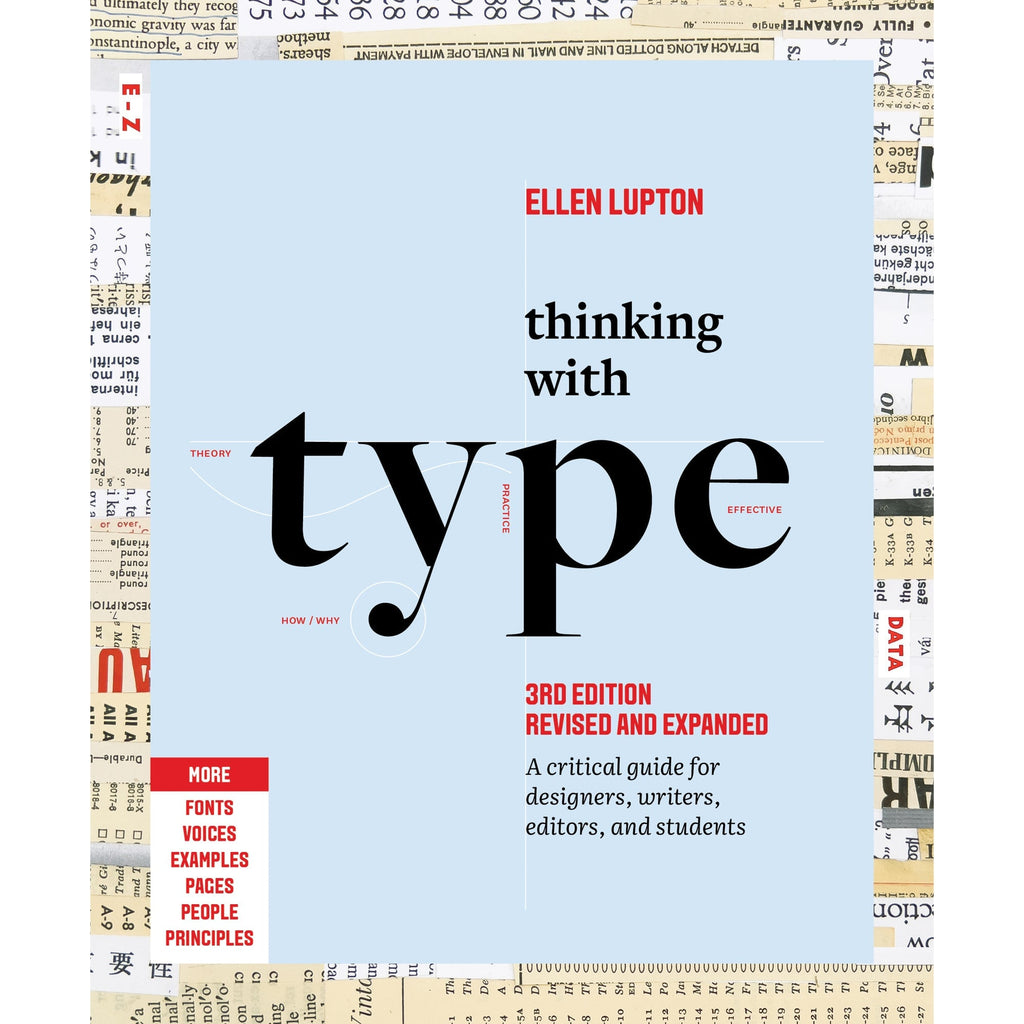
Thinking with Type
The essential and bestselling guide to typography from beloved design educator Ellen Lupton—revised and expanded to include new and additional voices, examples, and principles, and a wider array of typefaces. "Thinking with Type is to typography what Stephen Hawking's A Brief History of Time is to physics."—I Love TypographyThe bestselling Thinking with Type in a revised and expanded third edition: This is the definitive guide to using typography in visual communication. Covering the essentials of typography, this book explores everything from typefaces and type families to kerning and tracking to grids and layout principles.Ellen Lupton provides clear and focused guidance on how letters, words, and paragraphs should be aligned, spaced, ordered, and shaped. Historical and contemporary examples of graphic design show how to learn the rules and how to break them. Critical essays, eye-opening diagrams, helpful exercises, and dozens of examples and illustrations show readers how to be inventive within systems that inform and communicate.Featuring 32 pages of new content, the third edition is revised and refined from cover to cover: More fonts: old fonts, new fonts, weird fonts, libre fonts, Google fonts, Adobe fonts, fonts from independent foundries, and fonts and lettering by women and BIPOC designersIntroductions to diverse writing systems, contributed by expert typographers from around the worldDemonstrations of basic design principles, such as visual balance, Gestalt grouping, and responsive layoutCurrent approaches to typeface design, including variable fonts and optical sizes; tips for readability, legibility, and accessibility; and stunning reproductions from the Letterform Archive Thinking with Type is the typography book for everyone: designers, writers, editors, students, anyone who works with words on page or screen, and enthusiasts of type and lettering. Readers will also love Ellen Lupton's book Extra Bold: A Feminist, Inclusive, Anti-racist, Nonbinary Field Guide for Graphic Designers. Ellen Lupton is a designer, writer, and educator. She has written numerous books about graphic design, including Thinking with Type, Graphic Design Thinking, and Extra Bold: A Feminist, Inclusive, Anti-racist, Nonbinary Field Guide for Graphic Designers. She teaches in the Graphic Design MFA program at Maryland Institute College of Art in Baltimore (MICA), where she proudly serves as the Betty Cooke and William O. Steinmetz Design Chair. She is Curator Emerita at Cooper Hewitt, Smithsonian Design Museum in New York City, where her exhibitions included Herbert Bayer: Bauhaus Master and The Senses: Design Beyond Vision. Lupton loves reading, writing, teaching, and learning new things about design.
The Type Founders (@thetypefounders.bsky.social)
We built Typographer because finding the right font shouldn’t mean hunting down trials across dozens of foundry sites. A year after launch, we’re making it even more accessible: 38+ independent foundries in one place, now free to join.

Introduction - Standard.site
A brief introduction to Standard.site lexicons, what they are, and how they're used.
Browse Fonts - Google Fonts
Making the web more beautiful, fast, and open through great typography
Copyright and DMCA Best Practices for Fediverse Operators
People building the future of the social web—interoperable and decentralized—need to protect themselves against copyright liability. This post gives an overview of the steps to take. It’s meant for

Web Interface Guidelines
Guidelines for building great interfaces on the web. Covers interactions, animations, layout, content, forms, performance & design.
I kind of want to make a @standard.site format for characters..... Would be useful for adoptables and roleplayers and TTRPG people I think.
This generated some discussion so I want to expand on it a bit The context is that standard.site doesn't currently have any lexicons for the actual content. The idea is that the document content is covered by leaflet, offprint, pckt, or other lexicons. But...

P(aul) Frazee
You shouldn’t use lexicons that don’t actually exist
⁂ Standarding yo site

Blog posts and guides from folks who have integrated standard.site into their website
I Moved My Website to Leaflet - Norbert Woehnl Photography
Hello, Leaflet 👋🏼🍃 - augment

New: special subscribe route for *any* @standard.site publication…useful as an embeddable form! leaflet-hosted: `pub_domain/subscribe` e.g…
How to publish multiple Standard Site publications on one domain

Putting my Neocities blog on ATProto

Understanding Standard.Site

