


Race After Technology (Polity) cuts through tech-industry hype to understand how emerging technologies can reinforce white supremacy and deepen social inequity. Benjamin argues that automation has the potential to hide, speed, and even deepen discrimination, while appearing neutral and even benevole
A Real Political Economy of Technology - The Ideas Letter
Two technological futures are competing for political and material priority: generative AI and the green transition. Benanav argues that while AI is marketed as a world-reordering breakthrough, its productivity gains…

'Sovereignty' Myth-Making in the AI Race
Tech companies stand to gain by encouraging the illusion of a race for 'sovereign' AI, write Rui-Jie Yew, Kate Elizabeth Creasey, Suresh Venkatasubramanian.

Ghost in the Machine | Full Documentary
AI, Decomputing and the Interregnum
This paper treats AI as diagnostic for the deeper changes taking place in the existing order of things. It uses AI's alignment with both the political economy and with the dualisms that underpin it, including race, gender and anthropocentrism, to highlight the nihilistic character of the current restructuring. AI's scaling and accelerationism are taken as examples of the wider tactics being invoked by hegemonic power to maintain control under changing conditions. From this perspective, the massive build-out of data centres isn't simply a seizure of energy resources but a manifestation of an aggressive and misogynist technopolitics. The paper argues that a liberal push for digital sovereignty doesn't interrupt these dynamics but plays into the hands of emerging technofascism. It proposes instead the prefigurative tactic of 'decomputing', which draws on degrowth, deautomatisation and a convivial approach to technology. It explores decomputing as a means to mitigate both material and relational harms and as a decisive turn towards infrastructuring the common good. The paper concludes that AI is the contradiction that reveals many others, not least the gap between claims to legitimacy and the actuality of destructive violence, and proposes an alternative technopolitics of reciprocity that prioritises care and sustainability.
AI, Decomputing and the Interregnum
This paper treats AI as diagnostic for the deeper changes taking place in the existing order of things. It uses AI's alignment with both the political economy and with the dualisms that underpin it, including race, gender and anthropocentrism, to highlight the nihilistic character of the current restructuring. AI's scaling and accelerationism are taken as examples of the wider tactics being invoked by hegemonic power to maintain control under changing conditions. From this perspective, the massive build-out of data centres isn't simply a seizure of energy resources but a manifestation of an aggressive and misogynist technopolitics. The paper argues that a liberal push for digital sovereignty doesn't interrupt these dynamics but plays into the hands of emerging technofascism. It proposes instead the prefigurative tactic of 'decomputing', which draws on degrowth, deautomatisation and a convivial approach to technology. It explores decomputing as a means to mitigate both material and relational harms and as a decisive turn towards infrastructuring the common good. The paper concludes that AI is the contradiction that reveals many others, not least the gap between claims to legitimacy and the actuality of destructive violence, and proposes an alternative technopolitics of reciprocity that prioritises care and sustainability.
Anthropomorphism Is Breaking Our Ability to Judge AI
Tech Policy Press fellow James Ball asks, how should we interact with a technology designed to ‘speak’ with us on what appear to be human terms?

#LiberatingWebinars: Disability Justice & Crip Technoscience: Racism & Ableism in AI
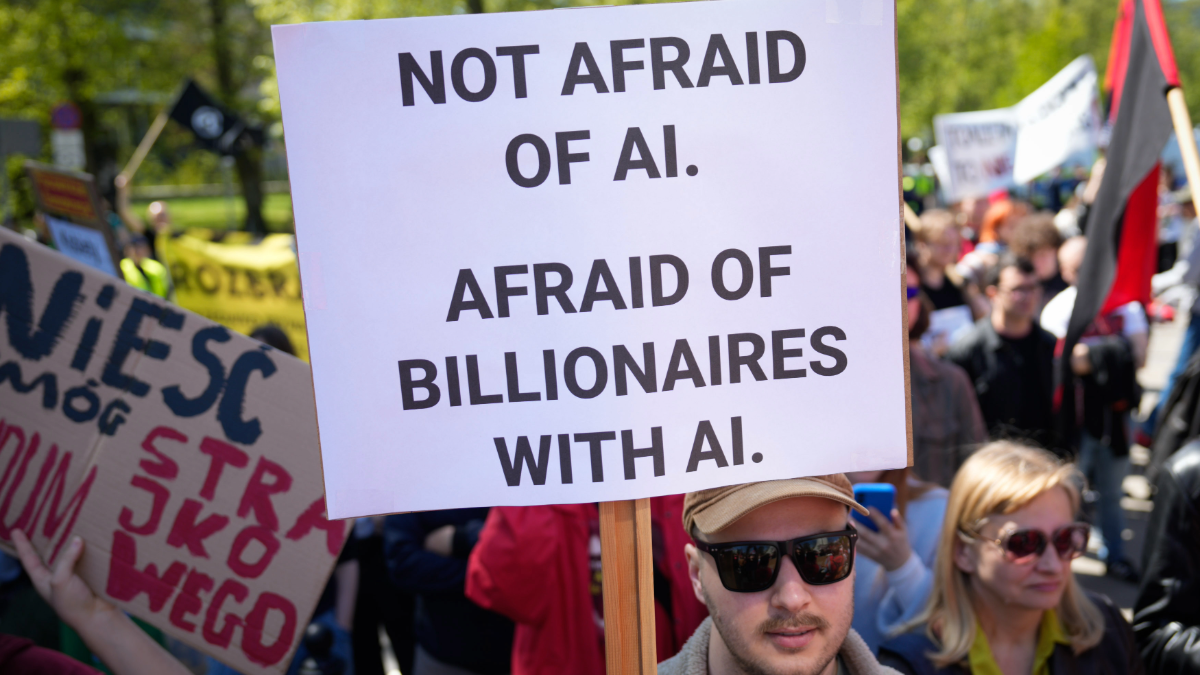
AI Billionaires Are Starting to Get Scared
The world's tech billionaires are starting to moderate their rhetoric on AI automation, but that doesn't mean it's all in good faith.

AI Bros Wanted Trump. Now They Learn What Happens When You Tell Him No.
Last year, in Fascism For First Time Founders, I warned the tech industry what happens when you cozy up to authoritarians. As I wrote then: Innovation requires trust. Not just between individuals, …

AI Science Fiction Versus Reality
Race Science, Slavery, And The Unreality Of White Supremacy
The unreality that justifies white supremacy has shape shifted

70 years of AI hype
Quoting from Olivia Guest et al. (2025) "Against the Uncritical Adoption of AI Technologies in Academia."

Separating AI’s Technological Problems From its Capitalism Problems
Nathan E. Sanders and Bruce Schneier say integrating a technology as disruptive as AI responsibly requires deep structural reforms.
Technology is Not Values Neutral: Ending the Reign of Nihilistic Design
We fail to take tech seriously when we do not grasp its full impact on humans

Field Theory: AI as Social Science Question, Object & Tool
Uses of advanced artificial intelligence are changing how societies organize labor, govern, produce knowledge, and make meaning. In light of these developments, this essay argues that AI models, tools, and systems pose three interrelated imperatives for social science: they demand renewed attention to social theories of how technology, human experience, and social order are entangled; they require study as objects of inquiry in their own right; and they offer capabilities that may transform—or upend—the practice of social investigation itself. From Weber’s analysis of rationalization to Du Bois’s study of technology and inequality to contemporary scholarship on algorithmic governance, the essay examines what social science distinctively offers: the capacity to historicize the apparently unprecedented, to trace connections across scales, and to center those most affected by technological change. It identifies how algorithmic systems are remaking the distribution of opportunity and risk as a central task of social inquiry and asks what futures social science might help bring into being.
The Technological Republic: The Sunday Times bestseller from the great minds behind Palantir
The Sunday Times and #1 New York Times Bestseller‘The Technological Republic is far too important to ignore’ Times Literary SupplementSilicon Valley’s brightest minds once collaborated with governments to advance technologies, securing the West’s dominance on the global stage. But that relationship has corroded – with perilous repercussions for us all.Lifting the veil on tech giant Palantir and its broader political project, visionary co-founder and CEO Alexander C. Karp and his long-time deputy Nicholas W. Zamiska offer a searing critique of our collective culture of complacency. To regain geopolitical power and preserve our freedoms, we must tackle the world’s most pressing challenges – including the artificial intelligence arms race – together and head-on. Now is the time for the West to wake up.‘Bold and ambitious ... Essential reading’ Eric Schmidt‘Fascinating’ Financial Times‘A stirring manifesto’ Niall Ferguson‘Provocative and insightful’ Jamie Dimon