

How Media – Namely News, Ads and Social Posts – Can Shape an Election
Improving social media for democratic discourse
Social media have expanded opportunities for communication and political participation, but today's dominant platforms are optimized primarily for engagement and advertising revenue, contributing...

How Technology Is Shaping Modern Politics
Discover how technology is reshaping politics, from digital campaigns to AI, and the challenges of misinformation and election security.
The small effects of political advertising are small regardless of context, message, sender, or receiver: Evidence from 59 real-time randomized experiments
Campaign persuasion operates with notable consistency across political parties, message tone, and information environment., Evidence across social science indicates that average effects of persuasive messages are small. One commonly offered explanation for these small effects is heterogeneity: Persuasion may only work well in specific circumstances. To evaluate heterogeneity, we repeated an experiment weekly in real time using 2016 U.S. presidential election campaign advertisements. We tested 49 political advertisements in 59 unique experiments on 34,000 people. We investigate heterogeneous effects by sender (candidates or groups), receiver (subject partisanship), content (attack or promotional), and context (battleground versus non-battleground, primary versus general election, and early versus late). We find small average effects on candidate favorability and vote. These small effects, however, do not mask substantial heterogeneity even where theory from political science suggests that we should find it. During the primary and general election, in battleground states, for Democrats, Republicans, and Independents, effects are similarly small. Heterogeneity with large offsetting effects is not the source of small average effects.

New study shows just how Facebook's algorithm shapes conservative and liberal bubbles
Research conducted at the height of the 2020 election reveals new details about how Facebook's algorithms handle political content. But it suggests there are no easy fixes to political polarization.

Mainstreaming the populist radical right? Online news exposure and voting behavior in the 2019 European Parliament election
How does media exposure relate to support for radical right populist parties (RRPPs)? We contribute to this classic debate by analyzing the web browsing histories and survey responses of six thousand study participants in France, Germany, Italy, Spain, and the UK during the 2019 European Parliament election. Linking direct measures of online news exposure to voting behavior allows us to assess the effects of the salience of issues politicized by RRPPs on their electoral support. The likelihood to vote for RRPPs was higher when the EU was more salient in individual media diets, while exposure to the less salient issue of immigration did not increase the propensity to vote for RRPPs. Alongside consistent results for other party families and interactions with pre-existing voting intentions, the findings indicate that the electoral effects of online media are contingent on the overall salience of a specific issue and voters’ predispositions.

How do social media feed algorithms affect attitudes and behavior in an election campaign?
We investigated the effects of Facebook’s and Instagram’s feed algorithms during the 2020 US election. We assigned a sample of consenting users to reverse-chronologically-ordered feeds instead of the default algorithms. Moving users out of algorithmic feeds substantially decreased the time they spent on the platforms and their activity. The chronological feed also affected exposure to content: The amount of political and untrustworthy content they saw increased on both platforms, the amount of content classified as uncivil or containing slur words they saw decreased on Facebook, and the amount of content from moderate friends and sources with ideologically mixed audiences they saw increased on Facebook. Despite these substantial changes in users’ on-platform experience, the chronological feed did not significantly alter levels of issue polarization, affective polarization, political knowledge, or other key attitudes during the 3-month study period.

Verifying information about elections
We can help you check the facts behind election information you receive.

Media Cues and Citizen Support for Right-Wing Populist Parties
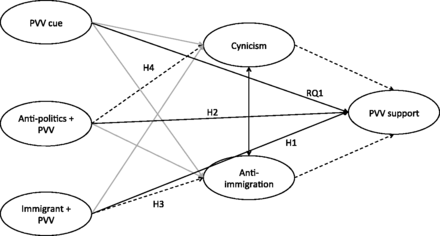
Abstract. Right-wing populist parties are thriving across Europe. Their success is usually attributed to demand-side voter factors and supply-side factors
Why Are American Presidential Election Campaign Polls so Variable When Votes Are so Predictable?
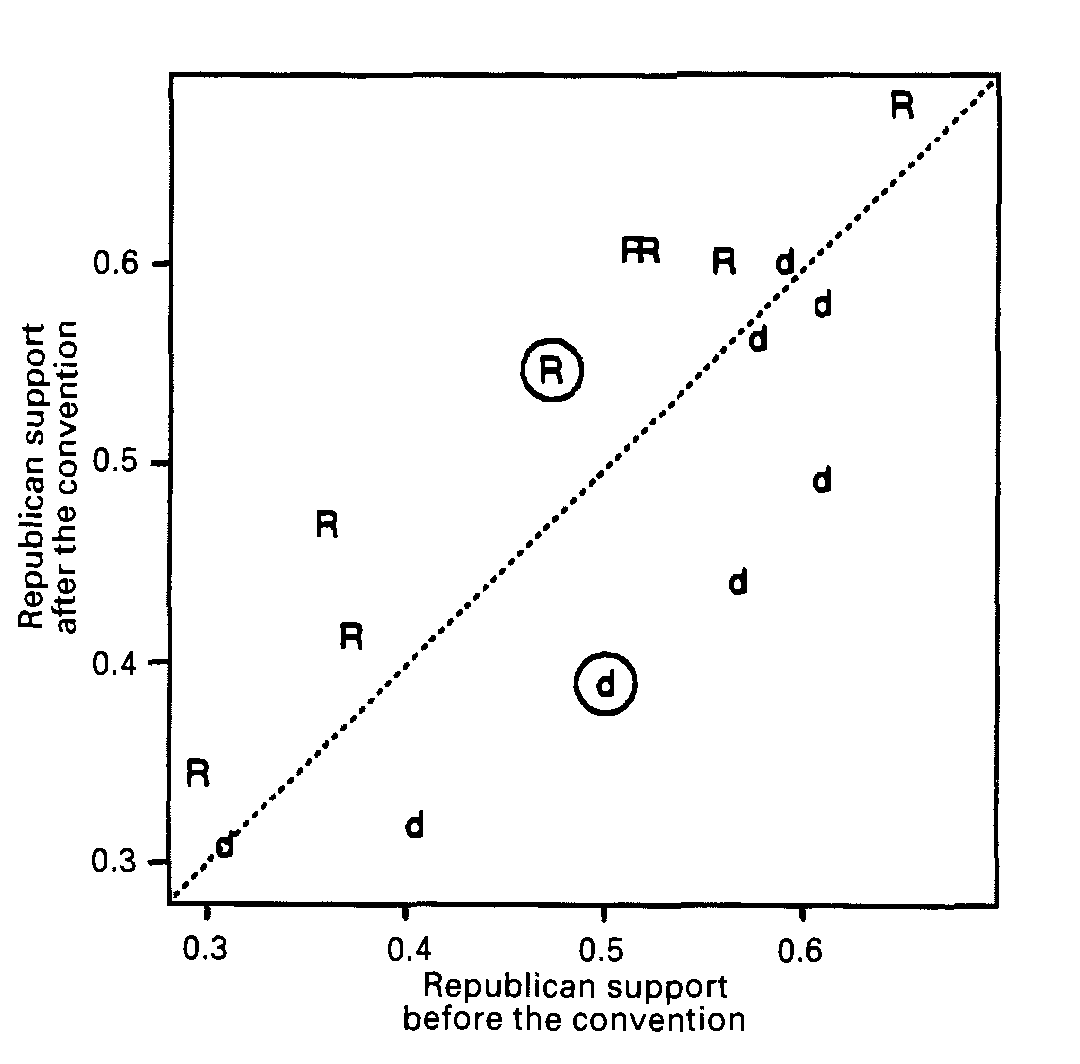
As most political scientists know, the outcome of the U.S. Presidential election can be predicted within a few percentage points (in the popular vote), based on information available months before the election. Thus, the general election campaign for president seems irrelevant to the outcome (except in very close elections), despite all the media coverage of campaign strategy. However, it is also well known that the pre-election opinion polls can vary wildly over the campaign, and this variation is generally attributed to events in the campaign. How can campaign events affect people's opinions on whom they plan to vote for, and yet not affect the outcome of the election? For that matter, why do voters consistently increase their support for a candidate during his nominating convention, even though the conventions are almost entirely predictable events whose effects can be rationally forecast? In this exploratory study, we consider several intuitively appealing, but ultimately wrong, resolutions to this puzzle, and discuss our current understanding of what causes opinion polls to fluctuate and yet reach a predictable outcome. Our evidence is based on graphical presentation and analysis of over 67,000 individual-level responses from forty-nine commercial polls during the 1988 campaign and many other aggregate poll results from the 1952–1992 campaigns. We show that responses to pollsters during the campaign are not generally informed or even, in a sense we describe, "rational." In contrast, voters decide which candidate to eventually support based on their enlightened preferences, as formed by the information they have learned during the campaign, as well as basic political cues such as ideology and party identification. We cannot prove this conclusion, but we do show that it is consistent with the aggregate forecasts and individual-level opinion poll responses. Based on the enlightened preferences hypothesis, we conclude that the news media have an important effect on the outcome of Presidential elections–-not due to misleading advertisements, sound bites, or spin doctors, but rather by conveying candidates' positions on important issues. Winner of the Pi Sigma Alpha Awardfor the best paper at the previous year's meetings of the Midwest Political Science Association. Replication data at the Harvard Dataverse: [https://doi.org/10.7910/DVN/I7GIKD](https://doi.org/10.7910/DVN/I7GIKD).
Social Media Effects: Hijacking Democracy and Civility in Civic Engagement
Perceived as an equalizing force for disenfranchised individuals without a voice, the importance of social networks as agents of change cannot be ignored. However, in some societies, social networks have evolved into a platform for fake news and propaganda, empowering disruptive voices, ideologies, and messages. Social networks such as Twitter, Facebook, and Google hold the potential to alter civic engagement, thus essentially hijacking democracy, by influencing individuals toward a particular way of thinking.
Simulating Aggregate Electoral Opinion Trajectories with LLM Personas and Media Exposure
LLM-based election simulation has largely been evaluated against a single final outcome, in many cases neglecting how much it can recover the trajectory shaped by media exposure and shifting candidate support. We propose evaluating election simulations in terms of trajectory fidelity: whether persona-conditioned LLM agents can update their beliefs in response to media to reproduce the temporal movement of public opinion, both in aggregate and across demographic subgroups. We design a framework in which each LLM agent carries its belief across time and updates it as new campaign information arrives. We further investigate how performance can vary across simulation design choices such as media exposure model, election context, and survey questionnaire. In a study on the 2026 Seoul mayoral and local elections, we validate simulated trajectories against weekly public-opinion polls and find that simulations that carry prior beliefs across time—rather than simulating each poll date independently—substantially improves alignment with observed polling movement, while the way media exposure is personalized leaves aggregate movement largely intact but reshapes subgroup-level dynamics. We propose a framework for validating simulated opinion trajectories against real-world traces, and discuss the simulation design choices that can influence the performance.
The Minimal Persuasive Effects of Campaign Contact in General Elections: Evidence from 49 Field Experiments
Significant theories of democratic accountability hinge on how political campaigns affect Americans’ candidate choices. We argue that the best estimate of the effects of campaign contact and advertising on Americans’ candidates choices in general elections is zero. First, a systematic meta-analysis of 40 field experiments estimates an average effect of zero in general elections. Second, we present nine original field experiments that increase the statistical evidence in the literature about the persuasive effects of personal contact tenfold. These experiments’ average effect is also zero. In both existing and our original experiments, persuasive effects only appear to emerge in two rare circumstances. First, when candidates take unusually unpopular positions and campaigns invest unusually heavily in identifying persuadable voters. Second, when campaigns contact voters long before election day and measure effects immediately—although this early persuasion decays. These findings contribute to ongoing debates about how political elites influence citizens’ judgments.
Stop and Consider:Our campaign
During a federal election there is a large amount of information being distributed, much of it online, which is seeking to influence your vote. Some of this may be disinformation, or false information.

Home - LogiVote
Complete Solutions for a Campaign Management System and for Digital or Online Voting

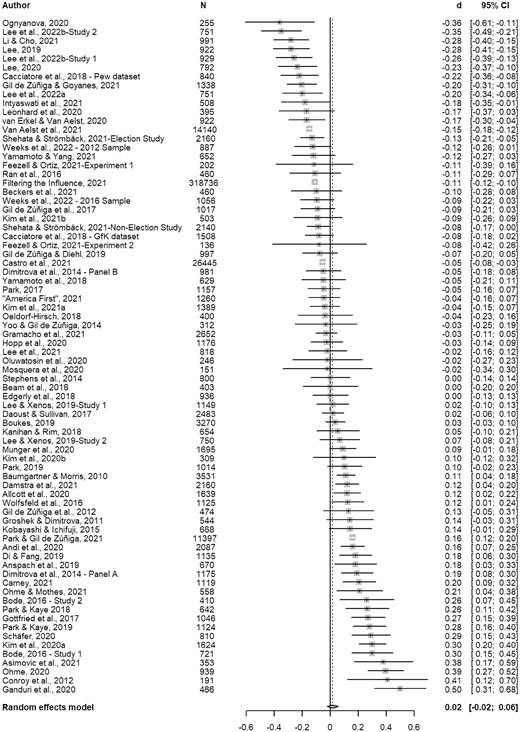
Do people learn about politics on social media? A meta-analysis of 76 studies
Abstract. Citizens turn increasingly to social media to get their political information. However, it is currently unclear whether using these platforms act
We keep asking what social media does to voters. The wrong end of the pipe. Platforms don't just distribute politics — they teach political actors what kind of speech pays. So I measured the going rate: what X, Bluesky and Mastodon reward in public speech. 🧵 arxiv.org/abs/2607.04220
