

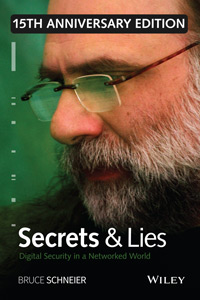
I have written this book partly to correct a mistake. Seven years ago I wrote another book: Applied Cryptography. In it I described a mathematical utopia: algorithms that would keep your deepest secrets safe for millennia, protocols that could perform the most fantastical electronic interactions-unregulated gambling, undetectable authentication, anonymous cash-safely and securely. In my vision cryptography was the great technological equalizer; anyone with a cheap (and getting cheaper every year) computer could have the same security as the largest government. In the second edition of the same book, written two years later, I went so far as to write: “It is insufficient to protect ourselves with laws; we need to protect ourselves with mathematics.”...
A Gentle Introduction to Secure Computation
In Fall 2015, I took CS 276, a graduate level introduction to theoretical cryptography. For the final project, I gave a short presentation on secure computation.
Let’s talk about AI and end-to-end encryption
Recently I came across a fantastic new paper by a group of NYU and Cornell researchers entitled “How to think about end-to-end encryption and AI.” I’m extremely grateful to see th…

Protocols: Power Hides in Boring Places
The fights over AI scraping and encrypted browsing are being settled in obscure standards bodies, and advocates need to be in the room, Mallory Knodel argues.

The Definitive Story of “Information Wants To Be Free”
The most famous phrase in “Hackers” wasn’t in the book.

Pluralistic: Hold on for dear life (28 May 2026) – Pluralistic: Daily links from Cory Doctorow
From the earliest days of technopolitics, the role of technology in resisting authoritarianism was unclear. On the one hand, there's the indisputable fact that modern cryptography, properly implemented, can deliver a degree of privacy that is proof against all technological attacks.
Cryptopedia — Oakland Public Library
Cryptopedia — Demcak, Andrew — Cryptopedia by Andrew Demcak speaks directly to the secret sides of our beings, to our shadow-selves. It is the oldest story we have, and it wants to be told. This collection comes from a place where children go missing, where monsters roam freely, and urban myths transform into realities.
DHH Nazism Funded by 1Password VP Who Wrote “Honest Security”
Jason Meller wrote a security rulebook. I read it. He is in direct violation of it.
Bartosz Naskręcki on Twitter / X
Congrats to @LechMazur for the solution and to Terence Tao for the digestion and storytelling. You see the trend. Mathematicians are still needed if we want to make any sense of the formal proofs. For now... Maybe the next gen LLMs will simply read allthe blogs of Terry and… https://t.co/yXiISCrNAF— Bartosz Naskręcki (@nasqret) August 13, 2026
#784: The absurdity of the apocalypse
Plus: repayment avoidance, the death of “hello,” and a Cinderella story for the algorithmic era

Meeting where AI eyes can't follow
I applied to the Community Privacy Residency, and the past projects reminded me of a cryptographic exploration I come back to every once in a while, just for...

Cory Doctorow Wants You to Know What Computers Can and Can’t Do
A conversation about the “mediocre monopolists” of Big Tech, the weirdness of crypto, and the real lessons of science fiction.
If math is more than proof, we need to better celebrate the rest of it
[This is a guest post by Grant Sanderson. This blog post was initially written in a different file format and converted using AI. — T.] A sentiment echoing throughout the mathematics communit…

Musings of a Trust Architect: The Gordian Club
ABSTRACT: Unencrypted data isn’t safe. Centralized servers aren’t reliable. Gordian Club offer an alternative: the autonomous cryptographic object (ACO)...

The Genius Who Invented Reverse Mathematics