


Subjective judgments, an essential information source for science and policy, are problematic because there are no public criteria for assessing judgmental truthfulness. I present a scoring method for eliciting truthful subjective data in situations ...
Judging facts, judging norms: Training machine learning models to judge humans requires a modified approach to labeling data
As governments and industry turn to increased use of automated decision systems, it becomes essential to consider how closely such systems can reproduce human judgment. We identify a core potential failure, finding that annotators label objects differently depending on whether they are being asked a factual question or a normative question. This challenges a natural assumption maintained in many standard machine-learning (ML) data acquisition procedures: that there is no difference between predicting the factual classification of an object and an exercise of judgment about whether an object violates a rule premised on those facts. We find that using factual labels to train models intended for normative judgments introduces a notable measurement error. We show that models trained using factual labels yield significantly different judgments than those trained using normative labels and that the impact of this effect on model performance can exceed that of other factors (e.g., dataset size) that routinely attract attention from ML researchers and practitioners. , Machine learning systems trained with factual features as labels do not reproduce human rule violation judgments on the same data.

A Knowledge Commons for the 21st Century
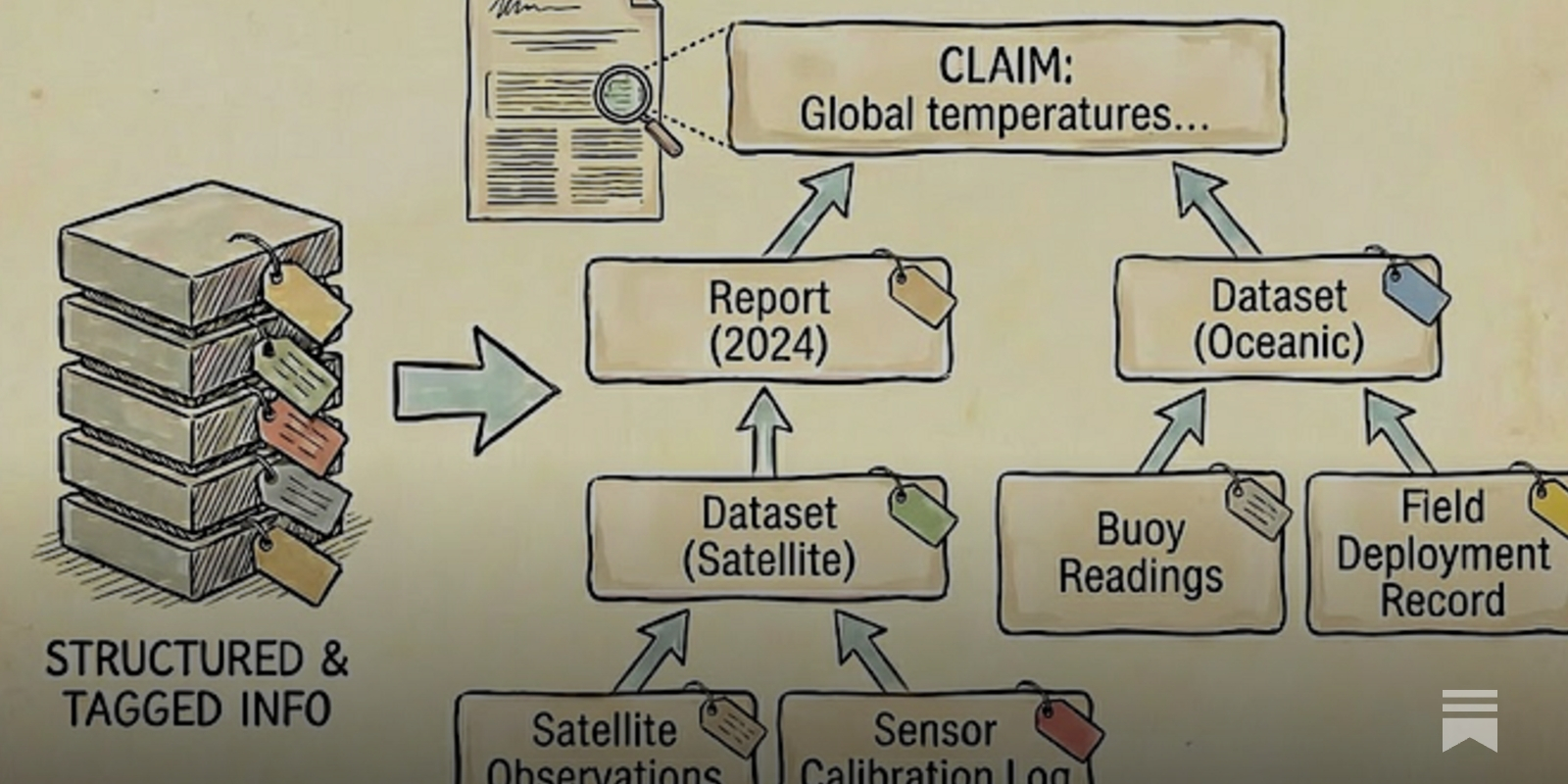
Truth-seeking infrastructure at scale
Reconciling truthfulness and relevance as epistemic and decision-theoretic utility.
What's Wrong with Bullshit
Past philosophical analyses of bullshit have generally presented bullshit as a formidable threat to truth. However, most of these analyses also reduce bullshit to a mere symptom of a greater evil (e.g. indifference towards truth). In this paper, I introduce a new account of bullshit which, I argue, is more suited to understand the threat posed by bullshit. I begin by introducing a few examples of “truth-tracking bullshit”, before arguing that these examples cannot be accommodated by past, process-based accounts of bullshit. I then introduce my new, output-based account of bullshit, according to which a claim is bullshit when it is presented as or appears as interesting at first sight but is revealed not to be that interesting under closer scrutiny. I present several arguments in favor of this account, then argue that it is more promising than past accounts when it comes to explaining how bullshit spreads and why it is a serious threat to truth.
Eliciting Beliefs with Random Generation Tasks
Elicitation methods, such as asking people to produce the deciles of a distribution, are standard practices in policy or applied statistics. Similarly, much of cognitive science and psychology focuses on determining people's people's beliefs or latent traits through questionnaires or judgment tasks. However, these approaches often only capture a rough outline of what people know and are usually limited to point estimates of people's beliefs. Here, we present a novel experimental paradigm that allows us to access people's beliefs and how variable these beliefs are. Our task is based on an established random generation paradigm in which participants produce quantities from a particular domain as randomly as possible. We hypothesize that due to the minds' general-purpose mechanisms for probabilistic inferences, these random sequences represent the participants' underlying prior beliefs. We show that our method can infer participants' beliefs for a wide range of numeric quantities at comparable accuracy as an established elicitation method. Moreover, these inferred beliefs are consistent with individual participants' generalization and inference patterns in a subsequent conditional prediction task. We then extend our approach to non-numeric belief elicitation, highlighting how our method can go beyond numeric elicitation and provide insight into complex beliefs that are challenging to assess experimentally. Empirically, our results highlight that people know the rough shapes of environmental distributions, and these beliefs guide inference and generalization. Moreover, using our novel approach, we also show that people know the fine details of environmental distributions. Finally, our experimental results show that random generation paradigms can be a useful tool for cognitive scientists, psychologists, and applied statisticians.
AI, peer review and the human activity of science
When researchers cede their scientific judgement to machines, we lose something important.


The Wisdom of Individuals: Exploring People's Knowledge About Everyday Events Using Iterated Learning
Abstract Determining the knowledge that guides human judgments is fundamental to understanding how people reason, make decisions, and form predictions. We use an experimental procedure called ‘‘iterated learning,’’ in which the responses that people give on one trial are used to generate the data they see on the next, to pinpoint the knowledge that informs people's predictions about everyday events (e.g., predicting the total box office gross of a movie from its current take). In particular, we use this method to discriminate between two models of human judgments: a simple Bayesian model ( Griffiths & Tenenbaum, 2006 ) and a recently proposed alternative model that assumes people store only a few instances of each type of event in memory (Min K ; Mozer, Pashler, & Homaei, 2008 ). Although testing these models using standard experimental procedures is difficult due to differences in the number of free parameters and the need to make assumptions about the knowledge of individual learners, we show that the two models make very different predictions about the outcome of iterated learning. The results of an experiment using this methodology provide a rich picture of how much people know about the distributions of everyday quantities, and they are inconsistent with the predictions of the Min K model. The results suggest that accurate predictions about everyday events reflect relatively sophisticated knowledge on the part of individuals.

A sampling model of social judgment.
A Model of Multi-turn Human Persuadability Using Probabilistic Belief Tracing
Large language models can shift human beliefs across high-stakes domains, but most persuasion studies rely on pre/post belief change. These endpoint measures identify whether persuasion occurred, yet miss where and how beliefs moved within a dialogue. We present PERSUASIONTRACE, a framework for studying persuasion in human–LLM interaction. Built on a web-based experimental platform, PERSUASIONTRACE contributes a tool for multi-turn persuasion studies and a process-level evaluation protocol: it records multi-turn belief reports from human or simulated targets of persuasion, annotates persuader turns with rhetorical dimensions (logos/pathos/ethos), and evaluates simulators by fidelity to real human belief dynamics. Using this framework, we find that human targets group into two clusters of multi-turn belief updates and exhibit susceptibility to rhetorical strategies, and that LLMs are persuasive across generic and personalized topics, text and audio modalities, and multi-turn interactions. Prior work has chiefly used vanilla-prompted LLMs to simulate human targets, but we show that these simulators fail to replicate human belief dynamics. We introduce a Bayesian-network simulated target that maintains an explicit latent belief state over time so each persuader message yields cognitively realistic belief updates. In human-likeness evaluation, our Bayesian target scores near a human reference (81 vs 80), while baseline LLM targets score substantially lower (64). PERSUASIONTRACE reframes persuasion evaluation from endpoint movement alone to process fidelity, providing a stronger basis for scientific analysis and safer optimization of persuasive systems.
AI False Claims Monitor
As the domain experts in data reliability in the topic of news and information, NewsGuard provides the leading red-teaming analysis for information reliability. AI models continue to face significant challenges in ensuring their models provide safe, accurate responses to prompts instead of spreading false claims on the internet or refusing to respond to topics in the news.

Assessing Moral Judgment by Large Language Models – A Survey of Available Datasets
Recent advances in language modeling have contributed to a growing emphasis on machine ethics, including researching and assessing moral judgments made by large language models (LLMs). This paper provides a critical survey of the existing datasets for exactly this assessment, with a special focus on the respective data sources. We address the current lack of theoretical grounding by providing an introduction to ethics and different frameworks from moral philosophy and moral psychology. Moreover, we identify four main data sources: webcrawled corpora, scholars, laypeople, and synthetic data generation. By discussing the strengths and weaknesses of these sources, we analyze their implications for the assessment of moral judgment. Importantly, systemizing the available datasets reveals an over-reliance on previous work, reinforcing existing shortcomings. Addressing the current limitations, we recommend adopting a consistent terminology and creating independently curated datasets based on interdisciplinary work. To ensure a clear delineation of normative approaches, we propose focusing on the assessment of moral consistency and certainty of LLMs as effective and well-defined indicators of their performance on moral judgment.
The Dynamics of Distortion: How Successive Summarization Alters the Retelling of News
This work advances and tests a theory of how news information evolves as it is successively retold by consumers. Drawing on data from over 11,000 participants across ten experiments, the authors offer evidence that when news is repeatedly retold, it undergoes a stylistic transformation termed “disagreeable personalization,” wherein original facts are increasingly supplanted by opinions and interpretations with a slant toward negativity. The central thesis is that when retellers believe they are more (vs. less) knowledgeable than their recipient about the information they are relaying, they feel more compelled to provide guidance on its meaning and to do so in a persuasive manner. This enhanced motivation to guide persuasively, in turn, leads retellers to not only select the subset of facts they deem most essential but, critically, to provide their interpretations and opinions on those facts, with negativity being used as a means of grabbing their audience’s attention. Implications of this work for research on retelling and consumer information diffusion are explored.

The Dynamics of Distortion: How Successive Summarization Alters the Retelling of News
This work advances and tests a theory of how news information evolves as it is successively retold by consumers. Drawing on data from over 11,000 participants across ten experiments, the authors offer evidence that when news is repeatedly retold, it undergoes a stylistic transformation termed “disagreeable personalization,” wherein original facts are increasingly supplanted by opinions and interpretations with a slant toward negativity. The central thesis is that when retellers believe they are more (vs. less) knowledgeable than their recipient about the information they are relaying, they feel more compelled to provide guidance on its meaning and to do so in a persuasive manner. This enhanced motivation to guide persuasively, in turn, leads retellers to not only select the subset of facts they deem most essential but, critically, to provide their interpretations and opinions on those facts, with negativity being used as a means of grabbing their audience’s attention. Implications of this work for research on retelling and consumer information diffusion are explored.
Bayesian Thinking in Everyday Life
More than 200 years ago, Thomas Bayes came up with a brilliant idea that has helped shape the world today, called Bayes Theorem. This…

