


Neurological symptoms highlight the need to understand pathophysiologic mechanisms , Although severe acute respiratory syndrome coronavirus 2 (SARS-CoV-2) is considered a respiratory pathogen, myriad neurologic complications—including confusion, stroke, and neuromuscular disorders—manifest during acute COVID-19. Furthermore, maladies such as impaired concentration, headache, sensory disturbances, depression, and even psychosis may persist for months after infection, as part of a constellation of symptoms now called Long Covid. Even young people with mild initial disease can develop acute COVID-19 and Long Covid neuropsychiatric syndromes. The pathophysiological mechanisms are not well understood, although evidence primarily implicates immune dysfunction, including nonspecific neuroinflammation and antineural autoimmune dysregulation. It is uncertain whether unforeseen neurological consequences may develop years after initial infection. With millions of individuals affected, nervous system complications pose public health challenges for rehabilitation and recovery and for disruptions in the workforce due to loss of functional capacity. There is an urgent need to understand the pathophysiology of these disorders and develop disease-modifying therapies.
Persistent Cognitive Dysfunction in a Non-Hospitalized COVID-19 Long-Hauler Patient Responding to Cognitive Rehabilitation and Citicoline Treatment
The Severe Acute Respiratory Syndrome Coronavirus 2 (SARS-CoV-2) infection is characterized by severe flu-like symptoms, which can progress to life-threatening systemic inflammation and multiorgan dysfunction. The nervous system is involved in over one-third of patients, and the most common neurological manifestations concern the central nervous system, such as headache, fatigue, and brain fog. The activation of innate, humoral, and cellular immune responses, resulting in a cytokine storm and endothelial and mitochondrial dysfunctions, are the main pathophysiological mechanisms of SARS-CoV-2 infection. Citicoline is an exogenous source of choline and cytidine involved in intracellular phospholipid synthesis, which improves blood flow, brain activity, and mitochondrial dysfunction. This report will present the case of a non-hospitalized, 59-year-old female. After a mild form of SARS-CoV-2 infection, the patient developed cognitive disturbances such as forgetfulness and anomia. The multidimensional neuropsychological assessment revealed an impairment in episodic memory with borderline performance in executive and visuospatial functioning. Cognitive rehabilitation and treatment with citicoline 1000 mg/daily led to a marked improvement in symptoms after six months. Early identification of the neurological sequelae of the Coronavirus Disease 2019 (COVID-19) and timely rehabilitation interventions are required in non-hospitalized long-hauler patients with COVID-19. Long-term treatment with citicoline should be considered as potentially effective in improving cognitive functioning in subjects with Post COVID-19 Neurological Syndrome.

Current status and future perspectives on the mechanistic and pathophysiological understanding of long COVID
Viral and infectious illnesses can exert profound and enduring effects on population health and well-being. In the aftermath of SARS-CoV-2 infection, post-acute sequelae, collectively referred to as Long COVID, have emerged as a major global health challenge, affecting more than 400 million people and contributing to estimated annual economic costs exceeding $1 trillion. Long COVID encompasses a wide and heterogeneous spectrum of debilitating symptoms, including cognitive dysfunction, sleep disturbances, severe fatigue, and post-exertional malaise. Despite its substantial burden, fundamental uncertainties remain regarding its underlying pathophysiology, the development of robust diagnostic criteria, and the identification of effective therapeutic options. This review synthesises current evidence on the biological mechanisms thought to contribute to Long COVID, spanning immune dysregulation, viral persistence, autonomic dysfunction, microvascular pathology, and other emerging hypotheses. We examine advances and limitations in contemporary diagnostic approaches and critically appraise existing treatment strategies, highlighting inconsistencies and gaps that hinder clinical consensus. By integrating interdisciplinary insights, this review underscores the urgent need for mechanistic clarity, validated diagnostic frameworks, and rigorously evaluated treatment pathways. Addressing these gaps will be essential to developing effective, evidence-based management strategies and mitigating the long-term impact of Long COVID on global health.
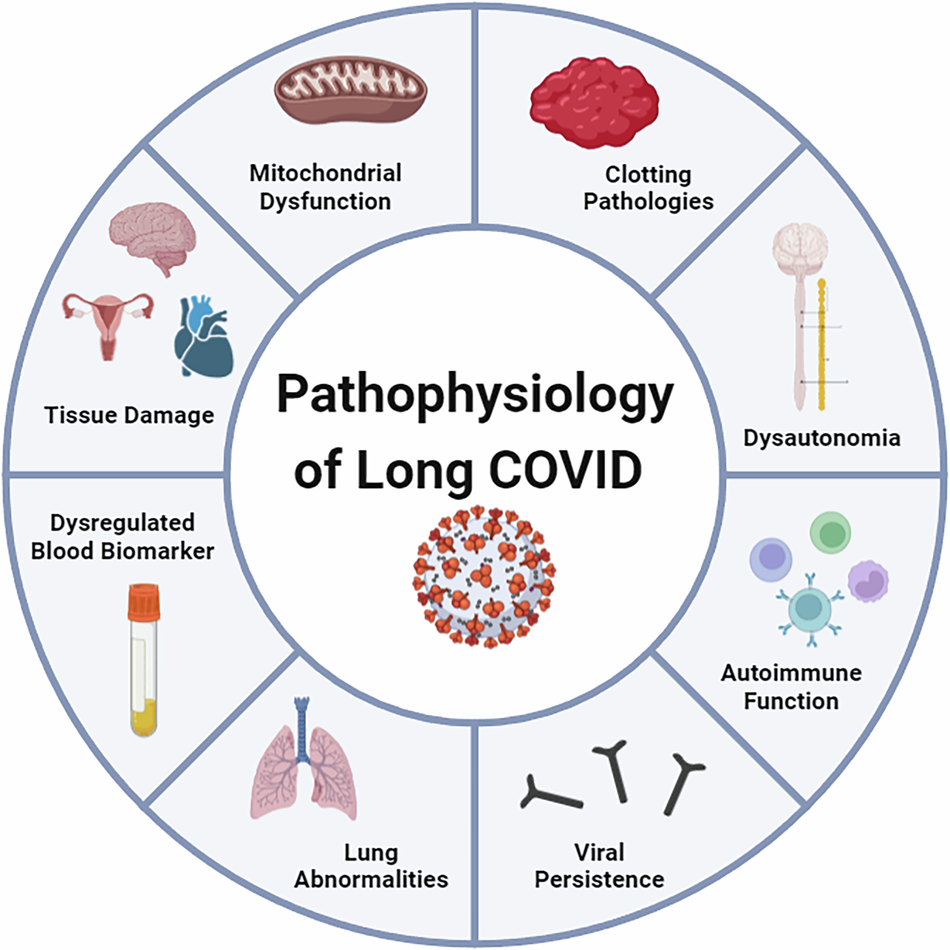
Current status and future perspectives on the mechanistic and pathophysiological understanding of long COVID
Viral and infectious illnesses can exert profound and enduring effects on population health and well-being. In the aftermath of SARS-CoV-2 infection, post-acute sequelae, collectively referred to as Long COVID, have emerged as a major global health challenge, affecting more than 400 million people and contributing to estimated annual economic costs exceeding $1 trillion. Long COVID encompasses a wide and heterogeneous spectrum of debilitating symptoms, including cognitive dysfunction, sleep disturbances, severe fatigue, and post-exertional malaise. Despite its substantial burden, fundamental uncertainties remain regarding its underlying pathophysiology, the development of robust diagnostic criteria, and the identification of effective therapeutic options. This review synthesises current evidence on the biological mechanisms thought to contribute to Long COVID, spanning immune dysregulation, viral persistence, autonomic dysfunction, microvascular pathology, and other emerging hypotheses. We examine advances and limitations in contemporary diagnostic approaches and critically appraise existing treatment strategies, highlighting inconsistencies and gaps that hinder clinical consensus. By integrating interdisciplinary insights, this review underscores the urgent need for mechanistic clarity, validated diagnostic frameworks, and rigorously evaluated treatment pathways. Addressing these gaps will be essential to developing effective, evidence-based management strategies and mitigating the long-term impact of Long COVID on global health.
Orthostatic Intolerance after COVID-19 Infection: Is Disturbed Microcirculation of the Vasa Vasorum of Capacitance Vessels the Primary Defect?
Following COVID-19 infection, a substantial proportion of patients suffer from persistent symptoms known as Long COVID. Among the main symptoms are fatigue, cognitive dysfunction, muscle weakness and orthostatic intolerance (OI). These symptoms also occur in myalgic encephalomyelitis/chronic fatigue (ME/CFS). OI is highly prevalent in ME/CFS and develops early during or after acute COVID-19 infection. The causes for OI are unknown and autonomic dysfunction is hypothetically assumed to be the primary cause, presumably as a consequence of neuroinflammation. Here, we propose an alternative, primary vascular mechanism as the underlying cause of OI in Long COVID. We assume that the capacitance vessel system, which plays a key role in physiologic orthostatic regulation, becomes dysfunctional due to a disturbance of the microvessels and the vasa vasorum, which supply large parts of the wall of those large vessels. We assume that the known microcirculatory disturbance found after COVID-19 infection, resulting from endothelial dysfunction, microthrombus formation and rheological disturbances of blood cells (altered deformability), also affects the vasa vasorum to impair the function of the capacitance vessels. In an attempt to compensate for the vascular deficit, sympathetic activity overshoots to further worsen OI, resulting in a vicious circle that maintains OI. The resulting orthostatic stress, in turn, plays a key role in autonomic dysfunction and the pathophysiology of ME/CFS.

Shadow Burden of Undiagnosed Myalgic Encephalomyelitis/Chronic Fatigue Syndrome (ME/CFS) on Society: Retrospective and Prospective—In Light of COVID-19
Background: Myalgic encephalomyelitis/chronic fatigue syndrome (ME/CFS) is a poorly understood, complex, multisystem disorder, with severe fatigue not alleviated by rest, and other symptoms, which lead to substantial reductions in functional activity and quality of life. Due to the unclear aetiology, treatment of patients is complicated, but one of the initial problems is the insufficient diagnostic process. The increase in the number of undiagnosed ME/CFS patients became specifically relevant in the light of the COVID-19 pandemic. The aim of this research was to investigate the issues of undiagnosed potential ME/CFS patients, with a hypothetical forecast of the expansion of post-viral CFS as a consequence of COVID-19 and its burden on society. Methods: The theoretical research was founded on the estimation of classic factors presumably affecting the diagnostic scope of ME/CFS and their ascription to Latvian circumstances, as well as a literature review to assess the potential interaction between ME/CFS and COVID-19 as a new contributing agent. The empirical study design consisted of two parts: The first part was dedicated to a comparison of the self-reported data of ME/CFS patients with those of persons experiencing symptoms similar to ME/CFS, but without a diagnosis. This part envisaged the creation of an assumption of the ME/CFS shadow burden “status quo”, not addressing the impact of COVID-19. The second part aimed to investigate data from former COVID-19 patients’ surveys on the presence of ME/CFS symptoms, 6 months after being affected by COVID-19. Descriptive and analytical statistical methods were used to analyse the obtained data. Results: The received data assumed that the previously obtained data on the ME/CFS prevalence of 0.8% in the Latvian population are appropriate, and the literature review reports a prevalence of 0.2–1.0% in developed countries. Regarding the reciprocity of ME/CFS and COVID-19, the literature review showed a lack of research in this field. The empirical results show quite similar self-esteem among ME/CFS patients and undiagnosed patients with longstanding disease experience, while former COVID-19 patients show a significantly lower severity of these problems. Notably, “psychological distress (anxiety)” and “episodic fatigue” are significantly predominant symptoms reported by former COVID-19 patients in comparison with ME/CFS patients and undiagnosed patients prior to the COVID-19 pandemic. The results of our analysis predict that the total amount of direct medical costs for undiagnosed patients (out-of-pocket payments) is more than EUR 15 million p.a. (in Latvia), and this may increase by at least 15% due to the consequences of COVID-19. Conclusions: ME/CFS creates a significant shadow burden on society, even considering only the direct medical costs of undiagnosed patients—the number of whom in Latvia is probably at least five times higher than the number of discerned patients. Simultaneously, COVID-19 can induce long-lasting complications and chronic conditions, such as post-viral CFS, and increase this burden. The Latvian research data assume that ME/CFS patients are not a high-risk group for COVID-19; however, COVID-19 causes ME/CFS-relevant symptoms in patients. This increases the need for monitoring of patients for even longer after recovering from COVID-19′s symptoms, in order to prevent complications and the progression of chronic diseases. In the context of further epidemiological uncertainty, and the possibility of severe post-viral consequences, preventive measures are becoming significantly more important; an integrated diagnostic approach and appropriate treatment could reduce this burden in the future.
Myalgic Encephalomyelitis/Chronic Fatigue Syndrome: Essentials of Diagnosis and Management
Despite myalgic encephalomyelitis/chronic fatigue syndrome (ME/CFS) affecting millions of people worldwide, many clinicians lack the knowledge to appropriately diagnose or manage ME/CFS. Unfortunately, clinical guidance has been scarce, obsolete, or potentially harmful. Consequently, up to 91% of patients in the United States remain undiagnosed, and those diagnosed often receive inappropriate treatment. These problems are of increasing importance because after acute COVID-19, a significant percentage of people remain ill for many months with an illness similar to ME/CFS.

COVID-19 affects memory and cognition long after infection, study warns
Those in the study who had been infected with the virus showed an increase in a brain protein that is often associated with a brain injury.

Do cognitive deficits persist after COVID-19 and, if so, what is their biological basis? Our NEW pre-print under review in @NaturePortfolio https://t.co/4JPGfeaSiB We report one-year cognitive, serum biomarker, and neuroimaging findings in 351 patients A thread 1/n
Do cognitive deficits persist after COVID-19 and, if so, what is their biological basis?Our NEW pre-print under review in @NaturePortfolio https://t.co/4JPGfeaSiBWe report one-year cognitive, serum biomarker, and neuroimaging findings in 351 patients A thread 1/n pic.twitter.com/W8MXV3qkVt— Greta Karen Wood (@gkwood3) January 9, 2024

The CDC whispered this a year ago. “SARS-CoV-2 can have lasting effects on nearly every organ & organ system of the body weeks, months, & potentially years after infection. Documented serious post-Covid conditions include cardiovascular, pulmonary, neurological, renal, endocrin
The CDC whispered this a year ago. “SARS-CoV-2 can have lasting effects on nearly every organ & organ system of the body weeks, months, & potentially years after infection. Documented serious post-Covid conditions include cardiovascular, pulmonary, neurological, renal,… pic.twitter.com/xkSStj51y2— Laura Miers (@LauraMiers) March 9, 2024

What Are COVID-19’s Long-Term Medical Effects?
Fascinating email from TPM Reader JO, whose personal bio is tailor-made for...

Evidence mounts that Long Covid is damaging the hearts of those affected
There are also increasing signs that the condition can disrupt the autonomic nervous system

Even Mild Covid is Linked To Brain Damage, Scans Show - Slashdot
During at least the first few months following a coronavirus infection, even mild cases of Covid-19 are associated with subtle tissue damage and accelerated losses in brain regions tied to the sense of smell, as well as a small loss in the brain's overall volume, a new British study finds. Having mi...

Long COVID linked to lower brain oxygen levels, cognitive problems and psychiatric symptoms | Waterloo News | University of Waterloo
Long COVID is associated with reduced brain oxygen levels, worse performance on cognitive tests and increased psychiatric symptoms such as depression and anx
Monocytes and the neurological health of Long-Covid Patients
This post brings together a two topics of research into Long-Covid. Full disclosure. I do primary care for a relative suffering from Long-Covid. I live in Arizona, which according to…

COVID-19

About the disease itself and/or SARS-CoV-2

49% of COVID infections are asymptomatic according to Yale School of Public Health. Yale advises layered protection: N95 masks, HEPA filters…
doi.org