


Finding agreement through a free exchange of views is often difficult. Collective deliberation can be slow, difficult to scale, and unequally attentive to different voices. In this study, we trained an artificial intelligence (AI) to mediate human deliberation. Using participants’ personal opinions and critiques, the AI mediator iteratively generates and refines statements that express common ground among the group on social or political issues. Participants ( N = 5734) preferred AI-generated statements to those written by human mediators, rating them as more informative, clear, and unbiased. Discussants often updated their views after the deliberation, converging on a shared perspective. Text embeddings revealed that successful group statements incorporated dissenting voices while respecting the majority position. These findings were replicated in a virtual citizens’ assembly involving a demographically representative sample of the UK population. , Editor’s summary To act collectively, groups must reach agreement; however, this can be challenging when discussants present very different but valid opinions. Tessler et al . investigated whether artificial intelligence (AI) can help groups reach a consensus during democratic debate (see the Policy Forum by Nyhan and Titiunik). The authors trained a large language model called the Habermas Machine to serve as an AI mediator that helped small UK groups find common ground while discussing divisive political issues such as Brexit, immigration, the minimum wage, climate change, and universal childcare. Compared with human mediators, AI mediators produced more palatable statements that generated wide agreement and left groups less divided. The AI’s statements were more clear, logical, and informative without alienating minority perspectives. This work carries policy implications for AI’s potential to unify deeply divided groups. —Ekeoma Uzogara , INTRODUCTION Democracy, at its best, rests upon the free and equal exchange of views among people with diverse perspectives. Collective deliberation can be effectively supported by structured events, such as citizens’ assemblies, but such events are expensive, are difficult to scale, and can result in voices being heard unequally. This study investigates the potential of artificial intelligence (AI) to overcome these limitations, using AI mediation to help people find common ground on complex social and political issues. RATIONALE We asked whether an AI system based on large language models (LLMs) could successfully capture the underlying shared perspectives of a group of human discussants by writing a “group statement” that the discussants would collectively endorse. Inspired by Jürgen Habermas’s theory of communicative action, we designed the “Habermas Machine” to iteratively generate group statements that were based on the personal opinions and critiques from individual users, with the goal of maximizing group approval ratings. Through successive rounds of human data collection, we used supervised fine-tuning and reward modeling to progressively enhance the Habermas Machine’s ability to capture shared perspectives. To evaluate the efficacy of AI-mediated deliberation, we conducted a series of experiments with over 5000 participants from the United Kingdom. These experiments investigated the impact of AI mediation on finding common ground, how the views of discussants changed across the process, the balance between minority and majority perspectives in group statements, and potential biases present in those statements. Lastly, we used the Habermas Machine for a virtual citizens’ assembly, assessing its ability to support deliberation on controversial issues within a demographically representative sample of UK residents. RESULTS Group opinion statements generated by the Habermas Machine were consistently preferred by group members over those written by human mediators and received higher ratings from external judges for quality, clarity, informativeness, and perceived fairness. AI-mediated deliberation also reduced division within groups, with participants’ reported stances converging toward a common position on the issue after deliberation; this result did not occur when discussants directly exchanged views, unmediated. Although support for the majority position increased after deliberation, the Habermas Machine demonstrably incorporated minority critiques into revised statements. We replicated these results in a virtual citizens’ assembly, additionally finding that during AI-mediated deliberation, the views of groups of discussants tended to move in a similar direction on controversial issues. These shifts were not attributable to biases in the AI, suggesting that the deliberation process genuinely aided the emergence of shared perspectives on potentially polarizing social and political issues. CONCLUSION This research demonstrates the potential of AI to enhance collective deliberation by finding common ground among discussants with diverse views. The AI-mediated approach is time-efficient, fair, scalable, and outperforms human mediators on key dimensions. Rather than simply appealing to the majority, the Habermas Machine prominently incorporated dissenting voices into the group statements. AI-assisted deliberation is not without its risks, however; to ensure fair and inclusive debate, steps must be taken to ensure users are representative of the target population and are prepared to contribute in good faith. Under such conditions, AI may be leveraged to improve collective decision-making across various domains, from contract negotiations and conflict resolution to political discussions and citizens’ assemblies. The Habermas Machine offers a promising tool for finding agreement and promoting collective action in an increasingly divided world. AI helps people find common ground in collective deliberation. (Left) The AI mediator uses participants’ opinions to generate group statements and iteratively refines those statements through participants’ critiques. (Middle) Statements from the AI mediator (purple) garner stronger endorsement than those written by a human mediator (orange). (Right) AI mediation leaves groups less divided after deliberation, whereas simply sharing opinions with others does not.
'Generative CI' through Collective Response Systems
How can many people (who may disagree) come together to answer a question or make a decision? "Collective response systems" are a type of generative collective intelligence (CI) facilitation process meant to address this challenge. They enable a form of "generative voting", where both the votes, and the choices of what to vote on, are provided by the group. Such systems overcome the traditional limitations of polling, town halls, standard voting, referendums, etc. The generative CI outputs of collective response systems can also be chained together into iterative "collective dialogues", analogously to some kinds of generative AI. Technical advances across domains including recommender systems, language models, and human-computer interaction have led to the development of innovative and scalable collective response systems. For example, Polis has been used around the world to support policy-making at different levels of government, and Remesh has been used by the UN to understand the challenges and needs of ordinary people across war-torn countries. This paper aims to develop a shared language by defining the structure, processes, properties, and principles of such systems. Collective response systems allow non-confrontational exploration of divisive issues, help identify common ground, and elicit insights from those closest to the issues. As a result, they can help overcome gridlock around conflict and governance challenges, increase trust, and develop mandates. Continued progress toward their development and adoption could help revitalize democracies, reimagine corporate governance, transform conflict, and govern powerful AI systems -- both as a complement to deeper deliberative democratic processes and as an option where deeper processes are not applicable or possible.

Generative AI for Pro-Democracy Platforms · From Novel Chemicals to Opera
Online discourse faces challenges in facilitating substantive and productive political conversations. Recent technologies have explored the potential of generative AI to promote civil discourse, encourage the development of mutual understanding in a discussion, produce . . .

An Experimental Method to Study Opinion Diffusion in Human-AI Hybrid Societies
As artificial intelligence increasingly mediates public discourse, it becomes important to understand how human-AI collectives shape opinion formation, deliberation, and democratic outcomes. We present a novel experimental method for studying opinion dynamics in hybrid human-AI social networks. Participants, human or AI, were embedded in $5\times5$ grid lattice networks and iteratively asked to select and revise statements on a given polarizing topic over eight rounds. We compared three conditions: human-only, AI-only, and hybrid networks with equal proportions of human and AI participants. Hybrid human-AI networks achieved the lowest final polarization while, in contrast, human-only networks exhibited higher polarization with lower neighbor agreement. We also ran additional experiments varying Large Language Model (LLM) prompt framing to explore whether instruction design might influence convergence patterns. Although these early findings are preliminary and cannot yet support broad generalizations, they highlight the potential value of experimental social networks for understanding opinion dynamics in human-AI hybrid societies.
The levers of political persuasion with conversational artificial intelligence
There are widespread fears that conversational artificial intelligence (AI) could soon exert unprecedented influence over human beliefs. In this work, in three large-scale experiments ( N = 76,977 participants), we deployed 19 large language models (LLMs)—including some post-trained explicitly for persuasion—to evaluate their persuasiveness on 707 political issues. We then checked the factual accuracy of 466,769 resulting LLM claims. We show that the persuasive power of current and near-future AI is likely to stem more from post-training and prompting methods—which boosted persuasiveness by as much as 51 and 27%, respectively—than from personalization or increasing model scale, which had smaller effects. We further show that these methods increased persuasion by exploiting LLMs’ ability to rapidly access and strategically deploy information and that, notably, where they increased AI persuasiveness, they also systematically decreased factual accuracy. , Editor’s summary Many fear that we are on the precipice of unprecedented manipulation by large language models (LLMs), but techniques driving their persuasiveness are poorly understood. In the initial “pretrained” phase, LLMs may exhibit flawed reasoning. Their power unlocks during vital “posttraining,” when developers refine pretrained LLMs to sharpen their reasoning and align with users’ needs. Posttraining also enables LLMs to maintain logical, sophisticated conversations. Hackenburg et al . examined which techniques made diverse, conversational LLMs most persuasive across 707 British political issues (see the Perspective by Argyle). LLMs were most persuasive after posttraining, especially when prompted to use facts and evidence (information) to argue. However, information-dense LLMs produced the most inaccurate claims, raising concerns about the spread of misinformation during rollouts of future models. —Ekeoma Uzogara , INTRODUCTION Rapid advances in artificial intelligence (AI) have sparked widespread concerns about its potential to influence human beliefs. One possibility is that conversational AI could be used to manipulate public opinion on political issues through interactive dialogue. Despite extensive speculation, however, fundamental questions about the actual mechanisms, or “levers,” responsible for driving advances in AI persuasiveness—e.g., computational power or sophisticated training techniques—remain largely unanswered. In this work, we systematically investigate these levers and chart the horizon of persuasiveness with conversational AI. RATIONALE We considered multiple factors that could enhance the persuasiveness of conversational AI: raw computational power (model scale), specialized post-training methods for persuasion, personalization to individual users, and instructed rhetorical strategies. Across three large-scale experiments with 76,977 total UK participants, we deployed 19 large language models (LLMs) to persuade on 707 political issues while varying these factors independently. We also analyzed more than 466,000 AI-generated claims, examining the relationship between persuasiveness and truthfulness. RESULTS We found that the most powerful levers of AI persuasion were methods for post-training and rhetorical strategy (prompting), which increased persuasiveness by as much as 51 and 27%, respectively. These gains were often larger than those obtained from substantially increasing model scale. Personalizing arguments on the basis of user data had a comparatively small effect on persuasion. We observe that a primary mechanism driving AI persuasiveness was information density: Models were most persuasive when they packed their arguments with a high volume of factual claims. Notably, however, we documented a concerning trade-off between persuasion and accuracy: The same levers that made AI more persuasive—including persuasion post-training and information-focused prompting—also systematically caused the AI to produce information that was less factually accurate. CONCLUSION Our findings suggest that the persuasive power of current and near-future AI is likely to stem less from model scale or personalization and more from post-training and prompting techniques that mobilize an LLM’s ability to rapidly generate information during conversation. Further, we reveal a troubling trade-off: When AI systems are optimized for persuasion, they may increasingly deploy misleading or false information. This research provides an empirical foundation for policy-makers and technologists to anticipate and address the challenges of AI-driven persuasion, and it highlights the need for safeguards that balance AI’s legitimate uses in political discourse with protections against manipulation and misinformation. Persuasiveness of conversational AI increases with model scale. The persuasive impact in percentage points on the y axis is plotted against effective pretraining compute [floating-point operations (FLOPs)] on the x axis. Point estimates are persuasive effects of different AI models. Colored lines show trends for models that we uniformly chat-tuned for open-ended conversation (purple) versus those that were post-trained using heterogeneous, opaque methods by AI developers (green). pp, percentage points; CI, confidence interval.

'Generative CI' through Collective Response Systems
How can many people (who may disagree) come together to answer a question or make a decision? "Collective response systems" are a type of generative collective intelligence (CI) facilitation...
LLM-generated messages can persuade humans on policy issues
The emergence of large language models (LLMs) has made it possible for generative artificial intelligence (AI) to tackle many higher-order cognitive tasks, with critical implications for industry, government, and labor markets. Here, we investigate whether existing, openly-available LLMs can be used to create messages capable of influencing humans’ political attitudes. Across three pre-registered experiments (total N = 4829), participants who read persuasive messages generated by LLMs showed significantly more attitude change across a range of policies - including polarized policies, like an assault weapons ban, a carbon tax, and a paid parental-leave program - relative to control condition participants who read a neutral message. Overall, LLM-generated messages were similarly effective in influencing policy attitudes as messages crafted by lay humans. Participants’ reported perceptions of the authors of the persuasive messages suggest these effects occurred through somewhat distinct causal pathways. While the persuasiveness of LLM-generated messages was associated with perceptions that the author used more facts, evidence, logical reasoning, and a dispassionate voice, the persuasiveness of human-generated messages was associated with perceptions of the author as unique and original. These results demonstrate that recent developments in AI make it possible to create politically persuasive messages quickly, cheaply, and at massive scale.

Physics of Agents: Statistical Mechanics Predicts Collective Behavior of AI Agents
AI agents increasingly operate as part of interacting systems rather than in isolation. As agents exchange information and jointly make decisions, their interactions can improve collective reasoning but may also produce herding, polarization, or amplify shared biases. Understanding and predicting these collective dynamics is therefore important for designing effective and aligned multi-agent systems. Here, we study over 10,000 communities of language-model agents that repeatedly exchange messages and revise their opinions across objective mathematics questions and subjective political statements. Despite substantial diversity in possible behavior, the individual and group dynamics can be represented by three characteristic regimes: indifference, polarization, and consensus. AI agents start indifferent and build conviction as they interact. On objective questions, communication improves collective accuracy, while on subjective questions it often drifts group opinions toward the right in the political spectrum. We explain these observations with a statistical-mechanics formalism in which agents stochastically favor lower social pressure. Given only initial opinions, our model predicts individual trajectories, outperforms all standard baselines, generalizes to unseen community graphs, and reproduces the observed group archetype distributions. Our fitted model parameters reveal the mechanics underlying our key observations: i) communities operate below the critical social temperature, which explains conviction buildup; ii) attractive ties outweigh repulsive ones, which favors consensus; and iii) agents holding the correct answer exert the strongest pull, which drives truth-seeking. Overall, our results demonstrate that collective behavior of AI agents, like that of other complex systems, follows compact and predictive dynamical laws.
Generative AI Meets Open-Ended Survey Responses: Research Participant Use of AI and Homogenization
The growing popularity of generative artificial intelligence (AI) tools presents new challenges for data quality in online surveys and experiments. This study examines participants’ use of large language models to answer open-ended survey questions and describes empirical tendencies in human versus large language model (LLM)-generated text responses. In an original survey of research participants recruited from a popular online platform for sourcing social science research subjects, 34 percent reported using LLMs to help them answer open-ended survey questions. Simulations comparing human-written responses from three pre-ChatGPT studies with LLM-generated text reveal that LLM responses are more homogeneous and positive, particularly when they describe social groups in sensitive questions. These homogenization patterns may mask important underlying social variation in attitudes and beliefs among human subjects, raising concerns about data validity. Our findings shed light on the scope and potential consequences of participants’ LLM use in online research.

Rational Silence and False Polarization: How Viewpoint Organizations and Recommender Systems Distort the Expression of Public Opinion
Social media platforms are one of the most important domains in which artificial intelligence (AI) has already transformed the nature of economic and social interaction. AI enables the massive scale and highly personalized nature of online information sharing that we now take for granted. Extensive attention has been devoted to the polarization that social media platforms appear to facilitate. However, a key implication of the transformation we are experiencing due to these AI-powered platforms has received much less attention: how platforms impact what observers of online discourse come to believe about community views. These observers include policymakers and legislators, who look to social media to gauge the prospects for policy and legislative change, as well as developers of AI models trained on large-scale internet data, whose outputs may similarly reflect a distorted view of public opinion. In this paper, we present a nested game-theoretic model to show how observed online opinion is produced by the interaction of the decisions made by users about whether and with what rhetorical intensity to share their opinions on a platform, the efforts of viewpoint organizations (such as traditional media and advocacy organizations) that seek to encourage or discourage opinion-sharing online, and the operation of AI-powered recommender systems controlled by social media platforms. We show that signals from ideological viewpoint organizations encourage an increase in rhetorical intensity, leading to the rational silence of moderate users. This, in turn, creates a polarized impression of where average opinions lie. We also show that this observed polarization can also be amplified by recommender systems that, pursuant to a platform’s incentive to maximize engagement, encourage the formation of viewpoint communities online that end up seeing a skewed sample of opinion. Unlike existing models, these well-known online phenomena are not here attributed to distortion in the formation of opinions nor to the seeking out of like-minded others, but rather to the interaction of the incentives of users, viewpoint organizations, and platforms implementing recommender systems. In addition to showing how these interactions can play out in simulations, we also identify practical strategies platforms can implement, such as reducing exposure to signals from ideological viewpoint organizations and a tailored approach to content moderation.
Dialogues on Democracy: Belief-Tailored AI Conversations Reduce Inaccurate Election Denial Beliefs
Elections, while central to democratic functioning, have become increasingly threatened by beliefs about election fraud. Artificial intelligence (AI) provides a novel opportunity to address such false beliefs through dynamic conversation and debunking. Through two experiments (N = 1,802 Republicans from Lucid who endorsed election fraud claims), we examined the use of AI to fact-check 2020 election conspiracies prior to the 2024 US Presidential election. We tested the effects of two treatments (an information-tailored and values-tailored AI dialogue) in which AI fact-checked their claims and tailored arguments to the specific election conspiracy that the participant themselves articulated. Both treatment conditions, when compared to a control dialogue and a simple statement that the conspiracy was incorrect, reduced confidence in their election conspiracy claims. There was no significant difference between information-tailored and values-tailored feedback. Promisingly, participants with the strongest baseline denialism experienced the largest decreases in denialism beliefs. These studies highlight the potential of AI-driven interventions to address election misinformation.

How malicious AI swarms can threaten democracy
The fusion of agentic AI and LLMs marks a new frontier in information warfare , Advances in artificial intelligence (AI) offer the prospect of manipulating beliefs and behaviors on a population-wide level ( 1 ). Large language models (LLMs) and autonomous agents ( 2 ) let influence campaigns reach unprecedented scale and precision. Generative tools can expand propaganda output without sacrificing credibility ( 3 ) and inexpensively create falsehoods that are rated as more human-like than those written by humans ( 3 , 4 ). Techniques meant to refine AI reasoning, such as chain-of-thought prompting, can be used to generate more convincing falsehoods. Enabled by these capabilities, a disruptive threat is emerging: swarms of collaborative, malicious AI agents. Fusing LLM reasoning with multiagent architectures ( 2 ), these systems are capable of coordinating autonomously, infiltrating communities, and fabricating consensus efficiently. By adaptively mimicking human social dynamics, they threaten democracy. Because the resulting harms stem from design, commercial incentives, and governance, we prioritize interventions at multiple leverage points, focusing on pragmatic mechanisms over voluntary compliance.

How malicious AI swarms can threaten democracy
The fusion of agentic AI and LLMs marks a new frontier in information warfare , Advances in artificial intelligence (AI) offer the prospect of manipulating beliefs and behaviors on a population-wide level ( 1 ). Large language models (LLMs) and autonomous agents ( 2 ) let influence campaigns reach unprecedented scale and precision. Generative tools can expand propaganda output without sacrificing credibility ( 3 ) and inexpensively create falsehoods that are rated as more human-like than those written by humans ( 3 , 4 ). Techniques meant to refine AI reasoning, such as chain-of-thought prompting, can be used to generate more convincing falsehoods. Enabled by these capabilities, a disruptive threat is emerging: swarms of collaborative, malicious AI agents. Fusing LLM reasoning with multiagent architectures ( 2 ), these systems are capable of coordinating autonomously, infiltrating communities, and fabricating consensus efficiently. By adaptively mimicking human social dynamics, they threaten democracy. Because the resulting harms stem from design, commercial incentives, and governance, we prioritize interventions at multiple leverage points, focusing on pragmatic mechanisms over voluntary compliance.
How large language models can reshape collective intelligence
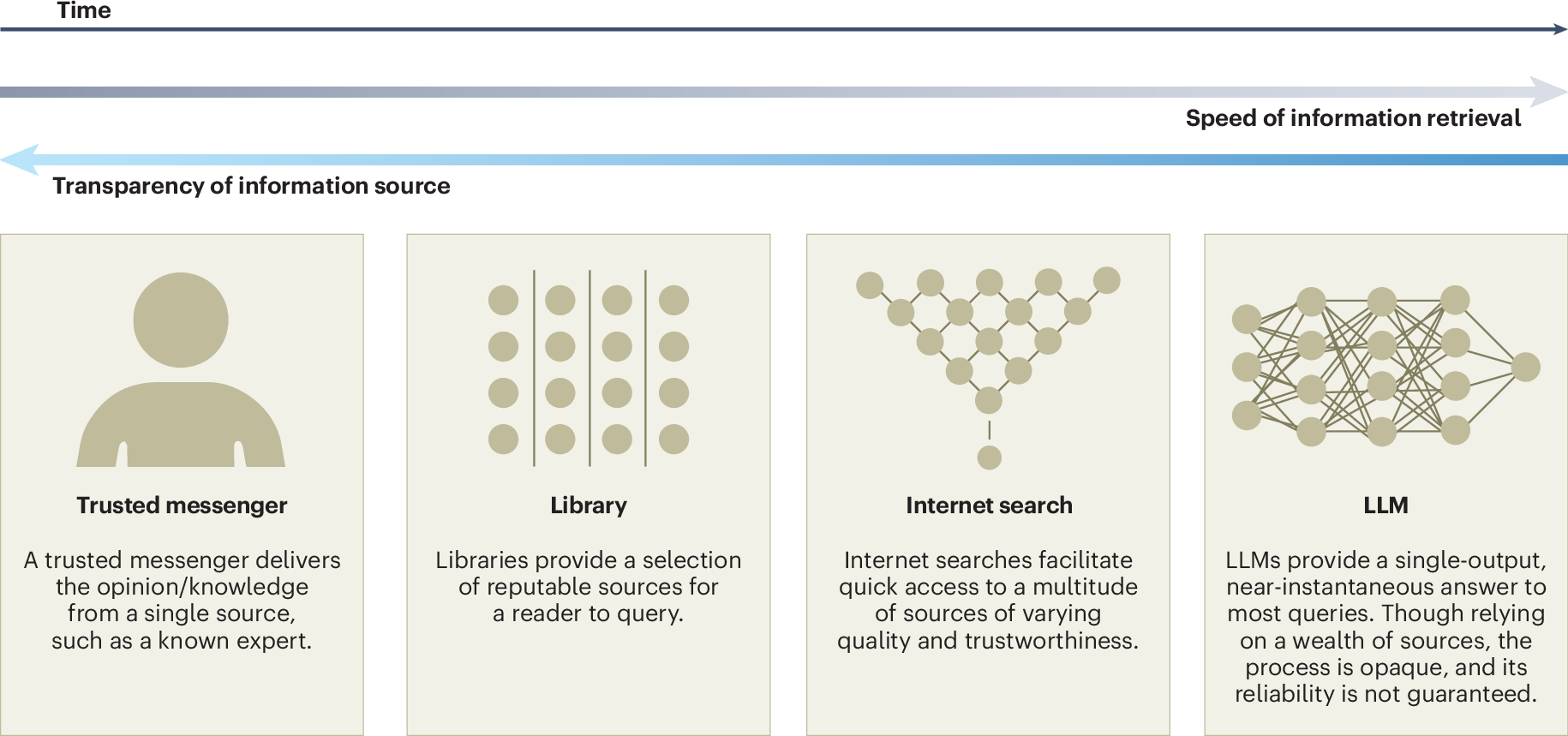
Collective intelligence underpins the success of groups, organizations, markets and societies. Through distributed cognition and coordination, collectives can achieve outcomes that exceed the capabilities of individuals—even experts—resulting in improved accuracy and novel capabilities. Often, collective intelligence is supported by information technology, such as online prediction markets that elicit the ‘wisdom of crowds’, online forums that structure collective deliberation or digital platforms that crowdsource knowledge from the public. Large language models, however, are transforming how information is aggregated, accessed and transmitted online. Here we focus on the unique opportunities and challenges this transformation poses for collective intelligence. We bring together interdisciplinary perspectives from industry and academia to identify potential benefits, risks, policy-relevant considerations and open research questions, culminating in a call for a closer examination of how large language models affect humans’ ability to collectively tackle complex problems.
How large language models can reshape collective intelligence
Collective intelligence underpins the success of groups, organizations, markets and societies. Through distributed cognition and coordination, collectives can achieve outcomes that exceed the capabilities of individuals—even experts—resulting in improved accuracy and novel capabilities. Often, collective intelligence is supported by information technology, such as online prediction markets that elicit the ‘wisdom of crowds’, online forums that structure collective deliberation or digital platforms that crowdsource knowledge from the public. Large language models, however, are transforming how information is aggregated, accessed and transmitted online. Here we focus on the unique opportunities and challenges this transformation poses for collective intelligence. We bring together interdisciplinary perspectives from industry and academia to identify potential benefits, risks, policy-relevant considerations and open research questions, culminating in a call for a closer examination of how large language models affect humans’ ability to collectively tackle complex problems.
Redesigning algorithms to intervene on social norm misperceptions during a national election
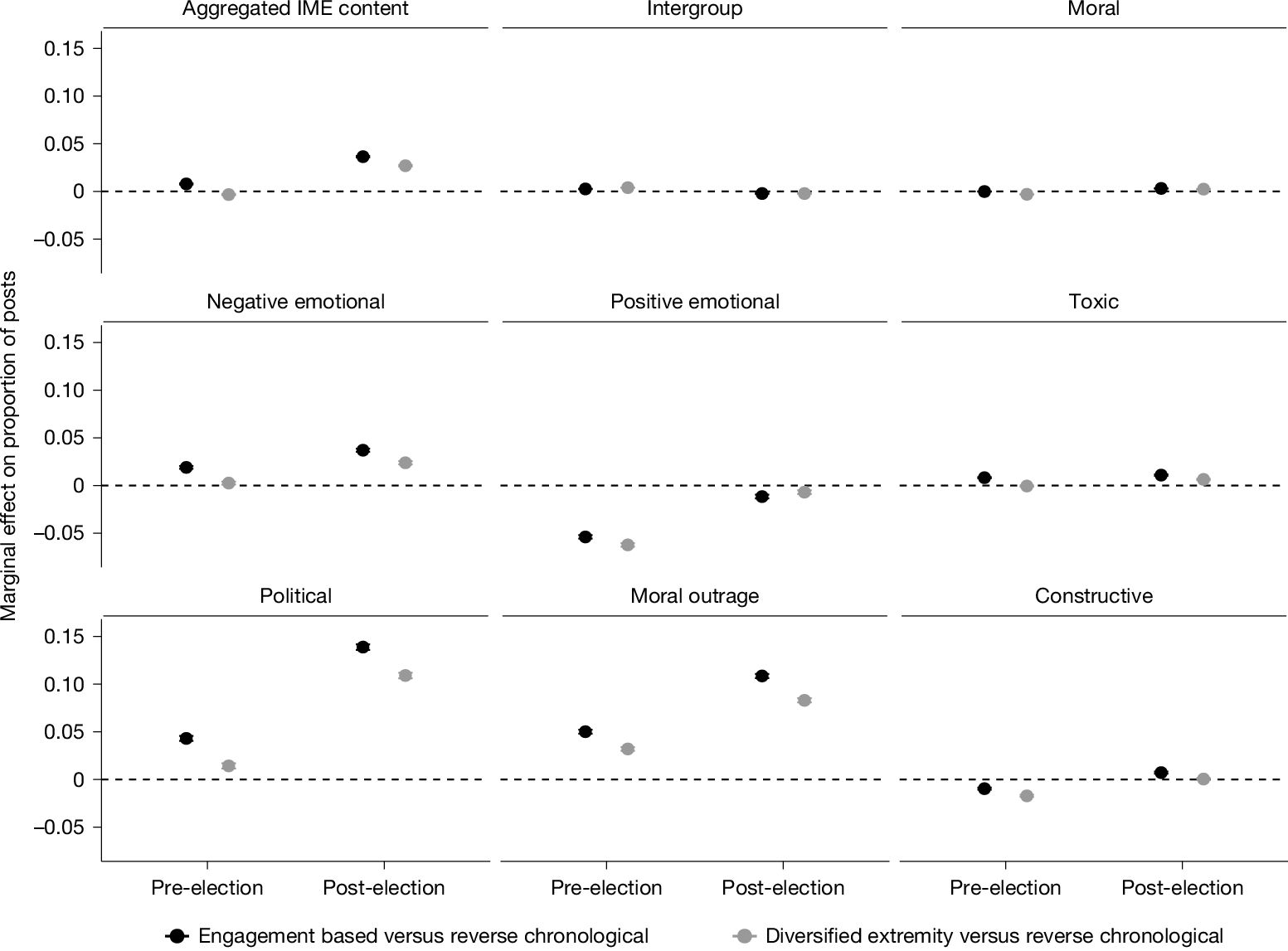
For the first time in history, civic discourse commonly occurs in digital environments in which algorithms influence exposure to social information1,2. It is increasingly important to understand whether and how these algorithms affect political discourse3–5. Here we built custom feed-ranking algorithms with full control over their features, and randomly assigned 2,000 participants to use them for 8 weeks (before and after the 2024 US presidential election). We tested whether an engagement-based algorithm (used on major social media platforms6,7) amplifies intergroup, moralized and emotional (IME) information in ways that skew perceptions of social norms around political dialogue5,8, and whether it increased engagement with IME content and perceptions of partisan animosity (compared with a reverse-chronological feed9,10). We also developed and tested a ‘diversified extremity’ algorithm to reduce the influence of extreme users11–13 to improve the accuracy of social norm perception14–16 and reduce perceptions of partisan animosity. We found that engagement-based feeds amplified IME and toxic content relative to reverse-chronological feeds, with the largest increases in moral outrage and political content. Engagement-based feeds also reduced prescriptive norm perception accuracy (albeit in an unexpected direction) and increased perceived partisan animosity. However, they did not significantly alter users’ own engagement behaviours. The diversified extremity algorithm reduced IME and toxic content exposure, improved prescriptive norm accuracy, yet maintained comparable platform enjoyment—suggesting that reducing the influence of extreme users can curb algorithmic distortions without diminishing user experience.
Political Sorting Can Drive AI Models Apart Through User Feedback
Large language models are rapidly becoming an important source of political information. This raises a fundamental question: will AI systems support a shared basis for political knowledge, or lead different political groups to rely on increasingly different models? Political sorting can drive model fragmentation if three conditions hold: politically different users select into different models, learning from user feedback pushes those models apart politically, and the resulting differences shape subsequent model choices. We call this self-reinforcing process the Centrifugal Alignment Spiral. We study its components in three steps. First, we draw on a human experiment showing that political identity predicts model choice. Second, we fine-tune language models on synthetic feedback reflecting predominantly Democratic or Republican preferences. Across five independent runs per model family, paired models diverged on 12-41% of unseen survey questions with large partisan gaps, and in every run the differences moved in the expected political direction; for some models, differentiation extended even to issue areas excluded from training. Pooling feedback across groups instead suppressed divergence. Third, an empirically anchored agent-based model shows what follows when political sorting and model adaptation operate together: models attract politically distinct audiences, learn from them, and diverge further. User feedback can therefore turn political sorting among AI users into durable differences between the models on which they rely for political information.