


Human languages encode similar average information rates (~39 bits/s) despite their remarkable differences. , Language is universal, but it has few indisputably universal characteristics, with cross-linguistic variation being the norm. For example, languages differ greatly in the number of syllables they allow, resulting in large variation in the Shannon information per syllable. Nevertheless, all natural languages allow their speakers to efficiently encode and transmit information. We show here, using quantitative methods on a large cross-linguistic corpus of 17 languages, that the coupling between language-level (information per syllable) and speaker-level (speech rate) properties results in languages encoding similar information rates (~39 bits/s) despite wide differences in each property individually: Languages are more similar in information rates than in Shannon information or speech rate. These findings highlight the intimate feedback loops between languages’ structural properties and their speakers’ neurocognition and biology under communicative pressures. Thus, language is the product of a multiscale communicative niche construction process at the intersection of biology, environment, and culture.
Different languages, similar encoding efficiency: Comparable information rates across the human communicative niche
Human languages encode similar average information rates (~39 bits/s) despite their remarkable differences.
The evolution of syntactic communication
Animal communication is typically non-syntactic, which means that signals refer to whole situations1,2,3,4,5,6,7. Human language is syntactic, and signals consist of discrete components that have their own meaning8. Syntax is a prerequisite for taking advantage of combinatorics, that is, “making infinite use of finite means”9,10,11. The vast expressive power of human language would be impossible without syntax, and the transition from non-syntactic to syntactic communication was an essential step in the evolution of human language12,13,14,15,16. We aim to understand the evolutionary dynamics of this transition and to analyse how natural selection can guide it. Here we present a model for the population dynamics of language evolution, define the basic reproductive ratio of words and calculate the maximum size of a lexicon. Syntax allows larger repertoires and the possibility to formulate messages that have not been learned beforehand. Nevertheless, according to our model natural selection can only favour the emergence of syntax if the number of required signals exceeds a threshold value. This result might explain why only humans evolved syntactic communication and hence complex language.

False Friends Are Not Foes: Investigating Vocabulary Overlap in Multilingual Language Models
Subword tokenizers trained on multilingual corpora naturally produce overlapping tokens across languages. Does token overlap facilitate cross-lingual transfer or instead introduce interference between languages? Prior work offers mixed evidence, partly due to varied setups and confounders, such as token frequency or subword segmentation granularity. To address this question, we devise a controlled experiment where we train bilingual autoregressive models on multiple language pairs under systematically varied vocabulary overlap settings. Crucially, we explore a new dimension to understanding how overlap affects transfer: the semantic similarity of tokens shared across languages. We first analyze our models' hidden representations and find that overlap of any kind creates embedding spaces that capture cross-lingual semantic relationships, while this effect is much weaker in models with disjoint vocabularies. On XNLI and XQuAD, we find that models with overlap outperform models with disjoint vocabularies, and that transfer performance generally improves as overlap increases. Overall, our findings highlight the advantages of token overlap in multilingual models and show that substantial shared vocabulary remains a beneficial design choice for multilingual tokenizers.

Evidence of a predictive coding hierarchy in the human brain listening to speech
Considerable progress has recently been made in natural language processing: deep learning algorithms are increasingly able to generate, summarize, translate and classify texts. Yet, these language models still fail to match the language abilities of humans. Predictive coding theory offers a tentative explanation to this discrepancy: while language models are optimized to predict nearby words, the human brain would continuously predict a hierarchy of representations that spans multiple timescales. To test this hypothesis, we analysed the functional magnetic resonance imaging brain signals of 304 participants listening to short stories. First, we confirmed that the activations of modern language models linearly map onto the brain responses to speech. Second, we showed that enhancing these algorithms with predictions that span multiple timescales improves this brain mapping. Finally, we showed that these predictions are organized hierarchically: frontoparietal cortices predict higher-level, longer-range and more contextual representations than temporal cortices. Overall, these results strengthen the role of hierarchical predictive coding in language processing and illustrate how the synergy between neuroscience and artificial intelligence can unravel the computational bases of human cognition.
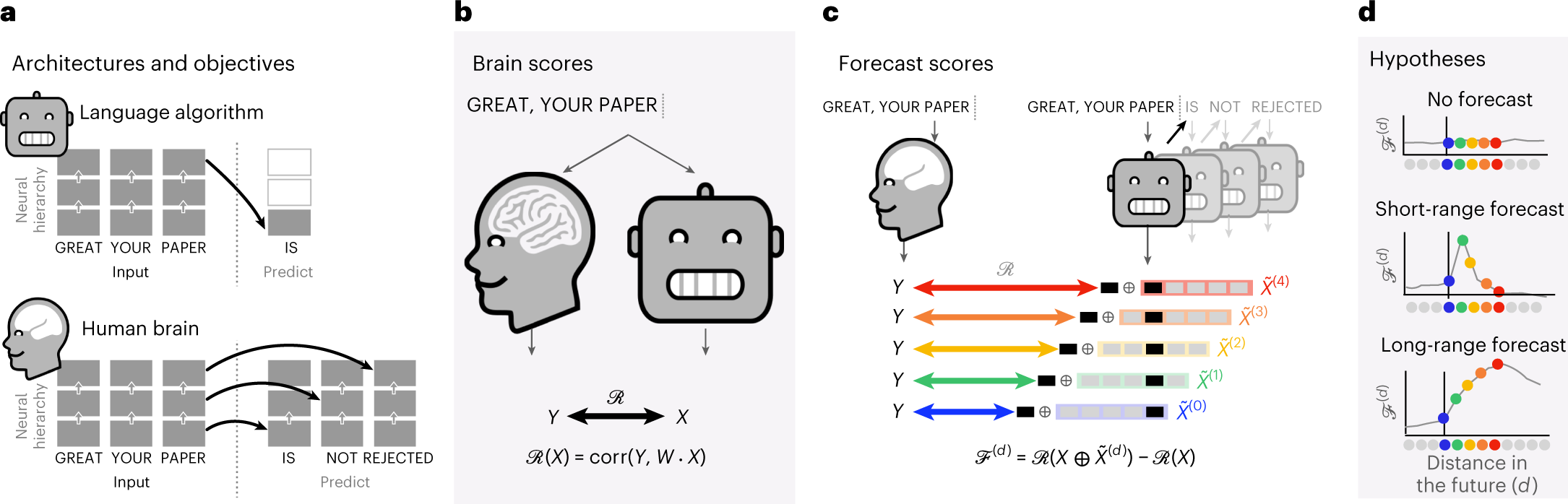
Localized Cultural Knowledge is Conserved and Controllable in Large Language Models
Large language models (LLMs), like human language learners, show patterns influenced by their dominant training language. Just as humans display language patterns influenced by their native tongue (semantic accents) when learning new languages, LLMs often default to English-centric responses even when generating in other languages. However, we observe that explicitly providing cultural context in prompts significantly improves the models' ability to generate culturally localized responses. We term this phenomenon the explicit-implicit localization gap, indicating that while cultural knowledge exists within LLMs, it may not naturally surface in multilingual interaction without explicitly including cultural context. In this paper, we (1) quantify this gap in multiple LLMs using a new cultural localization benchmark and find large (\ensuremath>10%) gaps in the majority of investigated models. (2) Demonstrate a fundamental trade-off between localization accuracy and output diversity. (3) Through mechanistic interpretability, we identify the underlying localization mechanisms within LLMs and show that these mechanisms are both language and task agnostic, with individual steering vectors effectively generalizing across different languages and culturally-relevant tasks.
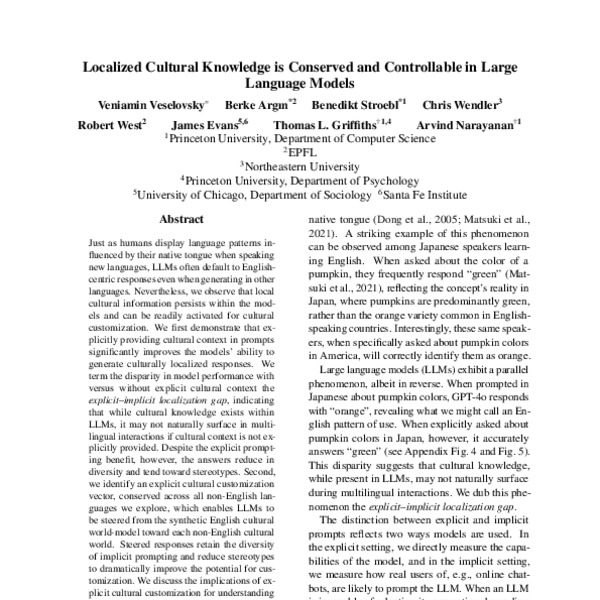
Lossy communication constrains iterated learning
Humans' distinctive role in the world can largely be attributed to our capacity for iterated learning, a process by which knowledge is expanded and refined over generations. A range of theories seek to explain why humans are so adept at iterated learning, many positing substantial evolutionary discontinuities in communication or cognition. Is it necessary to posit large differences in abilities between humans and other species, or could small differences in communication ability produce large differences in what a species can learn over generations? We investigate this question through a formal model based on information theory. We manipulate how much information individual learners can send each other and observe the effect on iterated learning performance. Incremental changes to the channel rate can lead to dramatic, non-linear changes to the eventual performance of the population. We complement this model with a theoretical result that describes how individual lossy communications constrain the global performance of iterated learning. Our results demonstrate that incremental, quantitative changes to communication abilities could be sufficient to explain large differences in what can be learned over many generations.
Greedy or not, here I come: Language production under vocabulary constraints in humans and resource-rational models
Communicating using only a limited vocabulary is a common but challenging cognitive phenomenon, requiring an ideal communicator to plan carefully to optimize for intelligibility while circumventing a constrained lexicon. In this work, we investigate how humans respond to a broad array of questions under variable vocabulary limitations, consisting of only 250 highly frequent words at the most restrictive. We provide theoretically motivated comparisons to greedy and globally optimal sampling algorithms using Sequential Monte Carlo inference with large language models. Humans generally resemble greedy sampling more than globally optimal sampling, though more skilled humans are more likely to backtrack and revise -- a non-greedy behavior. An observed human pattern of leaning on semantically light words in high-constraint settings falls out of both greedy and globally optimal sampling. We discuss the results and their broader implications for resource-rational cognition, psycholinguistics, L2 communication, and language impairments.
Empirical evidence of Large Language Model's influence on human spoken communication
From the printing press to social media, innovations in communication technology have repeatedly reshaped how ideas spread through human culture. Chatbots powered by generative artificial intelligence constitute a new medium, encoding cultural patterns in their neural representations and disseminating them in conversations with hundreds of millions of people. Whether these patterns transmit into human language, and ultimately shape human culture, is a fundamental question. While fully quantifying the causal impact of a chatbot like ChatGPT on human culture is challenging, lexical shifts in human spoken communication may offer an early indicator. Here we show that words preferentially generated by ChatGPT, such as delve, showcase, boast, intricacies and meticulous, increased abruptly in spontaneous human speech. A synthetic-control analysis of 737,083 hours of conversation from 824,634 podcast episodes, screened for unscripted speech, causally links this shift to ChatGPT's release. The measurable influence on spontaneous speech suggests that humans internalize the lexical choices of large language models (LLMs). A preregistered experiment (N = 496) confirms they do, as a brief chatbot interaction led participants to adopt its words as their own, persisting past a distractor task and confirmed in forced lexical choice, indicating entrenchment in the active vocabulary. Together these results show that machines trained on human data now feed their own traits back into human language, integrating LLMs into the ongoing processes of cultural evolution.. This coupling raises concerns about linguistic homogenization and the capacity of a few major AI providers for latent cultural influence at scale.
Do language models accommodate their users? A study of linguistic convergence
While large language models (LLMs) are generally considered proficient in generating language, how similar their language usage is to that of humans remains understudied. In this paper, we test whether models exhibit linguistic convergence, a core pragmatic element of human language communication: do models adapt, or converge, to the linguistic patterns of their user? To answer this, we systematically compare model completions of existing dialogues to original human responses across sixteen language models, three dialogue corpora, and various stylometric features. We find that models strongly converge to the conversation's style, often significantly overfitting relative to the human baseline. While convergence patterns are often feature-specific, we observe consistent shifts in convergence across modeling settings, with instruction-tuned and larger models converging less than their pretrained and smaller counterparts. Given the differences in human and model convergence patterns, we hypothesize that the underlying mechanisms driving these behaviors are very different.
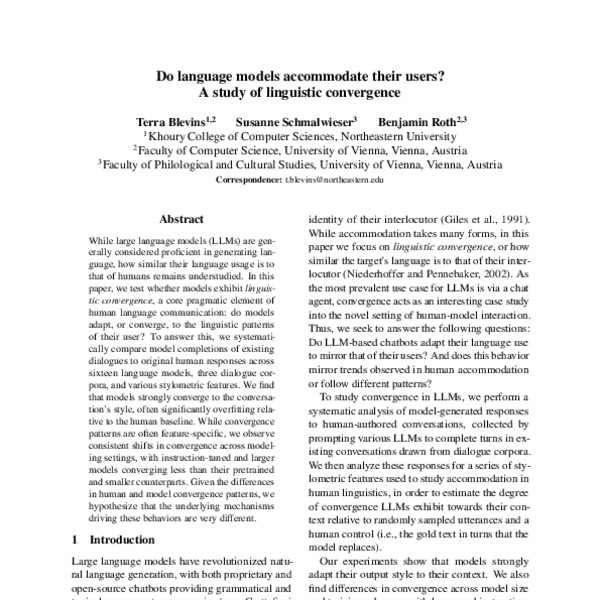
Do language models accommodate their users? A study of linguistic convergence
While large language models (LLMs) are generally considered proficient in generating language, how similar their language usage is to that of humans remains understudied. In this paper, we test whether models exhibit linguistic convergence, a core pragmatic element of human language communication: do models adapt, or converge, to the linguistic patterns of their user? To answer this, we systematically compare model completions of existing dialogues to original human responses across sixteen language models, three dialogue corpora, and various stylometric features. We find that models strongly converge to the conversation's style, often significantly overfitting relative to the human baseline. While convergence patterns are often feature-specific, we observe consistent shifts in convergence across modeling settings, with instruction-tuned and larger models converging less than their pretrained and smaller counterparts. Given the differences in human and model convergence patterns, we hypothesize that the underlying mechanisms driving these behaviors are very different.
Is Cross-Lingual Transfer in Bilingual Models Human-Like? A Study with Overlapping Word Forms in Dutch and English
Bilingual speakers show cross-lingual activation during reading, especially for words with shared surface form. Cognates (friends) typically lead to facilitation, whereas interlingual homographs (false friends) cause interference or no effect. We examine whether cross-lingual activation in bilingual language models mirrors these patterns. We train Dutch-English causal Transformers under four vocabulary-sharing conditions that manipulate whether (false) friends receive shared or language-specific embeddings. Using psycholinguistic stimuli from bilingual reading studies, we evaluate the models through surprisal and embedding similarity analyses. The models largely maintain language separation, and cross-lingual effects arise primarily when embeddings are shared. In these cases, both friends and false friends show facilitation relative to controls. Regression analyses reveal that these effects are mainly driven by frequency rather than consistency in form-meaning mapping. Only when just friends share embeddings are the qualitative patterns of bilinguals reproduced. Overall, bilingual language models capture some cross-linguistic activation effects. However, their alignment with human processing seems to critically depend on how lexical overlap is encoded, possibly limiting their explanatory adequacy as models of bilingual reading.
Beyond the Rosetta Stone: Unification Forces in Generalization Dynamics
Large language models (LLMs) struggle with cross-lingual knowledge transfer: they sometimes hallucinate when asked in one language about facts expressed in a different language during training. This work introduces a controlled setting to study the causes and training dynamics of this phenomenon by training small Transformer models from scratch on synthetic multilingual datasets. Depending on (1) the correlation between facts and the language they were learned in (informativeness), and (2) the ease of language identification (extractability), models either develop unified representations across languages or separate representations; only when representations are unified do facts transfer across languages. Based on these insights, we propose a unifying perspective which explains a range of prior observations concerning cross-lingual transfer in multilingual LLMs. Our work shows controlled settings can shed light on pre-training dynamics and suggests methods to encourage representational unification as part of training that would improve LLMs’ cross-lingual transfer.
LLMs and people both learn to form conventions -- just not with each other
Humans align to one another in conversation -- adopting shared conventions that ease communication. We test whether LLMs form the same kinds of conventions in a multimodal communication game. Both humans and LLMs display evidence of convention-formation (increasing the accuracy and consistency of their turns while decreasing their length) when communicating in same-type dyads (humans with humans, AI with AI). However, heterogenous human-AI pairs fail -- suggesting differences in communicative tendencies. In Experiment 2, we ask whether LLMs can be induced to behave more like human conversants, by prompting them to produce superficially humanlike behavior. While the length of their messages matches that of human pairs, accuracy and lexical overlap in human-LLM pairs continues to lag behind that of both human-human and AI-AI pairs. These results suggest that conversational alignment requires more than just the ability to mimic previous interactions, but also shared interpretative biases toward the meanings that are conveyed.
How Large Language Models Actually Work
Scaling Laws for Neural Language Models
We study empirical scaling laws for language model performance on the cross-entropy loss. The loss scales as a power-law with model size, dataset size, and the amount of compute used for training, with some trends spanning more than seven orders of magnitude. Other architectural details such as network width or depth have minimal effects within a wide range. Simple equations govern the dependence of overfitting on model/dataset size and the dependence of training speed on model size. These relationships allow us to determine the optimal allocation of a fixed compute budget. Larger models are significantly more sample-efficient, such that optimally compute-efficient training involves training very large models on a relatively modest amount of data and stopping significantly before convergence.
An investigation across 45 languages and 12 language families reveals a universal language network
To understand the architecture of human language, it is critical to examine diverse languages; yet most cognitive neuroscience research has focused on a handful of primarily Indo-European languages. Here, we report an investigation of the fronto-temporo-parietal language network across 45 languages and establish the robustness to cross-linguistic variation of its topography and key functional properties, including left-lateralization, strong functional integration among its brain regions, and functional selectivity for language processing.