


Neuroscientists have found that a small region of the brain's prefrontal cortex, where most thought and planning occurs, is responsible for moment-by-moment control of which habits are switched on at a given time.
How the brain selectively remembers new places
MIT neuroscientists have discovered how the brain preferentially forms memories of new locations. A small region of the brainstem, known as the locus coeruleus, releases a flood of dopamine in response to novel sensory stimuli, and this dopamine triggers a certain region of the hippocampus to store a memory of the new location.

3 simple habits that can protect your brain from cognitive decline - Fast Company
These three habits help your body, and also have a positive impact on your brain.

Neuroscientists show how neurons respond to sequences of familiar objects
The world grows increasingly more chaotic year after year, and our brains are constantly bombarded with images. A new study from Center for the Neural Basis of Cognition (CNBC), a joint project between ...

Keep Forgetting Things? Neuroscience Says These 8 Brain Habits Improve Memory and Leadership
A brief introduction to some of the most interesting studies from the past couple of years.

A neuroscientist who studies decision-making reveals the most important choice you can make
Neuroscientist Moran Cerf has found people's brain activity aligns when they're in each other's company. The finding can be used to maximize happiness.
First Brain-Wide Map of Decision-Making Charted In Mice - Slashdot
In a landmark collaboration across 22 labs, neuroscientists have created the first brain-wide map of decision-making in mice, tracking over 620,000 neurons across nearly 280 brain regions. They found that decision-making is distributed much more broadly than previously thought, involving not just "c...
Procrastination Is More About Managing Emotions Than Time, Says Study - Slashdot
An anonymous reader quotes a report from the BBC: [A new study] identified two areas of the brain that determine whether we are more likely to get on with a task or continually put it off. Researchers used a survey and scans of 264 people's brains to measure how proactive they were. Experts say the...

The Brain's Autopilot Mechanism Steers Consciousness
Freud’s notion of a dark, libidinous unconscious is obsolete. A new theory holds that the brain produces a continuous stream of unconscious predictions

MIT neuroscientist: The No. 1 skill that sets people with ‘excellent memory’ apart from those who struggle—'it's rare'
Memory skills vary from one person to another. MIT Sloan neuroscientist Dr. Tara Swart Bieber shares how she trains her brain to prevent memory decline as we age.

The Brain ‘Rotates’ Memories to Save Them From New Sensations | Quanta Magazine
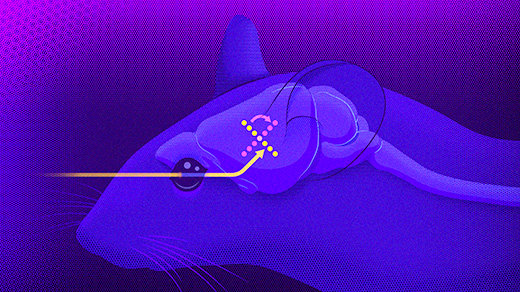
Some populations of neurons simultaneously process sensations and memories. New work shows how the brain rotates those representations to prevent interference.
Bridging the biological and cultural models of cognition
Our minds are a choice

How the Brain Uses Glucose to Fuel Self-Control
The brain requires tons of energy—and new experiments show how low glucose levels and self-control issues are connected.

To Make Sense of the Present, Brains May Predict the Future | Quanta Magazine
A controversial theory suggests that perception, motor control, memory and other brain functions all depend on comparisons between ongoing actual experiences and the brain’s modeled expectations.

Watch a thought race across the surface of the brain | TechCrunch
Although neuroscientists have a general idea of what parts of the brain do what, catching them in the act is a difficult proposition. But UC Berkeley researchers have managed to do it, visualizing based on direct measurement the path of a single thought (or at least thread) through the brain.
Resistance Is Futile. To Change Habits, Try Replacement Instead. (Published 2018)
An inconvenient bit of neuroscience: The more you try not to think about a bad habit, the harder it gets to resist. So think about something else.

Your Brain Chooses What to Let You See | Quanta Magazine
Beneath our awareness, the brain lets certain kinds of stimuli automatically capture our attention by lowering the priority of the rest.
