The brains of jazz musicians engrossed in spontaneous, improvisational musical conversation showed robust activation of brain areas traditionally associated with spoken language and syntax, which are used to interpret the structure of phrases and sentences. But this musical conversation shut down brain areas linked to semantics -- those that process the meaning of spoken language, according to results of a novel study.
Music on the brain: Listening can influence our brain’s activity
The "Mozart effect" isn't real—but music does affect our mental processes.

From Prompting to Describing: A Cross-Cultural Study of Language for AI-Generated Music
Recent text-to-music (TTM) systems such as Suno [22], Udio [23], and Google’s MusicFX [7] allow users to generate music from a natural language prompt, lowering the barrier to music creation for users without specialized musical knowledge [27]. Understanding how users write these prompts is therefore a fundamental question for music information retrieval and human-AI interaction research. Yet, prompting a generative system is not the same cognitive or linguistic act as describing music one has heard [12]. When a user writes a prompt, they encode anticipatory intent to steer the system toward a desired or imagined output, whereas when a listener describes a piece of music, their language is grounded in a perceptual experience. We argue that these two acts produce systematically different language—a distinction that, despite being intuitive, has not been quantitatively examined. This gap has practical consequences: recent TTM models are trained predominantly on metadata-centric corpora (genre labels, BPM, descriptive tags) [6] rather than on the kind of language users naturally produce when listening, leaving the prompt-description gap unexamined. Moreover, this gap limits our ability to evaluate and improve human–AI interaction in music generation, as current systems are optimized for prompt input but commonly assessed through human perception.
Network Science and the Effects of Music Preference on Functional Brain Connectivity: From Beethoven to Eminem
Most people choose to listen to music that they prefer or ‘like’ such as classical, country or rock. Previous research has focused on how different characteristics of music (i.e., classical versus country) affect the brain. Yet, when listening to preferred music—regardless of the type—people report they often experience personal thoughts and memories. To date, understanding how this occurs in the brain has remained elusive. Using network science methods, we evaluated differences in functional brain connectivity when individuals listened to complete songs. We show that a circuit important for internally-focused thoughts, known as the default mode network, was most connected when listening to preferred music. We also show that listening to a favorite song alters the connectivity between auditory brain areas and the hippocampus, a region responsible for memory and social emotion consolidation. Given that musical preferences are uniquely individualized phenomena and that music can vary in acoustic complexity and the presence or absence of lyrics, the consistency of our results was unexpected. These findings may explain why comparable emotional and mental states can be experienced by people listening to music that differs as widely as Beethoven and Eminem. The neurobiological and neurorehabilitation implications of these results are discussed.
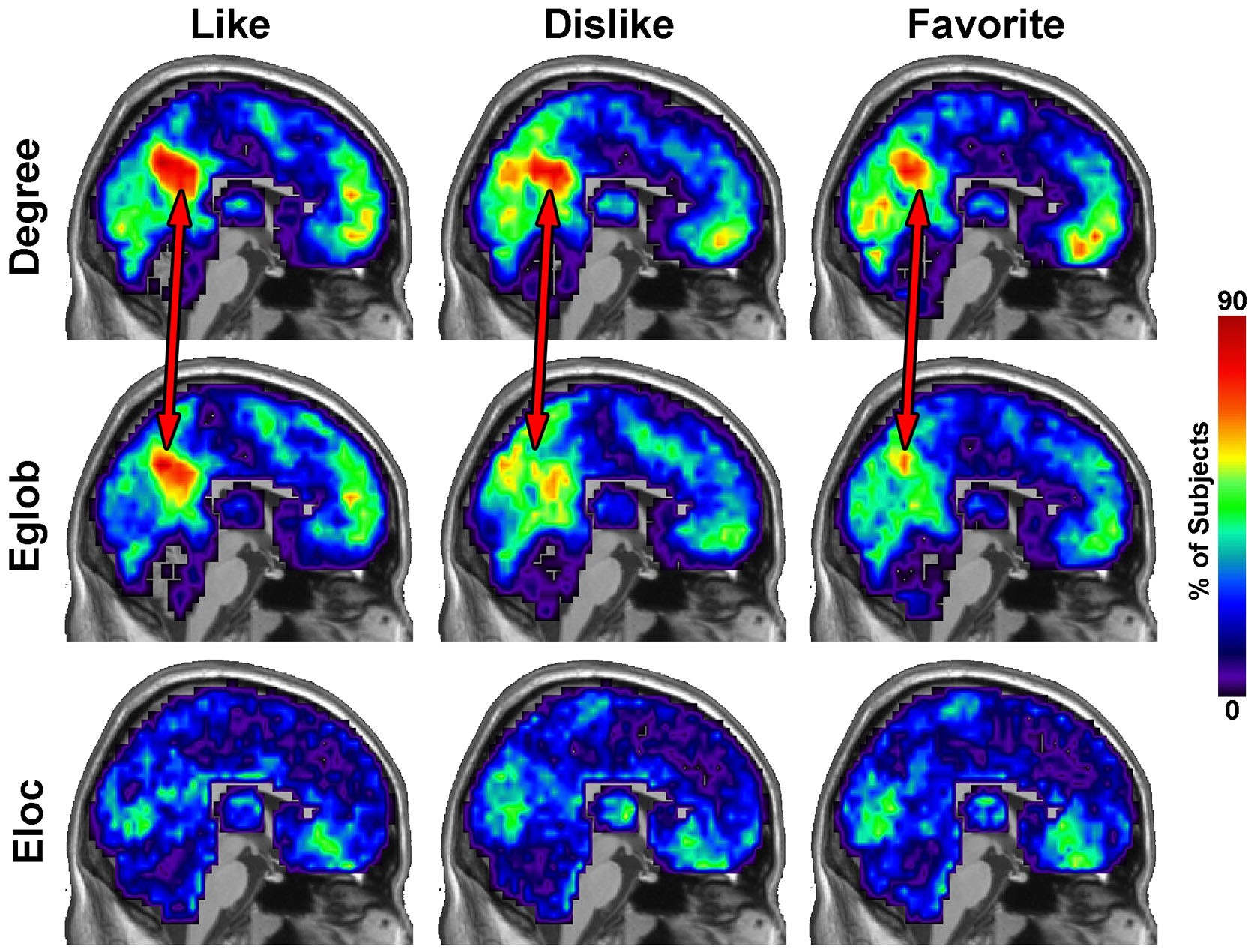
Brain scans reveal the neural networks that get songs stuck in your head
Earworms, stuck song syndrome, musical imagery repetition, involuntary musical imagery -- it is a phenomenon with a number of names, but now researchers

What making music does to your brain
What’s it like to have a song inside your head, itching to get out? A neuroscientist and a songwriter compare notes from the frontier of music and science.

Making music together connects brains
When guitarists play together, networks of nerve cells are formed between their brains

Brain knows how to stop thinking, start learning
Anyone who's ever learned music probably remembers reaching a point when they just played without "thinking" about the notes.

A foundation model of vision, audition, and language for in-silico neuroscience | Research - AI at Meta
Cognitive neuroscience is fragmented into specialized models, each tailored to specific experimental paradigms, hence preventing a unified model of...
Opinion | Why Music Makes Our Brain Sing (Published 2013)
When a song triggers both anticipation and reward, it moves us like nothing else.

How the brain perceives rhythm
MIT neuroscientists have found that people are biased toward hearing and producing rhythms composed of simple integer ratios. This holds true for musicians and non-musicians living in the United States, as well as members of a Bolivian tribe who have little exposure to Western music.

Listening to classical music modulates genes that are responsible for brain functions
Although listening to music is common in all societies, the biological determinants of listening to music are largely unknown. According to a new study, listening to classical music enhanced the activity of genes involved in dopamine secretion and transport, synaptic neurotransmission, learning and memory, and down-regulated the genes mediating neurodegeneration. Several of the up-regulated genes were known to be responsible for song learning and singing in songbirds, suggesting a common evolutionary background of sound perception across species.
[Interview] Snow J of Cheerful Music dives into the cross cultural intersection of AI and music – EARMILK
In conversation with Earmilk, Snow. J explores how AI has restructured the foundation of music culture, striking a balance between AI and human-made music as well as Cheerful Music's distinct approach to engaging AI technology in music making and marketing.

The Impact of Listening to Music on Cognitive Performance
Listening to music for relaxation is common among students to counter the effects of stress or anxiety while completing difficult academic tasks. Some studies supporting this technique have shown that background music promotes cognitive performance...

Study Reveals Music's Universal Patterns Across Societies Worldwide - Slashdot
From love songs to dance tunes to lullabies, music made in disparate cultures worldwide displays certain universal patterns, according to a study by researchers who suggest a commonality in the way human minds create music. From a report: The study focused on musical recordings and ethnographic reco...

Neural Translation of Musical Style
Can we teach a neural network to perform like a human?