

High intelligence is touted as being predictive of positive outcomes including educational success and income level. However, little is known about the difficulties experienced among this population. Specifically, those with a high intellectual capacity (hyper brain) possess overexcitabilities in various domains that may predispose them to certain psychological disorders as well as physiological conditions involving elevated sensory, and altered immune and inflammatory responses (hyper body). The present study surveyed members of American Mensa, Ltd. (n=3715) in order to explore psychoneuroimmunological (PNI) processes among those at or above the 98th percentile of intelligence. Participants were asked to self-report prevalence of both diagnosed and/or suspected mood and anxiety disorders, attention deficit hyperactivity disorder (ADHD), autism spectrum disorder (ASD), and physiological diseases that include environmental and food allergies, asthma, and autoimmune disease. High statistical significance and a remarkably high relative risk ratio of diagnoses for all examined conditions were confirmed among the Mensa group 2015 data when compared to the national average statistics. This implicates high IQ as being a potential risk factor for affective disorders, ADHD, ASD, and for increased incidence of disease related to immune dysregulation. Preliminary findings strongly support a hyper brain/hyper body association which may have substantial individual and societal implications and warrants further investigation to best identify and serve this at-risk population.
From gifted to high potential and twice exceptional: A state-of-the-art meta-review
Despite the abundant literature on intelligence and high potential individuals, there is still a lack of international consensus on the terminology and clinical characteristics associated to this population. It has been argued that unstandardized use of diagnosis tools and research methods make comparisons and interpretations of scientific and epidemiological evidence difficult in this field. If multiple cognitive and psychological models have attempted to explain the mechanisms underlying high potentiality, there is a need to confront new scientific evidence with the old, to uproot a global understanding of what constitutes the neurocognitive profile of high-potential in gifted individuals. Another particularly relevant aspect of applied research on high potentiality concerns the challenges faced by individuals referred to as "twice exceptional" in the field of education and in their socio-affective life. Some individuals have demonstrated high forms of intelligence together with learning, affective or neurodevelopmental disorders posing the question as to whether compensating or exacerbating psycho-cognitive mechanisms might underlie their observed behavior. Elucidating same will prove relevant to questions concerning the possible need for differential diagnosis tools, specialized educational and clinical support. A meta-review of the latest findings from neuroscience to developmental psychology, might help in the conception and reviewing of intervention strategies.
ADHD and giftedness: a neurocognitive consideration of twice exceptionality
Current models of cognition and behavioral diagnosis emphasize categorical classification over continuous considerations of function and promote the "differential diagnosis" of various conditions according to observational criteria. However, an overemphasis on a purely behavioral, categorical approach to understanding human function fails to address the comorbidity of different disorders and does not include a consideration of overlapping levels of function, from "pathological" through "normal," to "gifted" or exceptional. The frequent co-occurrence of "gifted" and "pathological" function is thus difficult to understand from a corticocentric and purely behavioral and observational point of view. This article reviews "giftedness" in relation to the diagnosis of attention-deficit hyperactivity disorder, coexistence of which is termed "twice exceptional." It additionally considers problems in assessing these functions using current neuropsychological tests and methodologies that are presumably based upon a corticocentric model of cognition.
Dose dependence of prenatal fluoride exposure associations with cognitive performance at school age in three prospective studies
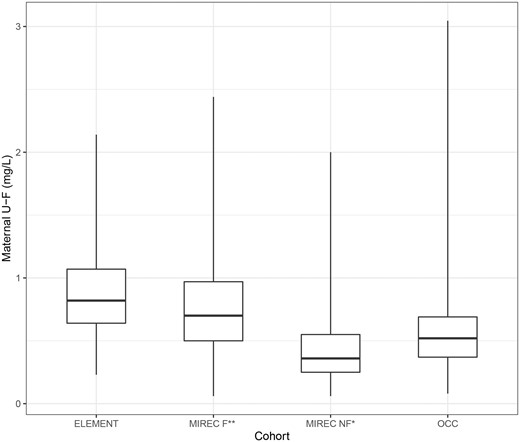
Abstract Background Fluoride may be a developmental neurotoxicant at elevated exposures. We merged new data from a prospective Odense Child Cohort (OCC) with results from two previous birth cohort studies from Mexico and Canada to characterize the dose–effect relationship in greater detail. Methods The OCC contributed 837 mother–child pairs to the total of >1500. We measured creatinine-adjusted urine-fluoride concentrations in maternal urine samples obtained during late pregnancy. Child IQ was determined at age 7 years using an abbreviated version of the Wechsler Intelligence Scales for Children. Findings from the three cohorts were used to calculate the joint benchmark concentration (BMC) and the lower confidence limit (BMCL) after adjustment for covariables. Results In the OCC, urine-fluoride concentrations varied between 0.08 and 3.04 mg/l (median 0.52 mg/l) but were not significantly associated with full-scale IQ at age 7 years (β = 0.08; 95% confidence interval −1.14 to 1.30 for a doubling in exposure). No difference was apparent between boys and girls. In the OCC, the BMC was 0.92 mg/l, with a BMCL of 0.30 mg/l. The joint analysis of all three cohorts showed a statistically significant association between urine-fluoride and IQ, with a BMC of 0.45 mg/l (BMCL, 0.28 mg/l), slightly higher than the BMC previously reported for the two North American cohorts alone. Conclusions As the BMCL reflects an approximate threshold for developmental neurotoxicity, the results suggest that pregnant women and children may need protection against fluoride toxicity.
Living With the Gift of Giftedness: An Exploratory Study on the Well-Being of Intellectually Gifted Adults
While it is now argued that intellectual giftedness is not causally associated with well-being, the individual and environmental determinants associated remain empirically underexplored. Trying to fill this gap, this study investigated potential risk and protective factors on the well-being and mental health of 219 Canadian intellectually gifted adults. Exploratory transversal analyses were conducted between 11 determinants frequently evoked in the literature on intellectually gifted individuals and hedonic well-being (positive/negative affect; ∝ = .85-.87; satisfaction with life; ∝ = .88), eudemonic well-being (existential crisis/meaning in life; ∝ = .76-.87; interpersonal connection; ∝ = 92) and psychopathologies. Results show that twice-exceptionality and lower socioeconomic status are risk factors for the development of psychopathologies, while being married/in civil union and having a higher perceived level of potential achievement are protective factors for hedonic and eudemonic well-being. Results are discussed in light of previous knowledge about gifted individuals.

Air pollution causes ‘huge’ reduction in intelligence, study reveals
Impact of high levels of toxic air ‘is equivalent to having lost a year of education’

Is AI on the Spectrum?
Some key traits of generative AI bear a striking similarity to autism spectrum disorder. Why does this matter?

Is AI on the Spectrum? Exploring the Parallels Between Artificial Intelligence and Autism Spectrum Disorder
An in-depth analysis of the similarities between AI behaviors and traits observed in Autism Spectrum Disorder, and how AI is being utilized in autism research and support.
The association between attention-deficit/hyperactivity (ADHD) symptoms and self-employment
Attention-deficit/hyperactivity (ADHD) symptoms have been associated with the decision to become self-employed. Although these symptoms are generally regarded as disadvantageous, there may also be a bright side. To our knowledge, however, there has been no systematic, epidemiological evidence to support this claim. This paper examines the association between ADHD symptoms and self-employment in a population-based sample from the STAGE cohort of the Swedish Twin Registry (N = 7208). For replication, we used a sample of Dutch students who participated in the Global University Entrepreneurial Spirit Students' Survey (N = 13,112). In the Swedish sample, we found a positive association with self-employment for both general ADHD symptoms [odds ratio (OR) 1.13; 95 % confidence intervals (CI) 1.04-1.23] and hyperactivity symptoms [OR 1.19; 95 % CI 1.08-1.32], whereas no association was found for attention-deficit symptoms [OR 0.99; 95 % CI 0.89-1.10]. The positive association between hyperactivity and self-employment was replicated in the Dutch student sample [OR 1.09; 95 % CI 1.03-1.15]. Our results show that certain aspects of ADHD, in particular hyperactivity, can have a bright side, as they are positively associated with self-employment.
How the hypercuriosity of ADHD may have helped humans thrive | Aeon Essays
ADHD isn’t merely a dysfunction. It’s best understood as an impulsive motivational drive for novel information

How the hypercuriosity of ADHD may have helped humans thrive | Aeon Essays
ADHD isn’t merely a dysfunction. It’s best understood as an impulsive motivational drive for novel information
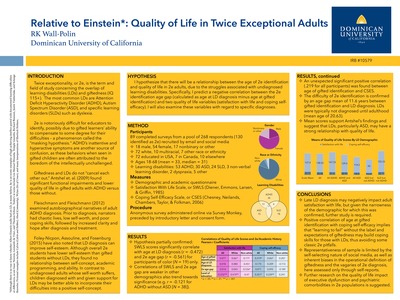
Relative to Einstein: Quality of Life in Twice Exceptional Adults
Twice exceptionality, or 2e, is the recently-coined term for the intersection of learning disabilities (LDs) and giftedness in an individual. Typically, these learning disabilities encompass ADHD, ASD, and/or specific learning disorders such as dyslexia. Because giftedness may obscure or compensate for a student’s academic struggles, and because institutional fixation on disability may overshadow intelligence, twice exceptionality is often missed by teachers and other authority figures in a child’s life. Given the ongoing difficulties of screening for twice exceptionality, it is likely that many 2e students have gone unidentified throughout most of their academic careers, without receiving the accommodations that would most benefit their studies. Furthermore, 2e adults whose schooling predated widespread awareness of twice exceptionality are more likely to have been diagnosed later in life. The twin prongs of identification and intervention for 2e youth make up the bulk of studies in the field. Today’s 2e youth are better-identified, better-studied, and better-supported than any previous generation, but 2e adults remain an understudied population. In addition to the difficulties and contradictions inherent in twice exceptionality, late identification and lack of support are likely to have negatively impacted twice exceptional adults, both in and out of the classroom. The present study will examine the ability of 2e adults to effectively cope with stressors in their lives, as well as their current level of life satisfaction. Approximately fifty or more 2e adults will be recruited through email and social media, and via the disability department of a small liberal arts university. Participants will be asked about their diagnostic histories and their experiences with higher education, and will then complete the Satisfaction With Life Scale (Diener, E., Emmons, R. A., Larsen, R. J., & Griffin, S., 1985) and Coping Self-Efficacy Scale (Chesney, M.A., Neilands, T.B., Chambers, D.B., Taylor, J.M., & Folkman, S., 2006). Data will be collected and analyzed in March and April 2017. We hypothesize that there will be a relationship between the age of identification as twice exceptional and adult quality of life, operationalized by Satisfaction with Life and Coping Self-Efficacy. Additionally, we will explore the relationships between specific diagnoses and these variables, as well as factors of race and gender. This study will provide information on an underserved and understudied group, and we hope it will provide a deeper understanding of the needs and strengths of this population.
Cognitive and Affective Empathy in Autism Spectrum Disorders: A Meta-analysis
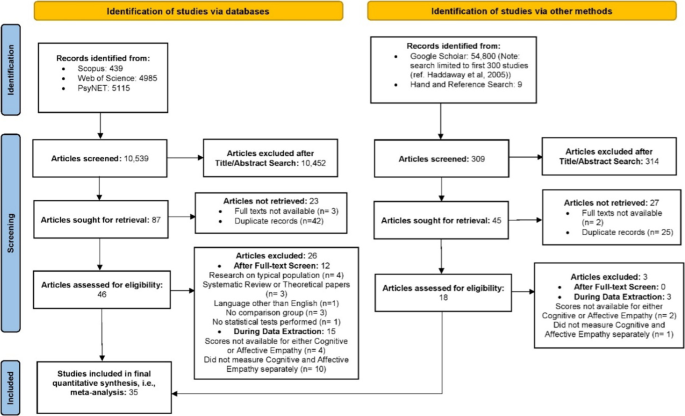
Research has consistently shown that individuals with Autism Spectrum Disorder (ASD) exhibit Empathy deficits. The aim of this study was to systematically review and meta-analyze the research conducted in the domain of cognitive and affective Empathy in Autism. The author also attempted to see the influence of moderators, such as age, culture, and measure-used, on the effect sizes. To fulfill the objective, the meta-analysis was performed on 35 studies that fulfilled the inclusion criteria with the help of the Meta-essentials, which is a free excel meta-analysis tool that facilitates the integration of effect sizes from various studies. The results indicated that the ASD group differs significantly from typically developing (TD) group in both cognitive and affective empathy. The effect size for cognitive empathy was very large (1.26), whereas, for affective empathy, the effect size was medium (0.58). Further, there was a significant moderating effect of the type of measure used on cognitive empathy. However, there are a few limitations of the present meta-analysis. Firstly, it does not shed light on how symptom severity in Autism influences empathy. Secondly, all the possible moderating variables influencing empathy could not be considered. Lastly, the generalizability of the findings may be limited owing to the limitations present in the included studies themselves. The present meta-analysis has implications for conceptualizing cognitive and affective empathy appropriately, and developing appropriate measures to assess empathy in the Autism population.
Methylphenidate Treatment and Risk of Psychotic Disorder
This cohort study of a Finnish national multiyear birth cohort uses instrumental variable analysis to investigate whether methylphenidate alters the long-term risk of psychotic disorder in children with attention-deficit/hyperactivity disorder.

Methylphenidate and the risk of psychosis in adolescents and young adults: a population-based cohort study
Background There is a clinical concern that prescribing methylphenidate, the most common pharmacological treatment for attention-deficit hyperactivity disorder (ADHD), might increase the risk of psychotic events, particularly in young people with a history of psychosis. We aimed to determine whether the risk of psychotic events increases immediately after initiation of methylphenidate treatment or, in the longer term, 1 year after treatment initiation in adolescents and young adults with and without a previously diagnosed psychotic disorder. Methods In this cohort study, we used population-based observational data from the Swedish Prescribed Drug Register, the National Patient Register, and the Total Population Register, three population-based registers containing data on all individuals in Sweden, to attain data on sex, birth, death, migration, medication use, and psychotic events for all eligible participants. We screened individuals on these registers to identify those receiving methylphenidate treatment, and who were aged 12–30 years at the start of treatment, for their inclusion in the study. We used a within-individual design to compare the incidence of psychotic events in these individuals during the 12-week periods immediately before and after methylphenidate initiation. Longer term risk was assessed by comparing the incidence of psychotic events 12 weeks before methylphenidate initiation and during a 12-week period one calendar year before the initiation of methylphenidate with the incidence of these events during the 12-week period one calendar year after methylphenidate initiation. We estimated the incidence rate ratios (IRR) and 95% CIs of psychotic events after the initation of methylphenidate treatment, relative to the events before treatment, which were defined as any hospital visit (inpatient admission or outpatient attendance, based on data from the National Patient Register) because of psychosis, using the International Classification of Diseases version 10 definition. Analyses were stratified by whether the individual had a history of psychosis. Findings We searched the Swedish Prescribed Drug Register to find eligible individuals who had received methylphenidate between Jan 1, 2007 and June 30, 2012. 61 814 individuals were screened, of whom 23 898 (38·7%) individuals were assessed and 37 916 (61·3%) were excluded from the study because they were outside of the age criteria at the start of treatment, they had immigrated, emigrated, or died during the study period, or because they were administered other ADHD medications. The median age at methylphenidate initiation was 17 years, and a history of psychosis was reported in 479 (2·0%) participants. The IRR of psychotic events in the 12-week period after initiation of methylphenidate treatment relative to that in the 12-week period before treatment start was 1·04 (95% CI 0·80–1·34) in adolescents and young adults without a history of psychosis and 0·95 (0·69–1·30) among those with a history of psychosis. Interpretation Contrary to clinical concerns, we found no evidence that initiation of methylphenidate treatment increases the risk of psychotic events in adolescents and young adults, including in those individuals with a history of psychosis. Our study should reassure clinicians considering initiating methylphenidate treatment for ADHD in adolescents and young adults, and it challenges the widely held view in clinical practice that methylphenidate should be avoided, or its use restricted, in individuals with a history of psychosis. Funding Swedish Research Council, National Institute of Mental Health, UK National Institute of Health Research Nottingham Biomedical Research Centre.

Brain Hyperconnectivity in Children with Autism and its Links to Social Deficits
In this study, Supekar, Menon, and colleagues shed light on a longstanding question about the nature of brain connectivity aberrations in autism. Using functional neuroimaging data, they demonstrate that the brains of children with autism are hyperconnected in ways that are related to the severity of social impairment exhibited by these children. They replicate these findings in two additional cohorts of children, challenging current theories of brain connectivity in autism and providing unique insights into the brain mechanisms underlying the disorder.
