When hunter-gatherers started to settle, they created new ecological niches for rodents, which could become a problem as soon as the residents started to grow cereals and wanted to store grains. Cats took over the pest control job to the extent that humans began to appreciate their presence and spread them around the world, along with their cereals and mice. Bioarchaeology and genetic studies are now beginning to reveal the origins of this curious and now ubiquitous ecological constellation. Michael Gross reports.
House Mice
The house mouse (Mus musculus) is considered one of the most troublesome and economically important rodents in the United States. House mice thrive under a variety of conditions. They are found in and around homes and farms as well as in open fields and agricultural lands. House mice consume and contaminate food meant for humans, livestock, or other animals. They cause damage to structures and property, and they transmit diseases such as salmonellosis and swine dysentery.

What if our cities were designed for wildlife as well as people?
New research argues urban planning must recognise animals, plants and ecosystems as fellow inhabitants of our cities.

Diverse Locations and a Long History: Historical Context for Urban Leopards (Panthera pardus) in the Early Anthropocene From Seoul, Korea
While the urban landscapes of the early Anthropocene may appear hostile to large carnivores, humans and leopards (Panthera pardus) are known to co-inhabit major urban centres like Mumbai (India), Nairobi (Kenya) and Johannesburg (South Africa). We provide evidence that the presence of leopards in urban landscapes is not, however, a new phenomenon and has occurred repeatedly over the early history of the Anthropocene. Using records of Amur leopards (P. p. orientalis) in Seoul, Korea, at the end of the 19th century, a capital city and major urban centre with a high human population density, we explore socio-cultural, political and ecological factors that may have facilitated human-leopard co-occurrence in an urban landscape and the factors that eventually led to the leopards' extirpation. We suggest that, in the absence of unsustainable levels of persecution by humans, leopards are able to persist in urban landscapes which contain small patches of dense vegetation and have sufficient alternative food supplies. In light of the continued expansion of urban landscapes in the 21st century and increasing conservation focus on the presence of large carnivore populations there, this paper provides historical context to human co-existence with leopards in urban landscapes during the Anthropocene – and what we can learn from it for the future.

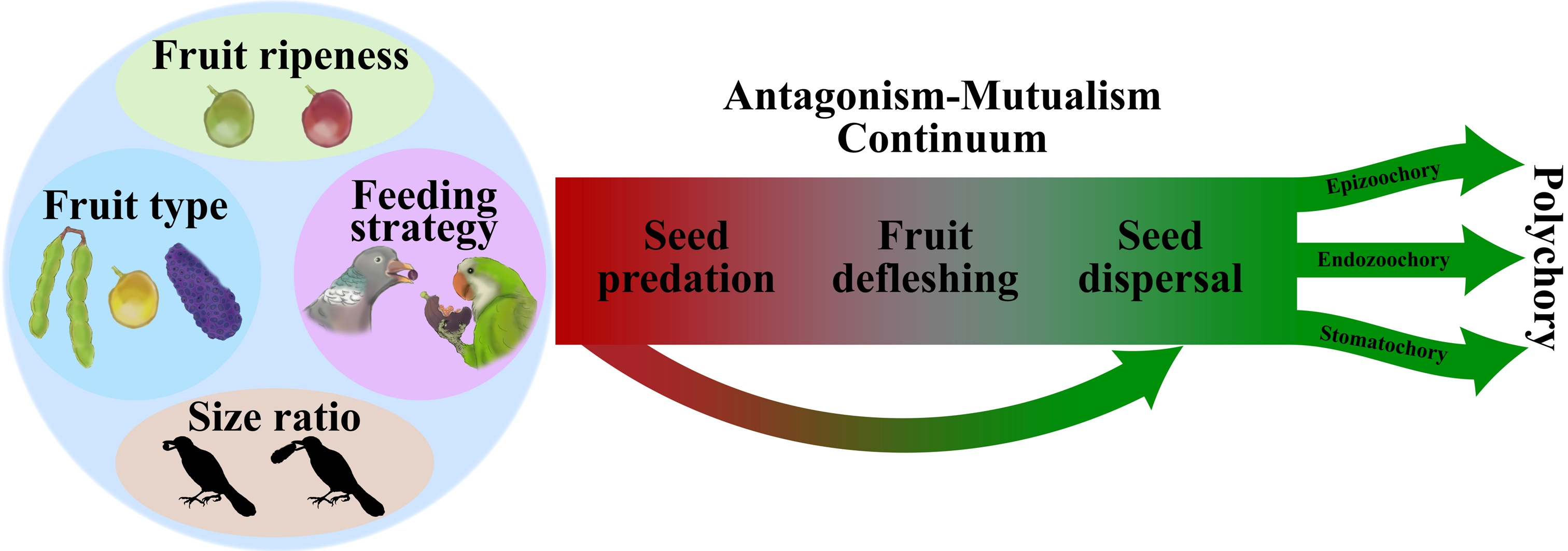
Embracing the complexity of plant–bird interactions to understand species’ roles within ecosystems
The context-dependent fate of seeds, shaped by birds that can act as both antagonists and mutualists, reveals a hidden variability of functions and seed dispersal mechanisms, underscoring the need for stronger empirical evidence to accurately understand seed dispersal ecology.
The ultrasocial origin of the Anthropocene
The current geological epoch has been dubbed the Anthropocene—the age of humans. We argue that the roots of the Anthropocene lie in the agricultural revolution that began some 8000years ago. Unique human psychological and cultural characteristics were present in our distant hunter–gatherer past, but in terms of the biophysical impact of our species, agricultural represented an unequivocal and decisive evolutionary break. With the transition to agriculture human society began to function as a superorganism functioning as a single unit designed by social natural selection to produce economic surplus. Where environmental conditions were permitted, early human agricultural societies followed the same pattern as a few social insects and exhibited explosive population growth, complex and detailed division of labor, intensive resource exploitation, territorial expansion, and a social organization favoring the survival and growth of the supergroup over the well-being of individuals within the group. Similar economic forces lie behind ultrasociality in social insects and humans—increased productivity from the division of labor, increasing returns to scale, and the exploitation of stocks of productive resources. Exploring the evolutionary mechanisms behind ultrasociality offers insights into the growth imperative that threatens the stability of the earth's life support systems.
Misreading as Foraging: How Systems Get Used for Things They Weren't Made For - Astral's Blog
Sapiens [Tenth Anniversary Edition]: A Brief History of Humankind
New York Times Readers’ Pick: Top 100 Books of the 21st CenturyThe tenth anniversary edition of the internationally bestselling phenomenon that cemented Yuval Noah Harari as one of the most prominent historians of our time—featuring a new afterword from the author.One hundred thousand years ago, at least six human species inhabited the earth. Today there is just one. Us. Homo sapiens. How did our species succeed in the battle for dominance? Why did our foraging ancestors come together to create cities and kingdoms? How did we come to believe in gods, nations, and human rights; to trust money, books, and laws; and to be enslaved by bureaucracy, timetables, and consumerism? And what will our world be like in the millennia to come?In Sapiens, Professor Yuval Noah Harari spans the whole of human history, from the very first humans to walk the earth to the radical—and sometimes devastating—breakthroughs of the Cognitive, Agricultural, and Scientific Revolutions. Drawing on insights from biology, anthropology, paleontology, and economics, and incorporating full-color illustrations throughout the text, he explores how the currents of history have shaped our human societies, the animals and plants around us, and even our personalities. Can we ever free our behavior from the legacy of our ancestors? And what, if anything, can we do to influence the course of the centuries to come?Bold, wide-ranging, and provocative, Sapiens integrates history and science to challenge everything we thought we knew about being human: our thoughts, our actions, our heritage...and our future.
The Cat API - Cat as a Service
Get free access to over 60K cat images and breed information. A fully protected and authenticated API to instantly fill your website or app with cat content.

Tend the System. Know the System.
They didn't wander. That's the first thing to understand. The popular image of the hunter-gatherer is someone moving through an indifferent landscape, taking what they find. It's not wrong about the movement. It's wrong about the indifference — theirs and the land's. What the archaeological and ecological record increasingly shows is
Gathering Moss: A Natural and Cultural History of Mosse…
Living at the limits of our ordinary perception, mosses…

The Ecological Theatre of Selfish Elements
Abstract. Some selfish genetic elements enhance their transmission to the next generation by interfering with and eliminating competing variants within the

Richard McElreath Director Department of Human Behavior, Ecology, and Culture [link] Max Planck Institute for Evolutionary Anthropology [link]

Feed The Cat
Watch live cat streams and feed cats remotely. A cozy place to watch cats eat.
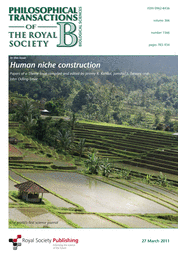
Niche construction on Bali: the gods of the countryside
Human niche construction encompasses both purely biological phenomena, such as the evolution of lactose tolerance, and dual inheritance theory, which investigates the transmission of cultural information. But does niche construction help to explain phenomena in which conscious intention also plays a role? The creation of the engineered landscape of Balinese rice terraces offers a test case. Population genetic analysis and archaeological evidence are used to investigate whether this phenomenon emerged historically from trial and error by generations of farmers, or alternatively was designed by Bali's rulers. In light of strong support for the former hypothesis, two models are developed to explore the emergence of functional structure at both local and global scales. As time goes forward and selected patterns of irrigation schedules are implemented, local variation in rice harvests influences future decisions by the farmers, creating a coupled human–natural system governed by feedback from the environment. This mathematical analysis received a measure of empirical support when government agricultural policies severed the local feedback channels, resulting in the almost instantaneous collapse of rice harvests. The historical process of niche construction may also have included an evolution of religious consciousness, reflected in the beliefs and practices of the water temple cult.