

In the era of rapid digitalization, the widespread integration of digital technology into various aspects of daily life has sparked significant interest in understanding its impact on cognitive mental processes. While the emerging data suggests that its influence may be positive or negative, the depth of evidence regarding neurobiological mechanisms remains limited. This review aims to synthesize previously published studies and develop a comprehensive framework that systematically categorizes digital technologies, the cognitive functions they impact, and developmental stages around the concept of neuroplasticity, while clearly illustrating their interconnections. Despite acknowledged limitations, through an exhaustive approach, this paper intends to offer a dynamic perspective on the effects of digital media on the human brain, before the onset of addiction.

Digital Echoes and Unquiet Minds - Christopher Butler
There's a psychological burden of digital life even heavier than distraction.

Smartphones and Cognition: A Review of Research Exploring the Links between Mobile Technology Habits and Cognitive Functioning
While smartphones and related mobile technologies are recognized as flexible and powerful tools that, when used prudently, can augment human cognition, there is also a growing perception that habitual involvement with these devices may have a negative and lasting impact on users’ ability to think, remember, pay attention, and regulate emotion. The present review considers an intensifying, though still limited, area of research exploring the potential cognitive impacts of smartphone-related habits, and seeks to determine in which domains of functioning there is accruing evidence of a significant relationship between smartphone technology and cognitive performance, and in which domains the scientific literature is not yet mature enough to endorse any firm conclusions. We focus our review primarily on three facets of cognition that are clearly implicated in public discourse regarding the impacts of mobile technology – attention, memory, and delay of gratification – and then consider evidence regarding the broader relationships between smartphone habits and everyday cognitive functioning. Along the way, we highlight compelling findings, discuss limitations with respect to empirical methodology and interpretation, and offer suggestions for how the field might progress toward a more coherent and robust area of scientific inquiry.

Dec 2020 -- Jelle Bruineberg -- Embodied cognition and the attention crisis
Is smartphone addiction really an addiction?
Aims In light of the rise in research on technological addictions and smartphone addiction in particular, the aim of this paper was to review the relevant literature on the topic of smartphone addiction and determine whether this disorder exists or if it does not adequately satisfy the criteria for addiction. Methods We reviewed quantitative and qualitative studies on smartphone addiction and analyzed their methods and conclusions to make a determination on the suitability of the diagnosis “addiction” to excessive and problematic smartphone use. Results Although the majority of research in the field declares that smartphones are addictive or takes the existence of smartphone addiction as granted, we did not find sufficient support from the addiction perspective to confirm the existence of smartphone addiction at this time. The behaviors observed in the research could be better labeled as problematic or maladaptive smartphone use and their consequences do not meet the severity levels of those caused by addiction. Discussion and conclusions Addiction is a disorder with severe effects on physical and psychological health. A behavior may have a similar presentation as addiction in terms of excessive use, impulse control problems, and negative consequences, but that does not mean that it should be considered an addiction. We propose moving away from the addiction framework when studying technological behaviors and using other terms such as “problematic use” to describe them. We recommend that problematic technology use is to be studied in its sociocultural context with an increased focus on its compensatory functions, motivations, and gratifications.
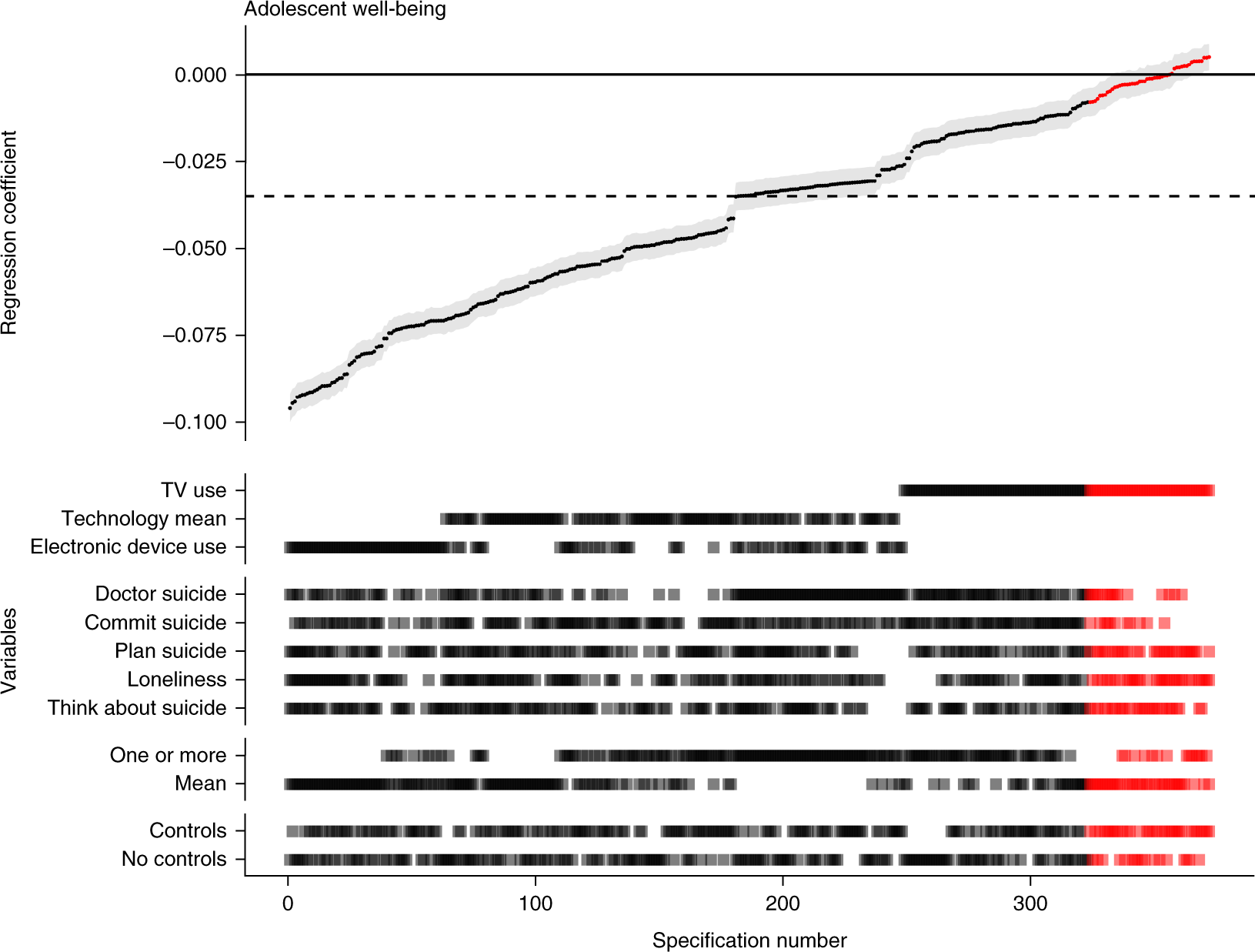
The association between adolescent well-being and digital technology use
The widespread use of digital technologies by young people has spurred speculation that their regular use negatively impacts psychological well-being. Current empirical evidence supporting this idea is largely based on secondary analyses of large-scale social datasets. Though these datasets provide a valuable resource for highly powered investigations, their many variables and observations are often explored with an analytical flexibility that marks small effects as statistically significant, thereby leading to potential false positives and conflicting results. Here we address these methodological challenges by applying specification curve analysis (SCA) across three large-scale social datasets (total n = 355,358) to rigorously examine correlational evidence for the effects of digital technology on adolescents. The association we find between digital technology use and adolescent well-being is negative but small, explaining at most 0.4% of the variation in well-being. Taking the broader context of the data into account suggests that these effects are too small to warrant policy change.
The Cognitive Debt of Digging Through Preprints
Your Brain on MIT Media Lab

Reciprocal Relationships between Trajectories of Depressive Symptoms and Screen Media Use during Adolescence
Adolescents are constantly connected with each other and the digital landscape through a myriad of screen media devices. Unprecedented access to the wider world and hence a variety of activities, particularly since the introduction of mobile technology, has given rise to questions regarding the impact of this changing media environment on the mental health of young people. Depressive symptoms are one of the most common disabling health issues in adolescence and although research has examined associations between screen use and symptoms of depression, longitudinal investigations are rare and fewer still consider trajectories of change in symptoms. Given the plethora of devices and normalisation of their use, understanding potential longitudinal associations with mental health is crucial. A sample of 1,749 (47% female) adolescents (10–17 years) participated in six waves of data collection over two years. Symptoms of depression, time spent on screens, and on separate screen activities (social networking, gaming, web browsing, TV/passive) were self-reported. Latent growth curve modelling revealed three trajectories of depressive symptoms (low-stable, high-decreasing, and low-increasing) and there were important differences across these groups on screen use. Some small, positive associations were evident between depressive symptoms and later screen use, and between screen use and later depressive symptoms. However, a Random Intercept Cross Lagged Panel Model revealed no consistent support for a longitudinal association. The study highlights the importance of considering differential trajectories of depressive symptoms and specific forms of screen activity to understand these relationships.

Thoughts on Cyberpositionality: The Construction of Digital Communities in Digital Spaces, Damien Patrick Williams
I found Rebecca Monteleone, Martin Perez Comisso, and Elma Hajric’s “Cyberpositionality: Sociotechnical Location in the Digital Age” (2024) to be an extremely timely and important article which can…

No Sense of Place: The Impact of Electronic Media on Social Behavior
Electronic media present us with a collage of experiences from everyplace. We eat dinner at home while watching starving children thousands of miles away reach out to us for food. From our easy chairs, we stare at blindfolded hostages, and coolly

The Digital Sublime: Myth, Power, and Cyberspace
Interpreting the myths of the digital age: why we believed in the power of cyberspace to open up a new world.The digital era promises, as did many other te

Building a Second Brain: The Definitive Introductory Guide
This is an introduction to Building a Second Brain, the proven method to organize your digital life and unlock your creative potential
Your smartphone is making you stupid, antisocial and unhealthy. So why can’t you put it down?
A decade ago, smart devices promised to change the way we think and interact, and they have – but not by making us smarter. Eric Andrew-Gee explores the growing body of scientific evidence that digital distraction is damaging our minds

Frontiers | Cyber-mobbing, technology-facilitated abuse and online violence
This article collection will explore the pressing issues of cyber-mobbing, technology-facilitated abuse and online violence, including online abuse, stalking...

The lost art of concentration: being distracted in a digital world
We check our phones every 12 minutes, often just after waking up. Always-on behaviour is harmful to long-term mental health, and we need to learn to the hit the pause button

“The internet represents a closing of the parenthesis and a return to older models of understanding. Human consciousness in the digital age, which de-emphasizes the categorization that marked the age of print, makes us think in a way that is reminiscent of a medieval peasant.”
The Gutenberg Parenthesis
web.mit.edu